

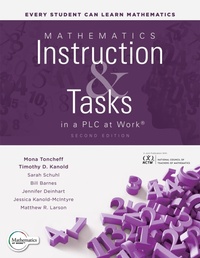
Mathematics Instruction and Tasks in a PLC at Work®, Second Edition
(Develop a standards-based curriculum for teaching student-centered mathematics.)
2nd Edition
Published on 15. August 2023
152 pages
978-1-958590-66-9 (ISBN)
Description

Build collective teacher efficacy and students' mathematical thinking using the Mathematics in a PLC at Work(TM) lesson-design process. This second edition of the popular Mathematics Instruction and Tasks book guides preK-12 teacher teams in ensuring improved mathematics achievement. Gain new and enhanced understanding of research-affirmed instructional routines, and learn how to efficiently elicit high levels of student engagement and self-efficacy. Implement instructional strategies and methods of teaching mathematics in a professional learning community.
This book will help preK-12 mathematics teachers and teacher teams:
- Identify essential mathematics content standards students learn during a unit
- Understand the importance of communicating the why of the essential mathematics learning standards to students
- Plan for the use of balanced rigor and mathematical routines to teach each content standard during instruction
- Use a balance of appropriate mathematics activities and tasks needed to develop conceptual understanding, procedural fluency, and application of mathematical concepts and skills
- Implement instructional math routines that ensure the formative learning of all students during lessons
Contents:
Preface
Introduction: The Mathematics at Work(TM) Lesson Design Framework
Chapter 1: Essential Learning Standards-The Why of the Lesson
Chapter 2: Prior-Knowledge Routines
Chapter 3: Mathematics Language Routines
Chapter 4: A Balance of Mathematical Tasks
Chapter 5: Mathematical Discourse Routines
Chapter 6: Lesson Closure Routines
Chapter 7: High-Quality Tier 1 Mathematics Intervention
Chapter 8: Analyzing the Effectiveness of Mathematics Instruction
Epilogue
Appendix A
Appendix B: Cognitive-Demand-Level Task Analysis Guide
Appendix C: Mathematics Instruction and Tasks in a PLC at Work Protocols and Tools
More details
Other editions
Additional editions
Mona Toncheff | Timothy D. Kanold | Sarah Schuhl
Mathematics Instruction and Tasks in a PLC at Work (R)
(Develop a Standards-Based Curriculum for Teaching Student-Centered Mathematics.)
Book
08/2023
2nd Edition
Solution Tree
€38.50
Article not available at the moment
Content
- Intro
- Acknowledgments
- Table of Contents
- About the Authors
- Preface
- Introduction
- Chapter 1
- Chapter 2
- Chapter 3
- Chapter 4
- Chapter 5
- Chapter 6
- Chapter 7
- Chapter 8
- Appendix
- References and Resources
- Index
