

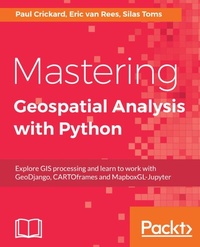
Mastering Geospatial Analysis with Python
Explore GIS processing and learn to work with GeoDjango, CARTOframes and MapboxGL-Jupyter
1st Edition
Published on 23. September 2024
440 pages
978-1-78829-381-5 (ISBN)
Description

Explore GIS processing and learn to work with various tools and libraries in Python. Key Features - [*] Analyze and process geospatial data using Python libraries such as; Anaconda, GeoPandas
- [*] Leverage new ArcGIS API to process geospatial data for the cloud.
- [*] Explore various Python geospatial web and machine learning frameworks.
Book DescriptionPython comes with a host of open source libraries and tools that help you work on professional geoprocessing tasks without investing in expensive tools. This book will introduce Python developers, both new and experienced, to a variety of new code libraries that have been developed to perform geospatial analysis, statistical analysis, and data management. This book will use examples and code snippets that will help explain how Python 3 differs from Python 2, and how these new code libraries can be used to solve age-old problems in geospatial analysis. You will begin by understanding what geoprocessing is and explore the tools and libraries that Python 3 offers. You will then learn to use Python code libraries to read and write geospatial data. You will then learn to perform geospatial queries within databases and learn PyQGIS to automate analysis within the QGIS mapping suite. Moving forward, you will explore the newly released ArcGIS API for Python and ArcGIS Online to perform geospatial analysis and create ArcGIS Online web maps. Further, you will deep dive into Python Geospatial web frameworks and learn to create a geospatial REST API. What you will learn - [*] Manage code libraries and abstract geospatial analysis techniques using Python 3.
- [*] Explore popular code libraries that perform specific tasks for geospatial analysis.
- [*] Utilize code libraries for data conversion, data management, web maps, and REST API creation.
- [*] Learn techniques related to processing geospatial data in the cloud.
- [*] Leverage features of Python 3 with geospatial databases such as PostGIS, SQL Server, and SpatiaLite.
Who this book is forThe audience for this book includes students, developers, and geospatial professionals who need a reference book that covers GIS data management, analysis, and automation techniques with code libraries built in Python 3.
- [*] Leverage new ArcGIS API to process geospatial data for the cloud.
- [*] Explore various Python geospatial web and machine learning frameworks.
Book DescriptionPython comes with a host of open source libraries and tools that help you work on professional geoprocessing tasks without investing in expensive tools. This book will introduce Python developers, both new and experienced, to a variety of new code libraries that have been developed to perform geospatial analysis, statistical analysis, and data management. This book will use examples and code snippets that will help explain how Python 3 differs from Python 2, and how these new code libraries can be used to solve age-old problems in geospatial analysis. You will begin by understanding what geoprocessing is and explore the tools and libraries that Python 3 offers. You will then learn to use Python code libraries to read and write geospatial data. You will then learn to perform geospatial queries within databases and learn PyQGIS to automate analysis within the QGIS mapping suite. Moving forward, you will explore the newly released ArcGIS API for Python and ArcGIS Online to perform geospatial analysis and create ArcGIS Online web maps. Further, you will deep dive into Python Geospatial web frameworks and learn to create a geospatial REST API. What you will learn - [*] Manage code libraries and abstract geospatial analysis techniques using Python 3.
- [*] Explore popular code libraries that perform specific tasks for geospatial analysis.
- [*] Utilize code libraries for data conversion, data management, web maps, and REST API creation.
- [*] Learn techniques related to processing geospatial data in the cloud.
- [*] Leverage features of Python 3 with geospatial databases such as PostGIS, SQL Server, and SpatiaLite.
Who this book is forThe audience for this book includes students, developers, and geospatial professionals who need a reference book that covers GIS data management, analysis, and automation techniques with code libraries built in Python 3.
More details
Other editions
Additional editions
Silas Toms | Eric van Rees | Paul Crickard
Mastering Geospatial Analysis with Python
Explore GIS processing and learn to work with GeoDjango, CARTOframes and MapboxGL-Jupyter
Book
04/2018
Packt Publishing
€64.00
Shipment within 3-4 weeks
Persons
Toms Silas :
Silas Toms is a long-time geospatial professional and author who has previously published ArcPy and ArcGIS and Mastering Geospatial Analysis with Python. His career highlights include developing the real-time common operational picture used at Super Bowl 50, building geospatial software for autonomous cars, designing computer vision for next-gen insurance, and developing mapping systems for Zillow. He now works at Volta Charging, predicting the future of electric vehicle adoption and electric charging infrastructure.Crickard Paul :
Paul Crickard authored a book on the Leaflet JavaScript module. He has been programming for over 15 years and has focused on GIS and geospatial programming for 7 years. He spent 3 years working as a planner at an architecture firm, where he combined GIS with Building Information Modeling (BIM) and CAD. Currently, he is the CIO at the 2nd Judicial District Attorney's Office in New Mexico.van Rees Eric :
Eric van Rees was first introduced to Geographical Information Systems (GIS) when studying Human Geography in the Netherlands. For 9 years, he was the editor-in-chief of GeoInformatics, an international GIS, surveying, and mapping publication and a contributing editor of GIS Magazine. During that tenure, he visited many geospatial user conferences, trade fairs, and industry meetings. He focuses on producing technical content, such as software tutorials, tech blogs, and innovative new use cases in the mapping industry.
Silas Toms is a long-time geospatial professional and author who has previously published ArcPy and ArcGIS and Mastering Geospatial Analysis with Python. His career highlights include developing the real-time common operational picture used at Super Bowl 50, building geospatial software for autonomous cars, designing computer vision for next-gen insurance, and developing mapping systems for Zillow. He now works at Volta Charging, predicting the future of electric vehicle adoption and electric charging infrastructure.Crickard Paul :
Paul Crickard authored a book on the Leaflet JavaScript module. He has been programming for over 15 years and has focused on GIS and geospatial programming for 7 years. He spent 3 years working as a planner at an architecture firm, where he combined GIS with Building Information Modeling (BIM) and CAD. Currently, he is the CIO at the 2nd Judicial District Attorney's Office in New Mexico.van Rees Eric :
Eric van Rees was first introduced to Geographical Information Systems (GIS) when studying Human Geography in the Netherlands. For 9 years, he was the editor-in-chief of GeoInformatics, an international GIS, surveying, and mapping publication and a contributing editor of GIS Magazine. During that tenure, he visited many geospatial user conferences, trade fairs, and industry meetings. He focuses on producing technical content, such as software tutorials, tech blogs, and innovative new use cases in the mapping industry.
Content
Table of Contents - Package installation and management
- Introduction to geospatial code libraries
- Introduction to geospatial databases
- Data types, storage and conversion
- Vector data analysis
- Raster data processing
- Geoprocessing with geodatabases
- Automating QGIS analysis
- ArcGIS API for Python and ArcGIS Online
- Geoprocessing with a GPU Database
- Flask and GeoAlchemy
- GeoDjango
- Creating a geospatial REST API
- Cloud Geodatabase Analysis and Visualization
- Automating Cloud Cartography
- Python geoprocessing with Hadoop
- Introduction to geospatial code libraries
- Introduction to geospatial databases
- Data types, storage and conversion
- Vector data analysis
- Raster data processing
- Geoprocessing with geodatabases
- Automating QGIS analysis
- ArcGIS API for Python and ArcGIS Online
- Geoprocessing with a GPU Database
- Flask and GeoAlchemy
- GeoDjango
- Creating a geospatial REST API
- Cloud Geodatabase Analysis and Visualization
- Automating Cloud Cartography
- Python geoprocessing with Hadoop
