

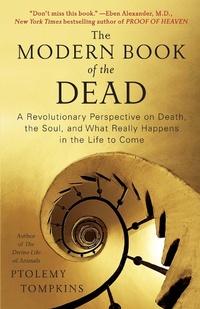
The Modern Book of the Dead
A Revolutionary Perspective on Death, the Soul, and What Really Happens in the Life to Come
Published on 14. February 2012
304 pages
978-1-4516-1654-5 (ISBN)
Description

A modern exploration of what happens after death, uniting spirituality with philosophy, biology, neuroscience, and rich examples of afterlife experiences.
What happens to us after we die?
It remains perhaps the single most important question we can ask, one that still inspires thousands to turn to the Tibetan and Egyptian Books of the Dead for hope and comfort. But we can no longer rely solely on ancient wisdom for truly useful answers about our own mortality. We must find explanations for the afterlife in the fruits of modern experience.
Critically acclaimed author Ptolemy Tompkins grew up in a family where questions about the shape and fate of the human soul were discussed on a daily basis, but it was only after his father's passing that he began to consider death in a genuinely concrete way. In this boldly unconventional book?part memoir, part history of ideas, part road map to what might truly await us?Tompkins approaches the question of the afterlife with refreshing intimacy. Weaving together philosophy, science, stories of near-death experiences, and theology, he offers readers a new perspective on death and comes to an amazing and uplifting conclusion: that, somehow, human consciousness lives on.
What happens to us after we die?
It remains perhaps the single most important question we can ask, one that still inspires thousands to turn to the Tibetan and Egyptian Books of the Dead for hope and comfort. But we can no longer rely solely on ancient wisdom for truly useful answers about our own mortality. We must find explanations for the afterlife in the fruits of modern experience.
Critically acclaimed author Ptolemy Tompkins grew up in a family where questions about the shape and fate of the human soul were discussed on a daily basis, but it was only after his father's passing that he began to consider death in a genuinely concrete way. In this boldly unconventional book?part memoir, part history of ideas, part road map to what might truly await us?Tompkins approaches the question of the afterlife with refreshing intimacy. Weaving together philosophy, science, stories of near-death experiences, and theology, he offers readers a new perspective on death and comes to an amazing and uplifting conclusion: that, somehow, human consciousness lives on.
More details
Other editions
Additional editions
Ptolemy Tompkins
Modern Book of the Dead
A Revolutionary Perspective on Death, the Soul, and What Really Happens in the Life to Come
Book
03/2013
Atria Books
€23.50
Shipment within 10-20 days
Person
Ptolemy Tompkins is a former editor at Guideposts Magazine and the author of seven books. His writing has been featured in Beliefnet, Harper's, The New York Times, the Los Angeles Times, The Best Spiritual Writing, and The Best American Spiritual Writing.
Content
- Intro
- Description
- Author Bio
- Praise
- Title Page
- Copyright Page
- Dedication
- Contents
- Preface: The Design in the Sand
- Chapter 1: A Long, Personal, but Necessary Introduction Explaining how i came to Write this Book
- Chapter 2: Ancient Egypt, the Origins of the Afterlife, and the Birth of the Idea that each of us is a God in Training
- Chapter 3: The Egyptian and Tibetan Books of the Dead, the Mortal and Immortal Parts of the Soul, and the Key Difference Between the Eastern and the Western Views of the Afterlife
- Chapter 4: The Need for a Single Map, the Imaginary and the Imaginal, What the Brain does (and doesn't) do, and the Nonlocal Nature of Consciousness
- Chapter 5: Different Kinds of Reincarnation, Different Kinds of Evolution, why Flying Saucers Help us Understand the Afterlife, and why the Romantics are still Important
- Chapter 6: The Transcendentalists, Reincarnation Reenvisioned, and what the Universe was Really Created for
- Chapter 7: The Age of Science and the Age of Spiritualism, the Unsung Discoverer of the Human Unconscious, the French Schoolteacher who Spoke to the Dead, and the Botanist who Mapped the Afterlife
- Chapter 8: Death on the Slopes, the Initial Stages of the Afterlife Journey, the "Silver Cord," "Ghost Clothing," and what it's like to Emerge from Physical Space
- Chapter 9: The Removal of the Coat of Images, more on Life as a Movie, and the Real Significance of the Life Review
- Chapter 10: A World much like this one, the Waning of the Etheric, the Rise of the Astral, the "Second Death," and Connectivity, Spiritual-Style
- Chapter 11: Private and Public Postmortem Worlds, the zone of the Earthbound Spirits, the Dangers of the Lower Astral, and the Continuing Power of Thought
- Chapter 12: Seven Planes, the Judgment, to be Reborn or not to Be Reborn, Life as a Movie Worth Watching, and the Concept of the Group Soul
- Chapter 13: The Pulse of Life, Keeping Heaven in your view, what lies Beyond the World of form, and what Waits Beyond the end of Time
- Acknowledgments
