

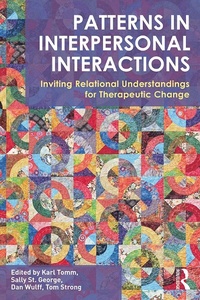
Patterns in Interpersonal Interactions
Inviting Relational Understandings for Therapeutic Change
1st Edition
Published on 16. May 2014
284 pages
978-1-134-46573-6 (ISBN)
Description

In this book we present a comprehensive view of a systemic approach to working with families, initiated by Karl Tomm more than two decades ago at the Calgary Family Therapy Centre in Canada. The contributors of this edited book articulate the IPscope framework as it was originally designed and its evolution over time. We invite you, experienced professionals and new family therapists, to join with us to explore some of the mysteries of human relationships. While the focus on our explorations revolves around clinical mental health problems and initiatives towards solutions, the concepts are applicable in many domains of daily life. They highlight the ways in which we, as persons, invite each other into recurrent patterns of interaction that generate and maintain some stability in our continuously changing relationships. The stabilities arise when our invitations become coupled and can be characterized as mutual; yet, they always remain transient. What is of major significance is that these transient relational stabilities can have major positive or negative effects in our lives. Consequently, we could all potentially benefit from greater awareness of the nature of these patterns, how particular patterns arise, and how we might be able to influence them.
Reviews / Votes
"At a time when more and more family therapists find themselves tacitly accepting the seemingly inevitable instantiation of individualistic (DSM) diagnoses and individualistic models of empirically validated therapies, Dr. Tomm and his talented, sophisticated colleagues offer a clear and compelling alternative (or complementary) perspective. I am heartened by the authors' invitation to make sense of client, supervisory, and societal conundrums and transformations in terms of the patterns of interaction unfolding between people. When innovators like these produce fresh and challenging work such as this, our field is renewed and enlivened, and our relationships are provided a template for moving toward patterns of wellness."--Douglas Flemons, PhD, LMFT, Co-author of Relational Suicide Assessment Professor of Family Therapy and Clinical Professor of Family Medicine Nova Southeastern University"This book is one of the most powerful demonstrations of relational patterns and their significance in our personal lives that I have ever encountered. With passion, focus, logic, and imagination, Karl Tomm and his colleagues demonstrate why it is so important to move beyond the individual in both our everyday understanding and our therapeutic practices. The present volume overcomes the limits of diagnostic categories by offering them as grounds for dialogue. The book is overflowing with good ideas, both inspiring and practical."--Kenneth Gergen, President, The Taos Institute
"At last! A social constructionist approach that focuses squarely on interpersonal patterns, never loses sight of larger societal processes, and can measure and track change! In a world that demands accountability, this will help my students integrate the foundations of family therapy with the relational ideals of postmodern practice." --Carmen Knudson-Martin, PhD, Professor and Director of PhD in Marriage and Family Therapy, Loma Linda University
"This book makes a critical contribution to the related fields of therapy, counselling, and psychological services. We have been poised, waiting for the next big idea and the IP scope fills this void. This will undoubtedly become a preferred practice approach solidly built on theoretical foundations that provides a clear framework for inquiring, understanding, deconstructing, intervening, and reflecting on patterns of interaction. It should be included in all therapy and counselling training programs." -- Barbara McKay, Director of the Institute of Family Therapy, London
"This volume is a welcomed voice in an ever-increasing world of pathologizing discourse. What we frequently define as a destructive, crazy, or "bad" person is unhinged by the palpable power of IPscope (i.e., the scope of interpersonal patterns). Extending this approach to explore broader issues of conflict and human challenge reminds us how significant our relational engagements are with others - at all levels - from the dyadic to the global; this is a powerful reminder of how important our relational lives are to our wellbeing and the wellbeing of the planet." --Sheila McNamee, PhD, Professor of Communication, University of New Hampshire and Co-Founder & Vice President, Taos Institute.
"Here in Europe, I have been hearing rumors about HIPS and PIPS for years. Finally now, here's the book that explains the IPscope model, and helps me to understand why these rumors sounded so unbelievably enthusiastic. The IPscope is a fascinating relational diagnostic system for distinguishing interpersonal patterns. The different chapters in the book tell the story of the IP Scope and how it can be applied in therapy, training, supervision, and in many other domains of life. I warmly recommend this book."--Peter Rober, PhD, Professor of Marital and Family Therapy, Leuven University, Belgium
"Karl Tomm and his colleagues at the Calgary Family Therapy Centre have been steadily building on his influential conceptual framework of Interpersonal Patterns. This book offers 25 years of development in an exciting and accessible form. Richly illustrated with clinical and training material and integrated with current thinking over many areas it will be of enormous value to trainers, researchers and therapists." --Peter Stratton, Emeritus Professor of Family Therapy, Leeds Family Therapy & Research Centre, UK
"This is one of the most important works on systemic therapy in the past decade. It will change how the next generation of therapists and counselors learn and practice systemic therapy." - Diane Gehart, PhD, Licensed Marriage and Family Therapist, California, USA
More details
Series
Language
English
Place of publication
London
United Kingdom
Publishing group
Taylor & Francis Ltd
Target group
College/higher education
Illustrations
3 s/w Photographien bzw. Rasterbilder, 53 s/w Zeichnungen
53 Line drawings, black and white; 3 Halftones, black and white
File size
4,91 MB
ISBN-13
978-1-134-46573-6 (9781134465736)
Copyright in bibliographic data and cover images is held by Nielsen Book Services Limited or by the publishers or by their respective licensors: all rights reserved.
Schweitzer Classification
Other editions
Additional editions
Karl Tomm | Sally St. George | Dan Wulff
Patterns in Interpersonal Interactions
Inviting Relational Understandings for Therapeutic Change
Book
05/2014
1st Edition
Routledge
€242.10
Shipment within 15-20 days
Karl Tomm | Sally St. George | Dan Wulff
Patterns in Interpersonal Interactions
Inviting Relational Understandings for Therapeutic Change
Book
05/2014
1st Edition
Routledge
€77.20
Shipment within 15-20 days
Persons
Karl Tomm, MD; Sally St. George, PhD; Dan Wulff, PhD; and Tom Strong, PhD, are all affiliated with the University of Calgary and the Calgary Family Therapy Centre in Alberta, Canada.
Content
Introduction: Origins of the PIPs and HIPs Framework K. Tomm 1. Introducing the IPscope: A Systemic Assessment Tool for Distinguishing Interpersonal Patterns K. Tomm 2. Conceptualizing Interactional Patterns: Theoretical Threads to Facilitate Recognizing and Responding to IPs T. Strong 3. Teaching and Learning Relational Practice S. Couture, K. Tomm 4. A Life History of a PIP: Snapshots in Time T. Mudry, T. Strong, J. Chang 5. Can I Give You a TIP? Inviting Healing Conversations in Practice J. Gaete, I. Sametband, O. Sutherland 6. Braiding Socio-Cultural Interpersonal Patterns into Therapy S. St. George, D.Wulff 7. His Cave and Her Kitchen. . .Gendered PIPs and HIPs and Societal Discourses J.S. Hall, I. Sametband 8. Sensing, Understanding, and Moving Beyond Intercultural PIPs I. Sametband, T. Wilson, C. Tsai 9. IPs-Supervision as Relationally Responsive Practice J. Chang and J. Gaete 10. Researching Interpersonal Patterns S. St. George, D. Wulff, T. Strong 11. Continuing the Journey K. Tomm Index
