

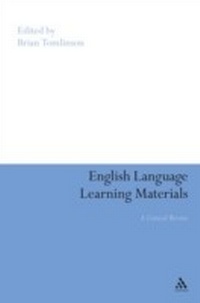
English Language Learning Materials
A Critical Review
1st Edition
Published on 17. March 2008
344 pages
978-1-4411-7856-5 (ISBN)
Description

This research collection presents a critical review of the materials used for learning English around the world. The first section includes a discussion of materials for specific learners and purposes, such as young learners, self-study, academic writing and general proficiency. The second section presents a detailed study of the materials used in Europe, Asia, North America, South America, Africa and Australia, and critically evaluates their effectiveness in the teaching of English to speakers of other languages. Taking both the teacher's and the learner's needs into consideration, the book makes a positive contribution to the future of research in materials development, and has practical applications.
This comprehensive, critical analysis of materials in use around the world will be useful for academics researching materials development and applied linguistics and for students on post-graduate applied linguistics and ELT courses.
This comprehensive, critical analysis of materials in use around the world will be useful for academics researching materials development and applied linguistics and for students on post-graduate applied linguistics and ELT courses.
More details
Edition
1. Auflage
Language
English
Place of publication
New York
United States
Target group
Professional and scholarly
ISBN-13
978-1-4411-7856-5 (9781441178565)
Copyright in bibliographic data and cover images is held by Nielsen Book Services Limited or by the publishers or by their respective licensors: all rights reserved.
Schweitzer Classification
Other editions
Additional editions
Book
10/2010
Continuum Publishing Corporation
€56.80
Shipment within 15-20 days
Person
Brian Tomlinson is Professor of TESOL at Anaheim University, USA and Honorary Visiting Professor at the University of Liverpool, UK. He has worked in Japan, Indonesia, Nigeria, Oman, Singapore, the UK, Vanuatu and Zambia, and is Founder and President of the Materials Development Association (MATSDA).
Content
Part I: Introduction
Preface, Brian Tomlinson
1. Language Acquisition and Language Learning Materials: Brian Tomlinson (Sultan Qaboos University, Oman)
Part II: Different Types of Materials
2. Materials for General English, Hitomi Masuhara (Sultan Qaboos University, Oman) and Brian Tomlinson (Sultan Qaboos University, Oman)
3. Materials for Teaching English to Young Learners, Wendy Arnold (Hong Kong)and Shelagh Rixon (University of Warwick, UK)
4. Materials for English for Science and Technology (EST), Philip Skeldon (Sohar College, Oman)
5. EAP Materials in Australia and New Zealand, Hans Mol (Southern Cross University, Australia) and Tan Bee (University of Auckland, New Zealand)
6. Multi-Media Materials in Developing Countries: The Malaysian Experience, Jaya Mukundan (Universiti Putra Malaysia, Malaysia)
7. Self-Access Materials, Lucy Cooker (Kanda University of International Studies, Japan)
8. Extensive Reading: Maid in Waiting, Alan Maley (Leeds Metropolitan University, UK)
PART III: Materials in Use Around the World
9. Materials Used in the UK, Brian Tomlinson (Sultan Qaboos University, Oman) and Hitomi Masuhar (Sultan Qaboos University, Oman)
10. Materials Used in the USA, Julia Frazier (Hunter College, New York) and Patricia Juza (Baruch College, New York)
11. Materials Used in Western Europe, Luke Prodromou (Leeds Metropolitan University, UK) and Freda Mishen (University of Limerick, Ireland)
12. Materials Used in Central and Eastern Europe and the Former Soviet Union, Rod Bolitho (Norwich Institution for Language Education, UK)
13. Materials Used in Africa, Masibo Mumala (University of Nottingham, UK) and Soufiane Trabelsi (University of Sfax, Tunisia)
14. Materials in Japan: Coexisting Traditions, Jim Smiley and Michiyo Masui (Tohuku Bunka Gakuen University, Sendai, Japan)
15. ELT Materials Used in South East Asia, Bao Dat (Monash University, Australia)
16. The Textbook, the Teacher and the Learner, A Middle East Perspective: Nahla Bacha (Lebanese American University, Lebanon), Irma-Kaarina Ghosn (Lebanese American University, Lebanon) and Neil McBeath (Technical Studies Institute, Dhahran, Saudi Arabia)
17. Materials in Use in Argentina and the Southern Cone, Mario Lopez Barrios (Universidad National de Cordoba, Argentina), Elba de Debat (Universidad National de Cordoba, Argentina), and Gabriella Tavella (Universidad Nacional del Comahue, Asentamiento)
PART IV: Conclusions
18. Conclusions about ELT Materials in Use Around the World, Brian Tomlinson (Sultan Qaboos University, Oman)
Index
Preface, Brian Tomlinson
1. Language Acquisition and Language Learning Materials: Brian Tomlinson (Sultan Qaboos University, Oman)
Part II: Different Types of Materials
2. Materials for General English, Hitomi Masuhara (Sultan Qaboos University, Oman) and Brian Tomlinson (Sultan Qaboos University, Oman)
3. Materials for Teaching English to Young Learners, Wendy Arnold (Hong Kong)and Shelagh Rixon (University of Warwick, UK)
4. Materials for English for Science and Technology (EST), Philip Skeldon (Sohar College, Oman)
5. EAP Materials in Australia and New Zealand, Hans Mol (Southern Cross University, Australia) and Tan Bee (University of Auckland, New Zealand)
6. Multi-Media Materials in Developing Countries: The Malaysian Experience, Jaya Mukundan (Universiti Putra Malaysia, Malaysia)
7. Self-Access Materials, Lucy Cooker (Kanda University of International Studies, Japan)
8. Extensive Reading: Maid in Waiting, Alan Maley (Leeds Metropolitan University, UK)
PART III: Materials in Use Around the World
9. Materials Used in the UK, Brian Tomlinson (Sultan Qaboos University, Oman) and Hitomi Masuhar (Sultan Qaboos University, Oman)
10. Materials Used in the USA, Julia Frazier (Hunter College, New York) and Patricia Juza (Baruch College, New York)
11. Materials Used in Western Europe, Luke Prodromou (Leeds Metropolitan University, UK) and Freda Mishen (University of Limerick, Ireland)
12. Materials Used in Central and Eastern Europe and the Former Soviet Union, Rod Bolitho (Norwich Institution for Language Education, UK)
13. Materials Used in Africa, Masibo Mumala (University of Nottingham, UK) and Soufiane Trabelsi (University of Sfax, Tunisia)
14. Materials in Japan: Coexisting Traditions, Jim Smiley and Michiyo Masui (Tohuku Bunka Gakuen University, Sendai, Japan)
15. ELT Materials Used in South East Asia, Bao Dat (Monash University, Australia)
16. The Textbook, the Teacher and the Learner, A Middle East Perspective: Nahla Bacha (Lebanese American University, Lebanon), Irma-Kaarina Ghosn (Lebanese American University, Lebanon) and Neil McBeath (Technical Studies Institute, Dhahran, Saudi Arabia)
17. Materials in Use in Argentina and the Southern Cone, Mario Lopez Barrios (Universidad National de Cordoba, Argentina), Elba de Debat (Universidad National de Cordoba, Argentina), and Gabriella Tavella (Universidad Nacional del Comahue, Asentamiento)
PART IV: Conclusions
18. Conclusions about ELT Materials in Use Around the World, Brian Tomlinson (Sultan Qaboos University, Oman)
Index
