

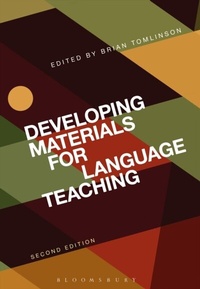
Developing Materials for Language Teaching
2nd Edition
Published on 19. December 2013
544 pages
978-1-4411-5311-1 (ISBN)
Description

There have been a number of books published on various aspects of materials development for language teaching but Developing Materials for Language Teaching is the only one which provides a comprehensive coverage of the main aspects and issues in the field. This second edition brings it completely up to date and expands on the original book. It deals with advances in IT and an increasingly globalized world.
It is the only publication which views current developments in materials development through the eyes of developers and users of materials from all over the world. In doing so it applies principles to practice in ways demonstrated to facilitate the effectiveness of language learning materials.
The chapters are written so that the book provides critical overviews of recent developments in materials development and at the same time acts as a stimulus for development and innovation in the field. It is intended both for use as a course book on postgraduate and teacher training courses and as a resource for the stimulus and refreshment of teachers, publishers and applied linguists in the field.
The book contains updated versions of many of the chapters in the 2003 edition plus new chapters on corpus-informed materials development, materials development for blended learning, materials development for EAP, materials development for ESOL and materials development for young learners.
It is the only publication which views current developments in materials development through the eyes of developers and users of materials from all over the world. In doing so it applies principles to practice in ways demonstrated to facilitate the effectiveness of language learning materials.
The chapters are written so that the book provides critical overviews of recent developments in materials development and at the same time acts as a stimulus for development and innovation in the field. It is intended both for use as a course book on postgraduate and teacher training courses and as a resource for the stimulus and refreshment of teachers, publishers and applied linguists in the field.
The book contains updated versions of many of the chapters in the 2003 edition plus new chapters on corpus-informed materials development, materials development for blended learning, materials development for EAP, materials development for ESOL and materials development for young learners.
Reviews / Votes
Because of its stress on practical applications of theory and research . . . [this book] will be of great value to materials writers, publishers, and teachers interested in designing their own materials. A welcome contribution to the field * [ "LinguistList"] *More details
Edition
2nd edition
Language
English
Place of publication
New York
United States
Publishing group
Bloomsbury Publishing PLC (Digital)
Target group
Professional and scholarly
File size
15,85 MB
ISBN-13
978-1-4411-5311-1 (9781441153111)
Copyright in bibliographic data and cover images is held by Nielsen Book Services Limited or by the publishers or by their respective licensors: all rights reserved.
Schweitzer Classification
Other editions
New editions
Brian Tomlinson
Developing Materials for Language Teaching
E-Book
07/2023
3rd Edition
Bloomsbury Academic
€36.49
Available for download
Additional editions
Brian Tomlinson
Developing Materials for Language Teaching
Book
12/2013
2nd Edition
Bloomsbury Academic USA
€71.98
Shipment within 15-20 days
Brian Tomlinson
Developing Materials for Language Teaching
Book
12/2013
2nd Edition
Bloomsbury Academic USA
€249.70
Shipment within 15-20 days
Person
Brian Tomlinson is a Visiting Professor at Leeds Metropolitan University and a TESOL Professor at Anaheim University. He has worked in Japan, Indonesia, Nigeria, Oman, Singapore, the UK, Vanuatu and Zambia and has given presentations in over sixty countries. He is Founder and President of MATSDA and has published many articles and books on materials development and on aspects of language teaching and language acquisition.
Content
List of Contributors
Preface, Brian Tomlinson
Introduction: Are Materials Developing?, Brian Tomlinson
PART A - EVALUATION AND ADAPTATION OF MATERIALS
Chapter 1) Materials Evaluation, Brian Tomlinson
Chapter 2) Adapting Courses: A Personal View, Claudia Saraceni
Chapter 3) The Instructional Design Of A Course Book Is As It Is Because Of What It Has To Do - An Application of Systemic Functional Theory, Duria Aziz Singapore Wala
Comments on Part A, Brian Tomlinson
PART B - PRINCIPLES AND PROCEDURES OF MATERIALS DEVELOPMENT
Chapter 4) Developing Principled Frameworks for Materials Development, Brian Tomlinson
Chapter 5) Publishing a Course Book: The Role of Feedback, Duria Aziz Singapore Wala
Chapter 6) Humanizing the Coursebook, Brian Tomlinson
Chapter 7) The Visual Elements in EFL Coursebooks, David A. Hill
Chapter 8) Creative Approaches to Materials Writing, Alan Maley
Chapter 9) Developing Digital Language Learning Materials, Thom Kiddle
Chapter 10) Demystifying Blended Learning, Freda Mishan
Comments on Part B, Brian Tomlinson
PART C - DEVELOPING MATERIALS FOR TARGET GROUPS
Chapter 11) Authors' Knowledge, Rationales and Principles - Steady Flow-Through or Stuck in the Publishing Pipeline? The Case of Early Reading with Young Learners, Shelagh Rixon
Chapter 12) Developing Motivating Materials for Refugee Children: From Theory to Practice, Irma-Kaarina Ghosn
Chapter 13) Materials for Adults: 'I am No Good at Languages!'- Inspiring and Motivating L2 Adult Learners of Beginner's Spanish, Rosa-Maria Cives-Enriquez
Chapter 14) Materials for Adult Beginners from a Users' Perspective, Vivian Cook
Chapter 15) Mining the L2 Environment: ESOL Learners and Strategies Outside the Classroom, Naeema Haan
Comments on Part C, Brian Tomlinson
PART D - DEVELOPING SPECIFIC TYPES OF MATERIALS
Chapter 16) Materials for the Teaching of Grammar, Jeff Stranks
Chapter 17) Materials for Teaching Vocabulary, Paul Nation
Chapter 18) Materials for Developing Reading Skills, Hitomi Masuhara
Chapter 19) Materials for Developing Writing Skills, Ken Hyland
Chapter 20) Developing Materials for Speaking Skills, Dat Bao
Chapter 21) Coursebook Listening Activities, David A. Hill and Brian Tomlinson
Chapter 22) Materials for Cultural Awareness, Alan Pulverness and Brian Tomlinson
Chapter 23) Corpora and Materials: Towards a Working Relationship, Ivor Timmis
Comments on Part D, Brian Tomlinson
PART E - MATERIALS DEVELOPMENT AND TEACHER TRAINING
Chapter 24) Materials Development Courses, Brian Tomlinson
Chapter 25) Simulations in Materials Development, Brian Tomlinson and Hitomi Masuhara
Chapter 26) Working with Student-Teachers to Design Materials for Language Support within the School Curriculum, Helen Emery
Comments on Part E, Brian Tomlinson
Conclusion, Brian Tomlinson
Index
Preface, Brian Tomlinson
Introduction: Are Materials Developing?, Brian Tomlinson
PART A - EVALUATION AND ADAPTATION OF MATERIALS
Chapter 1) Materials Evaluation, Brian Tomlinson
Chapter 2) Adapting Courses: A Personal View, Claudia Saraceni
Chapter 3) The Instructional Design Of A Course Book Is As It Is Because Of What It Has To Do - An Application of Systemic Functional Theory, Duria Aziz Singapore Wala
Comments on Part A, Brian Tomlinson
PART B - PRINCIPLES AND PROCEDURES OF MATERIALS DEVELOPMENT
Chapter 4) Developing Principled Frameworks for Materials Development, Brian Tomlinson
Chapter 5) Publishing a Course Book: The Role of Feedback, Duria Aziz Singapore Wala
Chapter 6) Humanizing the Coursebook, Brian Tomlinson
Chapter 7) The Visual Elements in EFL Coursebooks, David A. Hill
Chapter 8) Creative Approaches to Materials Writing, Alan Maley
Chapter 9) Developing Digital Language Learning Materials, Thom Kiddle
Chapter 10) Demystifying Blended Learning, Freda Mishan
Comments on Part B, Brian Tomlinson
PART C - DEVELOPING MATERIALS FOR TARGET GROUPS
Chapter 11) Authors' Knowledge, Rationales and Principles - Steady Flow-Through or Stuck in the Publishing Pipeline? The Case of Early Reading with Young Learners, Shelagh Rixon
Chapter 12) Developing Motivating Materials for Refugee Children: From Theory to Practice, Irma-Kaarina Ghosn
Chapter 13) Materials for Adults: 'I am No Good at Languages!'- Inspiring and Motivating L2 Adult Learners of Beginner's Spanish, Rosa-Maria Cives-Enriquez
Chapter 14) Materials for Adult Beginners from a Users' Perspective, Vivian Cook
Chapter 15) Mining the L2 Environment: ESOL Learners and Strategies Outside the Classroom, Naeema Haan
Comments on Part C, Brian Tomlinson
PART D - DEVELOPING SPECIFIC TYPES OF MATERIALS
Chapter 16) Materials for the Teaching of Grammar, Jeff Stranks
Chapter 17) Materials for Teaching Vocabulary, Paul Nation
Chapter 18) Materials for Developing Reading Skills, Hitomi Masuhara
Chapter 19) Materials for Developing Writing Skills, Ken Hyland
Chapter 20) Developing Materials for Speaking Skills, Dat Bao
Chapter 21) Coursebook Listening Activities, David A. Hill and Brian Tomlinson
Chapter 22) Materials for Cultural Awareness, Alan Pulverness and Brian Tomlinson
Chapter 23) Corpora and Materials: Towards a Working Relationship, Ivor Timmis
Comments on Part D, Brian Tomlinson
PART E - MATERIALS DEVELOPMENT AND TEACHER TRAINING
Chapter 24) Materials Development Courses, Brian Tomlinson
Chapter 25) Simulations in Materials Development, Brian Tomlinson and Hitomi Masuhara
Chapter 26) Working with Student-Teachers to Design Materials for Language Support within the School Curriculum, Helen Emery
Comments on Part E, Brian Tomlinson
Conclusion, Brian Tomlinson
Index
