

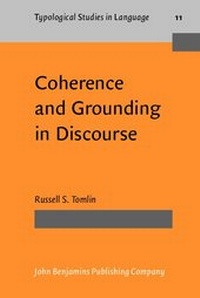
Coherence and Grounding in Discourse
Outcome of a Symposium, Eugene, Oregon, June 1984
1st Edition
Published on 1. January 1987
VIII, 512 pages
978-90-272-8627-7 (ISBN)
Description

This volume seeks to expand our understanding of the relation holding between discourse relations, cognitive units, and linguistic coding. The twenty contributions in this collection explore one or more of the following themes: How point of view, or the salience of information in discourse, affects the organizational coherence of text and discourse; the concept of cognitive and linguistic event and how events are reflected in text and discourse organization; the nature of linguistic coding of events and other kinds of significant information; and the cognitive bases or cognitive correlates of the linguistic organization of discourse.
More details
Other editions
Additional editions
Russell S. Tomlin
Coherence and Grounding in Discourse
Outcome of a Symposium, Eugene, Oregon, June 1984
Book
01/1987
John Benjamins Publishing Co
€165.36
Shipment within 10-15 days
Content
- COHERENCE AND GROUNDING IN DISCOURSE
- Editorial page
- Title page
- Copyright page
- Table of contents
- PREFACE
- NARRATIVE CONNECTIVES IN SÙPYÌRÉ
- Background
- Method
- Findings
- Discussion
- NOTES
- ABBREVIATIONS
- REFERENCES
- COGNITIVE CONSTRAINTS ON INFORMATION FLOW
- Intonation Units
- The Three Activation States
- Active Concepts ("Given Information")
- Semi-Active Concepts ("Accessible Information")
- Inactive Concepts ("New Information")
- Starting Points and Added Information
- What Intonation Units Do
- Extended Clauses
- Paragraphs
- Sentences
- The Narrative
- Summary
- NOTES
- REFERENCES
- TRANSITIVITY IN GRAMMAR AND COGNITION
- 1. Introduction
- 2. Transitivity in discourse
- 3. Natural and discourse context
- 4. Transitivity as a semantic prototype
- 5. The experiential basis of the transitivity prototype
- 6. Deviations from the prototype
- 7. Transitivity, volitionality, and person
- 8. Syntax and discourse
- REFERENCES
- ACTIONS AND PROCEDURAL DIRECTIONS
- 1. Introduction
- 2. A Framework for Studying Directions
- 3. The Hierarchical Plan Model
- 4. A Test of the Hierarchical Plan Model
- 5. The Role of Action Statements in Directions
- 6. Conclusions
- NOTE
- REFERENCES
- DISCOURSE FUNCTIONS OF WORD ORDER IN SESOTHO ACQUISITION
- 1. Introduction
- 2. Discourse Context and Word Order Strategies
- 3. Word Order in Sesotho
- 4. Adult Uses of Word Order in Talking with Children
- 5. Children's Use of Word Order
- 6. Discussion
- NOTES
- REFERENCES
- A UNIFORM PAUSE AND ERROR STRATEGY FOR NATIVE AND NON-NATIVE SPEAKERS
- 1. Overview of the Foregrounding Hierarchy
- 2. Methods
- 3. Pauses
- 3.1. Overall Pause Pattern
- 3.2. Empty Pauses
- 3.3. Filled Pauses
- 4. Errors
- 4.1. Error Overview
- 4.2. Repairs
- 4.3. Omissions
- 4.4. Misuse Errors
- 5. Conclusions
- NOTES
- REFERENCES
- THE GRAMMATICAL MARKING OF THEME IN ORAL POLISH NARRATIVE
- 1. Introduction
- 2. Data and Structure of the Narrative
- 3. Theme and Discourse Continuity
- 4. Narrative Discontinuities
- 5. Overt Theme as Method of Development for Background Motifs
- 6. Theme and Perspective
- 7. Conclusion
- NOTES
- REFERENCES
- ANAPHORA IN POPULAR WRITTEN ENGLISH NARRATIVES
- 1. Introduction
- 2. Previous Work
- 3. Anaphoric Patterning in four Popular Written Narratives
- 4. Anaphora in Written Narratives
- 5. The Basic Patterns
- 6. Demarcation of Narrative Units
- 7. Same-gender referents
- 8. Conclusion
- NOTES
- REFERENCES
- BEYOND FOREGROUND AND BACKGROUND
- 1. Introduction
- 2. Problems with the binary functional distinction foreground/background
- 2.1. The dynamic nature of discourse grounding
- 2.2. The correlation between background, presupposition and oid information
- 2.3. The correlation between foreground, sequentiality and main-line or "gist
- 2.4. Binary vs. scalar pragmatic space
- 2.5. Anaphoric vs. cataphoric grounding
- 3. Grounding and syntactic order
- 4. Ramsay's study of IF- and WHEN-clauses
- 5. Conclusions
- 5.1. At the functionallevel
- 5.2. At an intermediate level between function and structure
- 5.3. At the coding level
- NOTE
- REFERENCES
- THE USE OF PITCH PHENOMENA IN THE STRUCTURING OF STORIES
- 1. Introduction
- 2. Definitions
- 2. Tone Units in Discourse
- 3. Research Methodology
- 4. Results and Discussion
- 5. Conclusion
- NOTES
- REFERENCES
- ON THE STATUS OF SVO SENTENCES IN FRENCH DISCOURSE
- 1. Introduction
- 2. The preferred clause of spoken French
- 2.1 Grammatical constructions and the preferred clause
- 2.1.1. The identificational or focus marking construction
- 2.1.2. The presentational construction
- 2.1.3. Marked topic constructions
- 3. The status of lexical subjects
- 3.1. High and low topicality of referents
- 3.1.1. Topicality and salience
- 3.1.2. Anaphoric continuity
- 3.1.3. Referential specificity
- 3.1.4. Transitivity
- 3.1.5. Syntactic subordination
- 3.1.6. A class of exceptions: Proper names
- 3.1.7. A short narrative
- 4. Summary and conclusion
- NOTES
- REFERENCES
- ON THE ROLE OF CONDITIONALS IN GODIE PROCEDURAL DISCOURSE
- 1. The data
- 2. Features of the Godié procedural
- 3. Role of conditional clauses
- 4. Frequency of conditional clauses
- 5. Conclusion
- NOTES
- REFERENCES
- IS BASIC WORD ORDER UNIVERSAL?
- 1. Word Order in Some Perplexing Cases
- 1.1. The General Character of the Languages
- 1.2. Strategies for Determining Basic Word Order
- 1.2.1. Statistical Frequency
- 1.2.2. The Ambiguity Test
- 1.2.3. Relative Order within Pairs
- 1.3. Definiteness
- 1.4. Old versus New Information
- 1.5. Importance
- 1.6. Topic Shift
- 1.7. Contrast
- 1.8. The Determination of Word Order in Cayuga, Ngandi, and Coos
- 1.8.1. The Newsworthiness Principle
- 1.8.2. The Naturalness Issue
- 1.8.3. The Markedness of Pragmatic Ordering
- 2. Standard Strategies for Detecting Basic Order and Pragmatically BasedLanguages
- 2.1. Statistical Frequency
- 2.2. Descriptive Simplicity
- 2.3. Pragmatic Neutrality
- 3. Word Order Typology and Pragmatically Based Ordering
- 4. The Pragmatically Based Type
- 5. Conclusion
- NOTE
- REFERENCES
- ENCODING EVENTS IN KALAM AND ENGLISH: DIFFERENT LOGICS FOR REPORTING EXPERIENCE
- 1. Introduction
- 2. The hypothesis of a natural relation between clause, conceptual event and objective event
- 3. Comparing English and Kalam: Definitions
- 4. Some Familiar Event Sequences and Episodes
- 5. Hunting Game and Related Activities
- 6. Gathering Nuts
- 7. Other Event Sequences
- 8. Two Analyses of the English Metonymic Strategy
- 9. Conclusion
- 10. Clause and Case Relations as Putative Universals
- 11. A Core of Conceptual Events Common to English and Kalam
- 12. Differences in the Treatment of Case Relations
- 13. Conclusions
- NOTES
- REFERENCES
- WORD ORDER IN INTRANSITIVE CLAUSES IN HIGH AND LOW MALAY OF THE LATE NINETEENTH CENTURY
- 1. Introduction
- 2. The Data
- 3. Word Orders in High and Low Malay
- 4. Functions of SV and VS Word Orders in High Malay
- 5. The Tuhfat al-Nafis
- 6. Topicality of SV and VS Clauses
- 7. The Functions of SV and VS Word Orders in Low Malay
- 8. Conclusion
- NOTES
- REFERENCES
- THE FUNCTIONAL DISTRIBUTION OF PREPOSED ANDPOSTPOSED "IF" AND "WHEN" CLAUSESIN WRITTEN DISCOURSE
- 1. Introduction
- 2. Hypotheses
- 3. Method
- 3.1. Data base
- 3.2. Data collection
- 3.2.1. Referential distance
- 3.2.2. Scope
- 3.2.3. Aspect-Modality categorization of 'when' clauses
- 3.2.4. Distribution of commas
- 3.2.5. Distribution of IC and WC in paragraph breaks
- 4. Results of measurements
- 4.1. Referential distance
- 4.2. Scope
- 4.3. Aspect/Modality categorization of 'when' clauses
- 4.4. Distribution of commas
- 4.5. Distribution of WC and IC at paragraph breaks
- 5. Discussion
- REFERENCES
- FASTNESS" AND "NARRATIVE EVENTS" IN JAPANESE CONVERSATIONAL NARRATIVES
- 1. Introduction
- 2. The Study
- 3. Results for the Pastness Feature
- 4. Results for the Narrative Event Feature
- 5. Conclusion
- NOTES
- REFERENCES
- APPENDIX
- SUBORDINATION" AND NARRATIVE EVENT STRUCTURE
- 1. Introduction
- 2. Data Base
- 3. "Subordination" and Temporal Sequentiality
- 4. Conclusion
- NOTES
- REFERENCES
- LINGUISTIC REFLECTIONS OF COGNITIVE EVENTS
- 1. Introduction
- 2. Theoretical Model of Discourse Production
- 3. Analytical Categories and Discourse Production Measurements Analytical categories
- 4. The Experimental Data
- 5. The Video Data
- 6. Exceptions and Counterexamples
- 7. Discussion
- REFERENCES
- APPENDIX A
- APPENDIX B
- CROSS-CLAUSE RELATIONS AND TEMPORAL SEQUENCE IN NARRATIVE AND BEYOND
- 1. Introduction
- 2. Basic Concepts
- 2.1.
- 2.2. Narrative and temporal sequence
- 2.3. Subordination and grounding
- 3. The explicit marking of temporal sequence
- 4. Verb marking in Swahili discourse
- 4.1. KA
- 4.2. LI
- 4.3. KI
- 5. Conclusions and directions for research
- NOTES
- REFERENCES
