

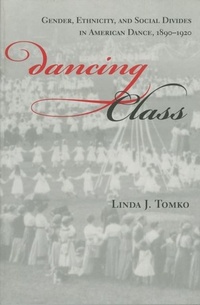
Dancing Class
Gender, Ethnicity, and Social Divides in American Dance, 1890-1920
1st Edition
Published on 22. January 2000
304 pages
978-0-253-02817-4 (ISBN)
Description

"Tomko blazes a new trail in dance scholarship by interconnecting U.S. History and dance studies. . . . the first to argue successfully that middle-class U.S. women promoted a new dance practice to manage industrial changes, crowded urban living, massive immigration, and interchange and repositioning among different classes." -Choice
From salons to dance halls to settlement houses, new dance practices at the turn of the century became a vehicle for expressing cultural issues and negotiating matters of gender. By examining master narratives of modern dance history, this provocative and insightful book demonstrates the cultural agency of Progressive-era dance practices.
From salons to dance halls to settlement houses, new dance practices at the turn of the century became a vehicle for expressing cultural issues and negotiating matters of gender. By examining master narratives of modern dance history, this provocative and insightful book demonstrates the cultural agency of Progressive-era dance practices.
Reviews / Votes
Tomko (Univ. of California, Riverside) blazes a new trail in dance scholarship by interconnecting US history and dance studies. Using analyses of class, gender, and ethnicity, she focuses on dance as a vehicle for cultural intervention in Progressive-era America, as manifested in immigration, physical culture movement, and the settlement projects. Others have concentrated on the art dancer as precursor to US modern dance, but Tomko is the first to argue successfully that middle-class US women promoted a new dance practice to manage industrial changes, crowded urban living, massive immigration, and interchange and repositioning among different classes. They blended foreign and US cultural practices and negotiated gender issues in education, social work, dance hall reforms, dance innovations, and dance patronage. Tomko links post-WW I immigration laws, shifting gender roles, and Freudian theories to the motivation of modern dancers to reject the derived conventionalized 'foreign' materials of the Progressive era. In so doing the author rewrites the history of 20th-century US dance, showing that the Progressive-era dance practices made significant cultural interventions in past US history and suggest relevant questions for the future. Annotated endnotes, bibliography, collections consulted, and index enhance the value of this rich book. All academic and general collectionNovember 2000 -- C. T. Bond * Goucher College *All prices
More details
Language
English
Place of publication
Bloomington, IN
United States
Target group
Professional and scholarly
US School Grade: College Graduate Student and over
Illustrations
21 b&w photos, 4 figures, 1 bibliog., 1 index
File size
3,71 MB
ISBN-13
978-0-253-02817-4 (9780253028174)
Copyright in bibliographic data and cover images is held by Nielsen Book Services Limited or by the publishers or by their respective licensors: all rights reserved.
Schweitzer Classification
Other editions
Additional editions
Book
01/2000
Indiana University Press
€25.50
Shipment within 10-20 days

Book
01/2000
Indiana University Press
€39.62
No shipping information available
Person
Linda J. Tomko is Associate Professor of Dance at the University of California, Riverside. She is President of the Society of Dance History Scholars and Co-Director of the annual Stanford University Summer Workshop in Baroque Dance. In 1997 she won the Gertrude Lippincott Prize, awarded by SDHS, for her article "Fete Accompli," published in Corporealities.
Content
- Intro
- Title Page
- Copyright Page
- Table of Contents
- ACKNOWLEDGMENTS
- INTRODUCTION
- One Bodies and Dances in Progressive-era America
- Two Constituting Culture, Authorizing Dance
- Three The Settlement House and the Playhouse: Cultivating Dance on New York's Lower East Side
- Four From Henry Street to Grand Street: Transfer and Transition to the Neighborhood Playhouse
- Five Working Women's Dancing, and Dance as Women's Work: Hull-House, Chicago Commons, and Boston's South End House
- Six Folk Dance, Park Fetes, and Period Political Values
- Conclusion
- NOTES
- COLLECTIONS CONSULTED
- INDEX
