

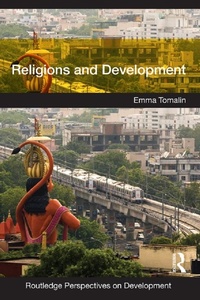
Religions and Development
1st Edition
Published on 3. July 2013
296 pages
978-1-136-82747-1 (ISBN)
Description

Religion has been excluded from development studies for decades. Religious traditions have contributed greatly towards development work, yet major international players have tended to ignore its role. Recent years have shown a noticeable shift in development policy, practice and research to recognize religion as a relevant factor.
This text provides a comprehensive insight into different approaches towards the understanding the relationships between religions and development studies, policy and practice. It guides readers through current debates, presenting, explaining and critically evaluating a broad range of literature and locating it within a theoretical context. The text explores the role of religion within development, from positive contributions, such as the important role that many 'faith-based organizations' play in education or health care, to more complicated and contested notions of impact, such as religiously inspired violence or gender inequality. The book begins with three background chapters, outlining the relevance of religions for development studies, policy and practice, and introducing the reader to the study of 'development' and of 'religions'. Following these, the focus then shifts to examine a number of thematic areas, including religion, gender and development, and the implications of the 'rise of religion' for mainstream development studies, policy and practice in the 21st century. Each chapter contains a range of features to assist undergraduate learning, including learning objectives for each chapter, discussion of key concepts, summaries, discussion questions, further reading and websites. The book also contains over sixty boxed case studies to provide further definition, explanation, and examples of the interactions between religions and development globally.
This innovative text presents religions as something that can both obstruct and aid development, encouraging readers to engage critically with the multiple ways that religion impacts on both the conceptualization of development as well the resulting project interventions. This will be of interest to undergraduate, postgraduate students and scholars interested in religious studies, development studies, and the broader study of societies and cultures.
This text provides a comprehensive insight into different approaches towards the understanding the relationships between religions and development studies, policy and practice. It guides readers through current debates, presenting, explaining and critically evaluating a broad range of literature and locating it within a theoretical context. The text explores the role of religion within development, from positive contributions, such as the important role that many 'faith-based organizations' play in education or health care, to more complicated and contested notions of impact, such as religiously inspired violence or gender inequality. The book begins with three background chapters, outlining the relevance of religions for development studies, policy and practice, and introducing the reader to the study of 'development' and of 'religions'. Following these, the focus then shifts to examine a number of thematic areas, including religion, gender and development, and the implications of the 'rise of religion' for mainstream development studies, policy and practice in the 21st century. Each chapter contains a range of features to assist undergraduate learning, including learning objectives for each chapter, discussion of key concepts, summaries, discussion questions, further reading and websites. The book also contains over sixty boxed case studies to provide further definition, explanation, and examples of the interactions between religions and development globally.
This innovative text presents religions as something that can both obstruct and aid development, encouraging readers to engage critically with the multiple ways that religion impacts on both the conceptualization of development as well the resulting project interventions. This will be of interest to undergraduate, postgraduate students and scholars interested in religious studies, development studies, and the broader study of societies and cultures.
Reviews / Votes
"Tomalin adds a great deal to our understanding of how religion and development intersect. This intersection of religion and development has long been ignored, misunderstood or misrepresented in the literature. This important book goes a long way to correcting this imbalance." Professor Matthew Clarke, Deakin University, Australia."An understanding of the links between religion and development, literacy in relevant concepts, approaches and faith traditions is much needed, as well as an understanding of the evidence on how the relationships play out in varying contexts. This book provides a provocative and readable introduction, examining religious perspectives on some key development issues (wealth and poverty, human rights, gender inequality, environmentalism) as well as a measured consideration of the development roles of so-called 'faith-based organisations." Carole Rakodi, Emeritus Professor, University of Birmingham, UK.
More details
Series
Language
English
Place of publication
London
United Kingdom
Publishing group
Taylor & Francis Ltd
Target group
College/higher education
Product notice
Reflowable
Illustrations
28 s/w Abbildungen, 4 s/w Tabellen, 28 s/w Photographien bzw. Rasterbilder
4 Tables, black and white; 28 Halftones, black and white; 28 Illustrations, black and white
File size
31,23 MB
ISBN-13
978-1-136-82747-1 (9781136827471)
Copyright in bibliographic data and cover images is held by Nielsen Book Services Limited or by the publishers or by their respective licensors: all rights reserved.
Schweitzer Classification
Other editions
Additional editions
Emma Tomalin
Religions and Development
Book
05/2013
1st Edition
Routledge
€237.61
Shipment within 15-20 days
Emma Tomalin
Religions and Development
Book
05/2013
1st Edition
Routledge
€72.03
Shipment within 15-20 days
Person
Dr Emma Tomalin is a Senior Lecturer in Religious Studies at the School of Philosophy, Religion and the History of Sciences at University of Leeds. Her research interests are focused around religion and global development. and religion, gender and society.
Content
1. Introduction: Religions and Development: A New Agenda 2. Approaches to the Theory and Practice of Development: From 'Estrangement' to 'Engagement' with Religions 3. Concepts and Theories for Studying Religions Globally 4. Religious Approaches to Development 5. Human Rights, Religions and Development 6. Gender, Religions and Development 7. Environmentalism, Religions and Development 8. Researching and Understanding the Role of 'Faith-based Organizations' (FBOs) in Development 9. Conclusion: Religions and International Development in the 21st Century
