

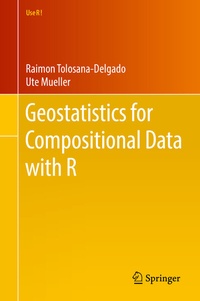
Geostatistics for Compositional Data with R
Description

This book provides a guided approach to the geostatistical modelling of compositional spatial data. These data are data in proportions, percentages or concentrations distributed in space which exhibit spatial correlation. The book can be divided into four blocks. The first block sets the framework and provides some background on compositional data analysis. Block two introduces compositional exploratory tools for both non-spatial and spatial aspects. Block three covers all necessary facets of multivariate spatial prediction for compositional data: variogram modelling, cokriging and validation. Finally, block four details strategies for simulation of compositional data, including transformations to multivariate normality, Gaussian cosimulation, multipoint simulation of compositional data, and common postprocessing techniques, valid for both Gaussian and multipoint methods.
All methods are illustrated via applications to two types of data sets: one a large-scale geochemical survey, comprised of a full suite of geochemical variables, and the other from a mining context, where only the elements of greatest importance are considered. R codes are included for all aspects of the methodology, encapsulated in the R package "gmGeostats", available in CRAN.
More details
Other editions
Additional editions
Persons
Ute Mueller is an associate professor in mathematics at Edith Cowan University in Perth, Australia. She has been teaching geostatistics for the last twenty years and has a research background in the application of multivariate geostatistical modelling techniques in mining, fisheries and health. In the last ten years she has focussed on compositional geostatistical data in particular.
Content
1 Introduction.- 2 A review of compositional data analysis.- 3 Exploratory data analysis.- 4 Exploratory spatial analysis.- 5 Variogram Models.- 6 Geostatistical estimation.- 7 Cross-validation.- 8 Multivariate normal score transformation.- 9 Simulation.- 10 Compositional Direct Sampling Simulation.- 11 Evaluation and Postprocessing of Results.- A Matrix decompositions.- B Complete data analysis workflows.- Index.
