

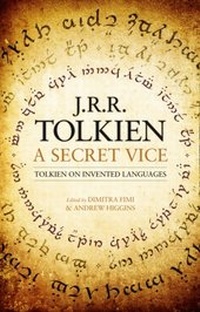
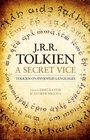
A Secret Vice
Tolkien on Invented Languages
1st Edition
Published on 7. April 2016
224 pages
978-0-00-813140-1 (ISBN)
Description

First ever critical study of Tolkien's little-known essay, which reveals how language invention shaped the creation of Middle-earth and beyond, to George R R Martin's Game of Thrones.
J.R.R. Tolkien's linguistic invention was a fundamental part of his artistic output, to the extent that later on in life he attributed the existence of his mythology to the desire to give his languages a home and peoples to speak them. As Tolkien puts it in 'A Secret Vice', 'the making of language and mythology are related functions'.
In the 1930s, Tolkien composed and delivered two lectures, in which he explored these two key elements of his sub-creative methodology. The second of these, the seminal Andrew Lang Lecture for 1938-9, 'On Fairy-Stories', which he delivered at the University of St Andrews in Scotland, is well known. But many years before, in 1931, Tolkien gave a talk to a literary society entitled 'A Hobby for the Home', where he unveiled for the first time to a listening public the art that he had both himself encountered and been involved with since his earliest childhood: 'the construction of imaginary languages in full or outline for amusement'.
This talk would be edited by Christopher Tolkien for inclusion as 'A Secret Vice' in The Monsters and the Critics and Other Essays and serves as the principal exposition of Tolkien's art of inventing languages. This new critical edition, which includes previously unpublished notes and drafts by Tolkien connected with the essay, including his 'Essay on Phonetic Symbolism', goes some way towards re-opening the debate on the importance of linguistic invention in Tolkien's mythology and the role of imaginary languages in fantasy literature.
J.R.R. Tolkien's linguistic invention was a fundamental part of his artistic output, to the extent that later on in life he attributed the existence of his mythology to the desire to give his languages a home and peoples to speak them. As Tolkien puts it in 'A Secret Vice', 'the making of language and mythology are related functions'.
In the 1930s, Tolkien composed and delivered two lectures, in which he explored these two key elements of his sub-creative methodology. The second of these, the seminal Andrew Lang Lecture for 1938-9, 'On Fairy-Stories', which he delivered at the University of St Andrews in Scotland, is well known. But many years before, in 1931, Tolkien gave a talk to a literary society entitled 'A Hobby for the Home', where he unveiled for the first time to a listening public the art that he had both himself encountered and been involved with since his earliest childhood: 'the construction of imaginary languages in full or outline for amusement'.
This talk would be edited by Christopher Tolkien for inclusion as 'A Secret Vice' in The Monsters and the Critics and Other Essays and serves as the principal exposition of Tolkien's art of inventing languages. This new critical edition, which includes previously unpublished notes and drafts by Tolkien connected with the essay, including his 'Essay on Phonetic Symbolism', goes some way towards re-opening the debate on the importance of linguistic invention in Tolkien's mythology and the role of imaginary languages in fantasy literature.
Reviews / Votes
'Anyone who has interest in language, linguistics, storytelling, or simply just fantasy in general should add this to their top shelf'5* Amazon Reviewer
'An absolute MUST HAVE for any Tolkien fan!'
5* Amazon Reviewer
More details
Language
English
Place of publication
United Kingdom
Publishing group
HarperCollins Publishers
Product notice
Reflowable
File size
3,62 MB
ISBN-13
978-0-00-813140-1 (9780008131401)
Copyright in bibliographic data and cover images is held by Nielsen Book Services Limited or by the publishers or by their respective licensors: all rights reserved.
Schweitzer Classification
Other editions
Additional editions
Book
02/2023
HarperCollins
€31.15
Article not available at the moment
Book
07/2020
HarperCollins
€14.00
Shipment within 15-20 days
Book
10/2019
HarperCollins
€25.50
Article not available at the moment
Book
04/2016
HarperCollins
€41.07
Article exhausted; check different version
Persons
Dimitra Fimi, PhD is one of the foremost experts on Tolkien and Fantasy Literature. Her published work includes Tolkien, Race and Cultural History, which won the Mythopoeic Scholarship Award for Inkling Studies for 2010. She is currently Senior Lecturer in English at Cardiff Metropolitan University.
Andrew Higgins, PhD is a Tolkien scholar who specialises in exploring the role of language invention in fiction. His thesis 'The Genesis of Tolkien's Mythology' explored the interrelated nature of myth and language in Tolkien's earliest work on his Legendarium. He is also Director of Development at Glyndebourne Opera.
J.R.R. Tolkien (1892-1973) was a distinguished academic, though he is best known for writing The Hobbit, The Lord of the Rings and The Silmarillion, plus other stories and essays. His books have been translated into over 50 languages and have sold many millions of copies worldwide.
Andrew Higgins, PhD is a Tolkien scholar who specialises in exploring the role of language invention in fiction. His thesis 'The Genesis of Tolkien's Mythology' explored the interrelated nature of myth and language in Tolkien's earliest work on his Legendarium. He is also Director of Development at Glyndebourne Opera.
J.R.R. Tolkien (1892-1973) was a distinguished academic, though he is best known for writing The Hobbit, The Lord of the Rings and The Silmarillion, plus other stories and essays. His books have been translated into over 50 languages and have sold many millions of copies worldwide.
