

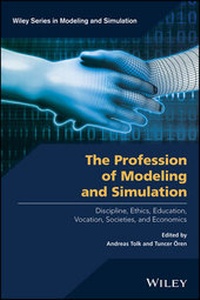
The Profession of Modeling and Simulation
Description

More details
Other editions
Additional editions
Persons
Content
Notes on Contributors
Robert K. Armstrong serves in multiple roles at Eastern Virginia Medical School (EVMS) in Norfolk, Virginia. He is Director of the Sentara Center for Simulation and Immersive Learning, leading a team of 140+ personnel providing healthcare training and education to the EVMS School of Medicine and School of Health Professions, various local Graduate Medical Education programs, regional emergency medical providers, and over 60 external healthcare clients. He is Director of the National Center for Collaboration in Medical Modeling and Simulation, helping commercial businesses to diversify their modeling and simulation products into the commercial healthcare sector. He is the Director of Corporate Relations, providing a link between EVMS researchers and regional commercial and entrepreneurial opportunities. He joined EVMS from Booz Allen Hamilton, where he provided modeling and simulation support and analysis, developed M&S training tools, and drafted M&S policy for U.S. Navy, Marine Corps, and Air Force clients. Prior to his time at Booz Allen, he was Director of Technology at the Virginia Modeling, Analysis and Simulation Center at Old Dominion University in Norfolk, Virginia. Bob holds a M.S. in Computer Science from the U.S. Naval Postgraduate School in Monterey, California, and a B.S. in General Engineering from the U.S. Naval Academy in Annapolis, Maryland. He is on the Board of Directors of the Society for Simulation in Healthcare. He is a U.S. Marine Corps veteran.
Curtis L. Blais is a member of the Naval Postgraduate School (NPS) research faculty in the Modeling, Virtual Environments, and Simulation (MOVES) Institute. He has over 42 years of experience in the specification, design, development, and employment of military simulation systems, including the past 17 years with NPS as a principal investigator, technical expert, and instructor in modeling and simulation projects and education. He began his career as an Operations Research Analyst at the Naval Electronics Laboratory Center (now called the Space and Naval Warfare Systems Center, Pacific) developing analytical simulation models of command and control systems and tactical communications systems and combat simulation models of Marine Corps operations for command staff training, as well as conducting evaluations of artificial intelligence techniques and natural language processing systems for military applications. Over a period of 20 years working in industry, Blais continued in software development for follow-on Marine Corps training systems, while holding progressively higher positions in technical management. Blais is active in several U.S. military and international modeling and simulation standards and professional education organizations. Blais earned B.S. and M.S. degrees in Mathematics from the University of Notre Dame.
Tim Cooley is President and Founder of DynamX Consulting, a veteran-owned consulting firm located in Castle Rock, Colorado. He is also an adjunct faculty member at Colorado College. He spent 16 years on the U.S. Air Force Academy faculty, both in uniform and as a civilian, holding numerous positions, including the DMSO Modeling and Simulation Chair, Deputy Department Head, and Senior Researcher. His previous military assignments included Squadron Commander of the 1987th Communications Squadron at Lowry AFB and Land Mobile Radio Manager for CINCNORAD. Cooley has completed a number of innovative mathematical and cost analyses for the USMC, USAF, and OSD and performed counterterrorism research for Joint Staff. He developed and taught the USAF Combat Analysis Class and has provided decision support tools and research for the FAA. He is coauthor of the 2011 Defense Acquisition University Research Paper of the Year and 2011 Hirsch Prize recipient. Cooley received his Ph.D. in Computer Science/Biomedical Engineering from Rutgers University in 1996.
Rudolph P. Darken is Professor of Computer Science at the Naval Postgraduate School in Monterey, California. He is a former Director of the Modeling, Virtual Environments, and Simulation (MOVES) Institute. He has served on advisory boards for the National Institutes of Health (NIH), the NASA Ames Research Center, the National Science Foundation, the Engineering and Physical Sciences Research Council (UK) as well as several technology companies. He was an Associate Editor of Presence Journal (MIT Press). He received his D.Sc. and M.S. degrees in Computer Science from the George Washington University and his B.S. in Computer Science Engineering from the University of Illinois at Chicago. He also holds a J.D. from the Monterey College of Law.
Saikou Y. Diallo is Research Associate Professor at the Virginia Modeling, Analysis and Simulation Center and adjunct Professor of Modeling, Simulation, and Visualization Engineering at Old Dominion University. He received his M.S and Ph.D. in Modeling and Simulation from Old Dominion University. His research focuses on the theory and practice of interoperability and the advancement of M&S. Diallo has authored over 100 publications, including a number of awarded papers and articles in conferences, journals, and book chapters. He is a member of SCS, IEEE, and ACM.
Umut Durak is a Research Scientist in the Flight Dynamics and Simulation Department of the German Aerospace Center (DLR) Institute of Flight Systems. His research interests include model-based simulation engineering, simulation-based systems engineering, and ontologies in simulation. He is teaching graduate-level courses on simulation at the Clausthal University of Technology, Department of Informatics as an adjunct lecturer. He received his B.S., M.S., and Ph.D. degrees in Mechanical Engineering from Middle East Technical University (METU) in Turkey. In the last 15 years, he contributed various research and development projects and published more than 50 papers in national and international conferences, workshops, and journals. He is a member of the Society for Computer Simulation International (SCS), Arbeitsgemeinschaft Simulation (ASIM), and the American Institute of Aeronautics and Astronautics (AIAA). He is a member of the AIAA Modeling and Simulation Technical Committee and editorial teams of the Simulation: Transactions of the Society for Modeling and Simulation International and the International Journal of Modeling, Simulation, and Scientific Computing.
Richard Fujimoto is a Regents' Professor in the School of Computational Science and Engineering at the Georgia Institute of Technology. He received the M.S. and Ph.D. degrees from the University of California at Berkeley in 1980 and 1983, respectively, in Computer Science and Electrical Engineering. He did his undergraduate work at the University of Illinois at Urbana-Champaign where he received B.S. degrees in Computer Science and Computer Engineering in 1977 and 1978, respectively. He was the founding chair of the School of Computational Science and Engineering (CSE) at Georgia Tech, an academic unit focused on computational models of natural and engineered systems. In this role he led in the creation of M.S. and Ph.D. degree programs in CSE as well as two undergraduate minor programs. He has been an active researcher in the parallel and distributed simulation field since 1985 and has published over 200 papers in this area. He is author or coauthor of three books. He has received several best paper awards for his research as well as the ACM SIGSIM Distinguished Contributions in Simulation Award. He led the definition of the time management services for the High Level Architecture (IEEE Standard 1516). Fujimoto has served as Co-Editor-in-Chief of the journal Simulation: Transactions of the Society for Modeling and Simulation International and was a founding area editor for the ACM Transactions on Modeling and Computer Simulation journal. He has also served on the organizing committees for several leading conferences in the parallel and distributed simulation field.
Randall B. Garrett remains actively involved throughout M&S and Research and Development (R&D) communities. This includes successful application of science and engineering for full-spectrum Live, Virtual, Constructive (LVC) training and immersive game applications. Garrett leads various R&D teams with the responsibility for practical evaluation of emerging technologies and identification of next-generation architectures supporting scientific and operational needs. His interests include the application of M&S principles for computational dynamics, analytics, and autonomous system controls. His interests also include the effective use of Artificial Intelligence (AI) for immersive games and robotics. Garrett holds a B.A. from the University of Arkansas and M.S. from Marshall University; he earned his Ph.D. from Old Dominion University with a degree in M&S. He served in the military as a Naval Officer where he held many leadership positions including that of Commanding Officer. His industry experience includes positions as Chief Scientist, Principal Investigator (PI), and Technical Director for large corporations. Garrett serves on regional, state, and national boards to include task forces addressing information technology standards and policies. Garrett actively participates in the National M&S Coalition (NMSC) as Vice Chair of the Policy Committee.
Steven Gordon is the Orlando Field Office Manager and a Principal Research Engineer for Georgia Tech Research Institute. He is the Director of the Georgia Tech Test and Evaluation Research and Education Center. He served 26 years in the U.S. Air Force with tours as an F-111 Weapons Systems Officer,...
