

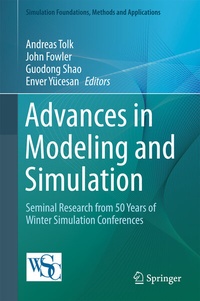
Advances in Modeling and Simulation
Description

This broad-ranging text/reference presents a fascinating review of the state of the art of modeling and simulation, highlighting both the seminal work of preeminent authorities and exciting developments from promising young researchers in the field. Celebrating the 50th anniversary of the Winter Simulation Conference (WSC), the premier international forum for disseminating recent advances in the field of system simulation, the book showcases the historical importance of this influential conference while also looking forward to a bright future for the simulation community.
Topics and features: examines the challenge of constructing valid and efficient models, emphasizing the benefits of the process of simulation modeling; discusses model calibration, input model risk, and approaches to validating emergent behaviors in large-scale complex systems with non-linear interactions; reviews the evolution of simulation languages, and the history of the Time Warp algorithm; offers afocus on the design and analysis of simulation experiments under various goals, and describes how data can be "farmed" to support decision making; provides a comprehensive overview of Bayesian belief models for simulation-based decision making, and introduces a model for ranking and selection in cloud computing; highlights how input model uncertainty impacts simulation optimization, and proposes an approach to quantify and control the impact of input model risk; surveys the applications of simulation in semiconductor manufacturing, in social and behavioral modeling, and in military planning and training; presents data analysis on the publications from the Winter Simulation Conference, offering a big-data perspective on the significant impact of the conference. This informative and inspiring volume will appeal to all academics and professionals interested in computational and mathematical modeling and simulation, as well as to graduate students on the path to form the nextgeneration of WSC pioneers.More details
Other editions
Additional editions
Persons
Dr. Andreas Tolk is a Technology Integrator at The MITRE Corporation, Hampton, VA, USA, and adjunct Professor at Old Dominion University, Norfolk, VA, USA.
Dr. John Fowler is the Motorola Professor of Supply Chain Management in the W.P. Carey School of Business at Arizona State University, AZ, Tempe, USA.
Dr. Guodong Shao is a Computer Scientist in the Systems Integration Division (SID) of the Engineering Laboratory (EL) at the National Institute of Standards and Technology (NIST), Gaithersburg, MD, USA.
Dr. Enver Yücesan is a Professor of Operations Management at INSEAD, Fontainebleau, France.
Content
A Brief Introduction to the Winter Simulation Conference.- Model is a Verb.- Model Calibration.- Validating Emergent Behavior in Complex Systems.- Input Model Risk.- Evolution of Simulation Languages.- A Brief History of Time Warp.- Design and Analysis of Simulation Experiments: Tutorial.- Better Big Data via Data Farming Experiments.- Bayesian Belief Models in Simulation-Based Decision Making.- Simulation Optimization under Input Model Uncertainty.- Parallel Ranking and Selection.- A History of Military Computer Simulation.- Modeling and Analysis of Semiconductor Manufacturing.- Social and Behavioral Simulation.- Analysis of M&S Literature Published in the Proceedings of the Winter Simulation Conference from 1981 to 2016.
