

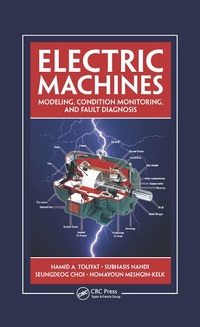
Electric Machines
Modeling, Condition Monitoring, and Fault Diagnosis
1st Edition
Published on 19. December 2017
272 pages
978-1-4200-0628-5 (ISBN)
Description

With countless electric motors being used in daily life, in everything from transportation and medical treatment to military operation and communication, unexpected failures can lead to the loss of valuable human life or a costly standstill in industry. To prevent this, it is important to precisely detect or continuously monitor the working condition of a motor. Electric Machines: Modeling, Condition Monitoring, and Fault Diagnosis reviews diagnosis technologies and provides an application guide for readers who want to research, develop, and implement a more effective fault diagnosis and condition monitoring scheme-thus improving safety and reliability in electric motor operation. It also supplies a solid foundation in the fundamentals of fault cause and effect.
Combines Theoretical Analysis and Practical Application
Written by experts in electrical engineering, the book approaches the fault diagnosis of electrical motors through the process of theoretical analysis and practical application. It begins by explaining how to analyze the fundamentals of machine failure using the winding functions method, the magnetic equivalent circuit method, and finite element analysis. It then examines how to implement fault diagnosis using techniques such as the motor current signature analysis (MCSA) method, frequency domain method, model-based techniques, and a pattern recognition scheme. Emphasizing the MCSA implementation method, the authors discuss robust signal processing techniques and the implementation of reference-frame-theory-based fault diagnosis for hybrid vehicles.
Fault Modeling, Diagnosis, and Implementation in One Volume
Based on years of research and development at the Electrical Machines & Power Electronics (EMPE) Laboratory at Texas A&M University, this book describes practical analysis and implementation strategies that readers can use in their work. It brings together, in one volume, the fundamentals of motor fault conditions, advanced fault modeling theory, fault diagnosis techniques, and low-cost DSP-based fault diagnosis implementation strategies.
Combines Theoretical Analysis and Practical Application
Written by experts in electrical engineering, the book approaches the fault diagnosis of electrical motors through the process of theoretical analysis and practical application. It begins by explaining how to analyze the fundamentals of machine failure using the winding functions method, the magnetic equivalent circuit method, and finite element analysis. It then examines how to implement fault diagnosis using techniques such as the motor current signature analysis (MCSA) method, frequency domain method, model-based techniques, and a pattern recognition scheme. Emphasizing the MCSA implementation method, the authors discuss robust signal processing techniques and the implementation of reference-frame-theory-based fault diagnosis for hybrid vehicles.
Fault Modeling, Diagnosis, and Implementation in One Volume
Based on years of research and development at the Electrical Machines & Power Electronics (EMPE) Laboratory at Texas A&M University, this book describes practical analysis and implementation strategies that readers can use in their work. It brings together, in one volume, the fundamentals of motor fault conditions, advanced fault modeling theory, fault diagnosis techniques, and low-cost DSP-based fault diagnosis implementation strategies.
More details
Language
English
Place of publication
Baton Rouge
United States
Publishing group
Taylor & Francis Inc
Target group
Professional and scholarly
Electrical, power, and maintenance engineers; graduate students, practitioners, and researchers in the power area.
Illustrations
161 s/w Abbildungen, 21 s/w Tabellen
21 Tables, black and white; 161 Illustrations, black and white
File size
12,36 MB
ISBN-13
978-1-4200-0628-5 (9781420006285)
Copyright in bibliographic data and cover images is held by Nielsen Book Services Limited or by the publishers or by their respective licensors: all rights reserved.
Schweitzer Classification
Other editions
New editions
E-Book
10/2021
2nd Edition
CRC Press
€65.99
Available for download
Additional editions
Hamid A. Toliyat | Subhasis Nandi | Seungdeog Choi
Electric Machines
Modeling, Condition Monitoring, and Fault Diagnosis
Book
03/2017
1st Edition
CRC Press
€123.00
Shipment within 10-20 days
Hamid A. Toliyat | Subhasis Nandi | Seungdeog Choi
Electric Machines
Modeling, Condition Monitoring, and Fault Diagnosis
Book
10/2012
1st Edition
CRC Press
€297.70
Shipment within 15-20 days
Persons
Prof. Toliyat is currently a Raytheon Company endowed professor of electrical and computer engineering at Texas A&M University. He has received several awards, including the prestigious Cyrill Veinott Award in Electromechanical Energy Conversion from the IEEE Power Engineering Society (2004), the Patent and Innovation Award from Texas A&M University System Office of Technology Commercialization (2007), the TEES Faculty Fellow Award (2006), the Texas A&M Select Young Investigator Award (1999), and the Space Act Award from NASA (1999). He has also received four prize paper awards from the IEEE. Prof. Toliyat has published more than 370 technical papers (including more than 110 in IEEE Transactions) and has 12 issued and pending U.S. patents.
Content
Introduction. Faults in Induction and Synchronous Motors. Modeling of Electric Machines Using Winding and Modified Winding Function Approaches. Modeling of Electric Machines Using Magnetic Equivalent Circuit Method. Analysis of Faulty Induction Motors Using Finite Element Method. Fault Diagnosis of Electric Machines Using Techniques Based on Frequency Domain. Fault Diagnosis of Electric Machines Using Model-Based Techniques. Application of Pattern Recognition to Fault Diagnosis. Implementation of Motor Current Signature Analysis Fault Diagnosis Based on Digital Signal Processors. Implementation of Fault Diagnosis in Hybrid Vehicles Based on Reference Frame Theory. Robust Signal Processing Techniques for the Implementation of Motor Current Signature Analysis Diagnosis Based on Digital Signal Processors. Index.
