

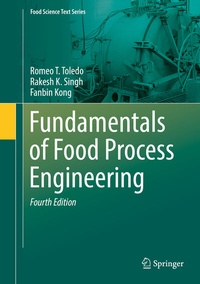
Fundamentals of Food Process Engineering
Description

While continuing the tradition of expansive coverage, Fundamentals of Food Process Engineering, Fourth Edition, has been updated and revised. The new edition of this classic text emphasizes problem solving, including technological principles that form the basis for a process so that the process can be better understood and the selection of processing parameters to maximize product quality and safety can be made more effective. In addition, the book contains new, hard-to-find data needed to conduct food process engineering calculations.
Two new chapters, aseptic processing and packaging, and emerging food processing technologies have been added, and one chapter on review of mathematical principles was deleted. The new chapters reflect the current state of technology and will be very useful to practicing food engineers in academics and the food industry. New chapters include:
· Aseptic processingsystems containing diagrams of various equipment, flow and residence time distributions, and calculations for hold tube and process lethality.
· Emerging food processing technologies include heating methods with microwave, radiofrequency, and pulse electricity, and high pressure processing. Each topic includes equations and example calculations to strengthen rigor for food engineering calculations.
The thermal process calculation chapter was extensively revised to remove outdated information and add more relevant examples. Similarly, other chapters were also revised for updated tabular data and text write-up.
Written for the upper level undergraduate, Fundamentals of Food Process Engineering, Fourth Edition, is a solid reference for the graduate food engineering student and professional.
More details
Other editions
Additional editions
Persons
Romeo T. Toledo, Ph.D. is Emeritus Professor; Rakesh K. Singh, Ph.D. is Professor and Head; and Fan-bin Kong, Ph.D. is Associate Professor, in the Department of Food Science and Technology at the University of Georgia, Athens.
