

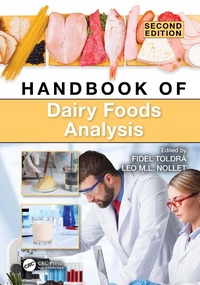
Handbook of Dairy Foods Analysis
2nd Edition
Published on 29. March 2021
1040 pages
978-1-000-34203-1 (ISBN)
Description

Dairy foods account for a large portion of the Western diet, but due to the potential diversity of their sources, this food group often poses a challenge for food scientists and their research efforts. Bringing together the foremost minds in dairy research, Handbook of Dairy Foods Analysis, Second Edition, compiles the top dairy analysis techniques and methodologies from around the world into one well-organized volume.
Exceptionally comprehensive in both its detailing of methods and the range of dairy products covered, this handbook includes tools for analyzing chemical and biochemical compounds and also bioactive peptides, prebiotics, and probiotics. It describes noninvasive chemical and physical sensors and starter cultures used in quality control.
This second edition includes four brand-new chapters covering the analytical techniques and methodologies for determining bioactive peptides, preservatives, activity of endogenous enzymes, and sensory perception of dairy foods, and all other chapters have been adapted to recent research. All other chapters have been thoroughly updated.
Key Features:
Explains analytical tools available for the analysis of the chemistry and biochemistry of dairy foods
Covers a variety of dairy foods including milk, cheese, butter, yogurt, and ice cream
Analysis of nutritional quality includes prebiotics, probiotics, essential amino acids, bioactive peptides, and healthy vegetable-origin compounds
Includes a series of chapters on analyzing sensory qualities, including color, texture, and flavor.
Covering the gamut of dairy analysis techniques, th
e book discusses current methods for the analysis of chemical and nutritional compounds, and the detection of microorganisms, allergens, contaminants, and/or other adulterations, including those of environmental origin or introduced during processing. Other methodologies used to evaluate color, texture, and flavor are also discussed.
Written by an international panel of distinguished contributors
under the editorial guidance of renowned authorities, Fidel Toldra and Leo M.L. Nollet, this handbook is one of the few references that is completely devoted to dairy food analysis - an extremely valuable reference for those in the dairy research, processing, and manufacturing industries.
Exceptionally comprehensive in both its detailing of methods and the range of dairy products covered, this handbook includes tools for analyzing chemical and biochemical compounds and also bioactive peptides, prebiotics, and probiotics. It describes noninvasive chemical and physical sensors and starter cultures used in quality control.
This second edition includes four brand-new chapters covering the analytical techniques and methodologies for determining bioactive peptides, preservatives, activity of endogenous enzymes, and sensory perception of dairy foods, and all other chapters have been adapted to recent research. All other chapters have been thoroughly updated.
Key Features:
Explains analytical tools available for the analysis of the chemistry and biochemistry of dairy foods
Covers a variety of dairy foods including milk, cheese, butter, yogurt, and ice cream
Analysis of nutritional quality includes prebiotics, probiotics, essential amino acids, bioactive peptides, and healthy vegetable-origin compounds
Includes a series of chapters on analyzing sensory qualities, including color, texture, and flavor.
Covering the gamut of dairy analysis techniques, th
e book discusses current methods for the analysis of chemical and nutritional compounds, and the detection of microorganisms, allergens, contaminants, and/or other adulterations, including those of environmental origin or introduced during processing. Other methodologies used to evaluate color, texture, and flavor are also discussed.
Written by an international panel of distinguished contributors
under the editorial guidance of renowned authorities, Fidel Toldra and Leo M.L. Nollet, this handbook is one of the few references that is completely devoted to dairy food analysis - an extremely valuable reference for those in the dairy research, processing, and manufacturing industries.
More details
Edition
2nd edition
Language
English
Place of publication
London
United Kingdom
Publishing group
Taylor & Francis Ltd
Target group
Professional and scholarly
Illustrations
111 Tables, black and white; 162 Illustrations, black and white
ISBN-13
978-1-000-34203-1 (9781000342031)
Copyright in bibliographic data and cover images is held by Nielsen Book Services Limited or by the publishers or by their respective licensors: all rights reserved.
Schweitzer Classification
Other editions
Additional editions
Fidel Toldra | Leo M.L. Nollet
Handbook of Dairy Foods Analysis
Book
09/2025
2nd Edition
CRC Press
€92.99
Shipment within 15-20 days
Fidel Toldra | Leo M.L. Nollet
Handbook of Dairy Foods Analysis
Book
03/2021
2nd Edition
CRC Press
€272.81
Shipment within 15-20 days
Persons
Fidel Toldra, Ph.D. in Chemistry (University of Valencia, 1984) and Research Professor at the Department of Food Science, Instituto de Agroquimica y Tecnologia de Alimentos (CSIC). He serves as Editor of Trends in Food Science & Technology (Elsevier), Associate Editor of Meat Science (Elsevier) and Editor-in-Chief of book serial Advances in Food & Nutrition Research (Academic Press/Elsevier). He has acted as Editor or Associate Editor of several books in recent years. He was Associate Editor of the Handbook of Food Product Manufacturing published (2007, John Wiley & Sons), the Handbook of Food and Beverage Fermentation Technology and the Handbook of Food Science, Technology and Engineering both published in 2004 and 2006, respectively, by CRC Press..
From 2008 to 2011, he edited with Leo Nollet seven volumes on animal product-related books for CRC Press: Handbook of Muscle Foods Analysis, Handbook of Processed Meats and Poultry Analysis, Handbook of Seafood and Seafood Products Analysis, Handbook of Dairy Foods Analysis, Handbook of Analysis of Edible Animal By-Products, Safety Analysis of Foods of Animal Origin and Sensory Analysis of Foods of Animal Origin. They also edited for CRC Press the Handbook of Analysis of Active Compounds in Functional Foods (2012), the 2<+>nd<+> edition of Advanced Technologies for Meat Processing (2018), the 3<+>rd<+> editions of Food Analysis by HPLC (2013) and Handbook of Food Analysis (2015), and Advances in Food Diagnostics (2017, Blackwell Publishing).
Prof. Toldra has been the Editor of the Handbook of Meat Processing (2010, Wiley), Meat Biotechnology (2008) and Safety of Meat and Processed Meat (2009) for Springer, and the 8th edition of Lawrie?s Meat Science (2015, Woodhead). He was the Editor-in-Chief of the 1<+>st<+> and 2<+>nd<+> editions of Handbook of fermented meat and poultry (Wiley-Blackwell) and one of the Editors-in-Chief of the Encyclopedia of Food & Health (Academic Press/Elsevier).
Prof. Toldra serves at the Editorial Board of 15 journals such as Food Chemistry, Current Opinion in Food Science and Journal of Food Engineering. He has published >320 research articles (h index =60), >143 chapters of books and edited/co-edited >50 books. He is a Fellow of the Institute of Food Technologists (IFT) and the International Academy of Food Science & Technology (IAFOST). He received the 2002 IMS International Prize for Meat Science and Technology, 2010 Distinguished Research Award and 2014 Meat Processing Award both of American Meat Science Association (AMSA), 2015 Dupont Science Award, the 2019 Innovation Award from the Association of Spanish Meat Industry and the 2019 Award for Advancement of Application of Agricultural and Food Chemistry from the American Chemical Society (ACS).
Leo M. L. Nollet earned an MS (1973) and PhD (1978) in biology from the Katholieke Universiteit Leuven, Belgium. He is an editor and associate editor of numerous books. He edited for M. Dekker, New York-now CRC Press of Taylor & Francis Publishing Group-the first, second, and third editions of Food Analysis by HPLC and Handbook of Food Analysis. The last edition is a two-volume book. Dr. Nollet also edited the Handbook of Water Analysis (first, second, and third editions) and Chromatographic Analysis of the Environment, third and fourth editions (CRC Press). With F. Toldra, he coedited two books published in 2006, 2007, and 2017: Advanced Technologies for Meat Processing (CRC Press) and Advances in Food Diagnostics (Blackwell Publishing-now Wiley). With M. Poschl, he coedited the book Radionuclide Concentrations in Foods and the Environment, also published in 2006 (CRC Press). Dr. Nollet has also coedited with Y. H. Hui and other colleagues on several books: Handbook of Food Product Manufacturing (Wiley, 2007), Handbook of Food Science, Technology, and Engineering (CRC Press, 2005), Food Biochemistry and Food Processing (first and second editions; Blackwell Publishing-now Wiley-2006 and 2012), and the Handbook of Fruits and Vegetable Flavors (Wiley, 2010). In addition, he edited the Handbook of Meat, Poultry, and Seafood Quality, first and second editions (Blackwell Publishing-now Wiley-2007 and 2012). From 2008 to 2011, he published five volumes on animal product-related books with F. Toldra: Handbook of Muscle Foods Analysis, Handbook of Processed Meats and Poultry Analysis, Handbook of Seafood and Seafood Products Analysis, Handbook of Dairy Foods Analysis, and Handbook of Analysis of Edible Animal By-Products. Also, in 2011, with F. Toldra, he coedited two volumes for CRC Press: Safety Analysis of Foods of Animal Origin and Sensory Analysis of Foods of Animal Origin. In 2012, they published the Handbook of Analysis of Active Compounds in Functional Foods. In a coedition with Hamir Rathore, Handbook of Pesticides: Methods of Pesticides Residues Analysis was marketed in 2009; Pesticides: Evaluation of Environmental Pollution in 2012; Biopesticides Handbook in 2015; and Green Pesticides Handbook: Essential Oils for Pest Control in 2017. Other finished book projects include Food Allergens: Analysis, Instrumentation, and Methods (with A. van Hengel; CRC Press, 2011) and Analysis of Endocrine Compounds in Food (Wiley-Blackwell, 2011). Dr. Nollet's recent projects include Proteomics in Foods with F. Toldra (Springer, 2013) and Transformation Products of Emerging Contaminants in the Environment: Analysis, Processes, Occurrence, Effects, and Risks with D. Lambropoulou (Wiley, 2014). In the series Food Analysis & Properties, he edited (with C. Ruiz-Capillas) Flow Injection Analysis of Food Additives (CRC Press, 2015) and Marine Microorganisms: Extraction and Analysis of Bioactive Compounds (CRC Press, 2016). With A.S. Franca, he coedited Spectroscopic Methods in Food Analysis (CRC Press, 2017), and with Horacio Heinzen and Amadeo R. Fernandez-Alba he coedited Multiresidue Methods for the Analysis of Pesticide Residues in Food (CRC Press, 2017). Further volumes in the series Food Analysis & Properties are Phenolic Compounds in Food: Characterization and Analysis (with Janet Alejandra Gutierrez-Uribe, 2018), Testing and Analysis of GMO-containing Foods and Feed (with Salah E. O. Mahgoub, 2018), Fingerprinting Techniques in Food Authentication and Traceability (with K. S. Siddiqi, 2018), Hyperspectral Imaging Analysis and Applications for Food Quality (with N.C. Basantia, Leo M.L. Nollet, Mohammed Kamruzzaman, 2018), Ambient Mass Spectroscopy Techniques in Food and the Environment (with Basil K. Munjanja, 2019), Food Aroma Evolution: During Food Processing, Cooking, and Aging (with M. Bordiga, 2019), Mass Spectrometry Imaging in Food Analysis (2020), Proteomics in Food Authentication (with S. OEtles, 2020) and Analysis of Nanoplastics and Microplastics in Food (with K.S. Siddiqi, 2020).
?
From 2008 to 2011, he edited with Leo Nollet seven volumes on animal product-related books for CRC Press: Handbook of Muscle Foods Analysis, Handbook of Processed Meats and Poultry Analysis, Handbook of Seafood and Seafood Products Analysis, Handbook of Dairy Foods Analysis, Handbook of Analysis of Edible Animal By-Products, Safety Analysis of Foods of Animal Origin and Sensory Analysis of Foods of Animal Origin. They also edited for CRC Press the Handbook of Analysis of Active Compounds in Functional Foods (2012), the 2<+>nd<+> edition of Advanced Technologies for Meat Processing (2018), the 3<+>rd<+> editions of Food Analysis by HPLC (2013) and Handbook of Food Analysis (2015), and Advances in Food Diagnostics (2017, Blackwell Publishing).
Prof. Toldra has been the Editor of the Handbook of Meat Processing (2010, Wiley), Meat Biotechnology (2008) and Safety of Meat and Processed Meat (2009) for Springer, and the 8th edition of Lawrie?s Meat Science (2015, Woodhead). He was the Editor-in-Chief of the 1<+>st<+> and 2<+>nd<+> editions of Handbook of fermented meat and poultry (Wiley-Blackwell) and one of the Editors-in-Chief of the Encyclopedia of Food & Health (Academic Press/Elsevier).
Prof. Toldra serves at the Editorial Board of 15 journals such as Food Chemistry, Current Opinion in Food Science and Journal of Food Engineering. He has published >320 research articles (h index =60), >143 chapters of books and edited/co-edited >50 books. He is a Fellow of the Institute of Food Technologists (IFT) and the International Academy of Food Science & Technology (IAFOST). He received the 2002 IMS International Prize for Meat Science and Technology, 2010 Distinguished Research Award and 2014 Meat Processing Award both of American Meat Science Association (AMSA), 2015 Dupont Science Award, the 2019 Innovation Award from the Association of Spanish Meat Industry and the 2019 Award for Advancement of Application of Agricultural and Food Chemistry from the American Chemical Society (ACS).
Leo M. L. Nollet earned an MS (1973) and PhD (1978) in biology from the Katholieke Universiteit Leuven, Belgium. He is an editor and associate editor of numerous books. He edited for M. Dekker, New York-now CRC Press of Taylor & Francis Publishing Group-the first, second, and third editions of Food Analysis by HPLC and Handbook of Food Analysis. The last edition is a two-volume book. Dr. Nollet also edited the Handbook of Water Analysis (first, second, and third editions) and Chromatographic Analysis of the Environment, third and fourth editions (CRC Press). With F. Toldra, he coedited two books published in 2006, 2007, and 2017: Advanced Technologies for Meat Processing (CRC Press) and Advances in Food Diagnostics (Blackwell Publishing-now Wiley). With M. Poschl, he coedited the book Radionuclide Concentrations in Foods and the Environment, also published in 2006 (CRC Press). Dr. Nollet has also coedited with Y. H. Hui and other colleagues on several books: Handbook of Food Product Manufacturing (Wiley, 2007), Handbook of Food Science, Technology, and Engineering (CRC Press, 2005), Food Biochemistry and Food Processing (first and second editions; Blackwell Publishing-now Wiley-2006 and 2012), and the Handbook of Fruits and Vegetable Flavors (Wiley, 2010). In addition, he edited the Handbook of Meat, Poultry, and Seafood Quality, first and second editions (Blackwell Publishing-now Wiley-2007 and 2012). From 2008 to 2011, he published five volumes on animal product-related books with F. Toldra: Handbook of Muscle Foods Analysis, Handbook of Processed Meats and Poultry Analysis, Handbook of Seafood and Seafood Products Analysis, Handbook of Dairy Foods Analysis, and Handbook of Analysis of Edible Animal By-Products. Also, in 2011, with F. Toldra, he coedited two volumes for CRC Press: Safety Analysis of Foods of Animal Origin and Sensory Analysis of Foods of Animal Origin. In 2012, they published the Handbook of Analysis of Active Compounds in Functional Foods. In a coedition with Hamir Rathore, Handbook of Pesticides: Methods of Pesticides Residues Analysis was marketed in 2009; Pesticides: Evaluation of Environmental Pollution in 2012; Biopesticides Handbook in 2015; and Green Pesticides Handbook: Essential Oils for Pest Control in 2017. Other finished book projects include Food Allergens: Analysis, Instrumentation, and Methods (with A. van Hengel; CRC Press, 2011) and Analysis of Endocrine Compounds in Food (Wiley-Blackwell, 2011). Dr. Nollet's recent projects include Proteomics in Foods with F. Toldra (Springer, 2013) and Transformation Products of Emerging Contaminants in the Environment: Analysis, Processes, Occurrence, Effects, and Risks with D. Lambropoulou (Wiley, 2014). In the series Food Analysis & Properties, he edited (with C. Ruiz-Capillas) Flow Injection Analysis of Food Additives (CRC Press, 2015) and Marine Microorganisms: Extraction and Analysis of Bioactive Compounds (CRC Press, 2016). With A.S. Franca, he coedited Spectroscopic Methods in Food Analysis (CRC Press, 2017), and with Horacio Heinzen and Amadeo R. Fernandez-Alba he coedited Multiresidue Methods for the Analysis of Pesticide Residues in Food (CRC Press, 2017). Further volumes in the series Food Analysis & Properties are Phenolic Compounds in Food: Characterization and Analysis (with Janet Alejandra Gutierrez-Uribe, 2018), Testing and Analysis of GMO-containing Foods and Feed (with Salah E. O. Mahgoub, 2018), Fingerprinting Techniques in Food Authentication and Traceability (with K. S. Siddiqi, 2018), Hyperspectral Imaging Analysis and Applications for Food Quality (with N.C. Basantia, Leo M.L. Nollet, Mohammed Kamruzzaman, 2018), Ambient Mass Spectroscopy Techniques in Food and the Environment (with Basil K. Munjanja, 2019), Food Aroma Evolution: During Food Processing, Cooking, and Aging (with M. Bordiga, 2019), Mass Spectrometry Imaging in Food Analysis (2020), Proteomics in Food Authentication (with S. OEtles, 2020) and Analysis of Nanoplastics and Microplastics in Food (with K.S. Siddiqi, 2020).
?
Content
Part I Chemistry and Biochemistry Chapter 1 Introduction to Analysis in the Dairy Industry Chapter 2 Amino Acids in Dairy Foods Chapter 3 Peptides Chapter 4 Milk Proteins Chapter 5 Proteomics and Peptidomics in Dairy Science Chapter 6 Indigenous Milk Enzymes Chapter 7 Carbohydrates Chapter 8 Triacylglycerols in Dairy Foods Chapter 9 Polar Lipids Chapter 10 Fatty Acids Chapter 11 Cholesterol Chapter 12 Organic Acids Chapter 13 Aroma Compounds Part II Technological Quality Chapter 14 Microstructure Chapter 15 Biosensors Chapter 16 Hyperspectral Imaging in Dairy Products Analysis Chapter 17 Determination of Identity and Quality of Dairy Products Chapter 18 Determination of Glycolysis Chapter 19 Proteomic Authentication of Dairy Products Chapter 20 Determination of Lipolysis Chapter 21 Characterization of Lactic Acid Bacteria Used in Dairy Foods Chapter 22 Detection of Bacteriophages in Milk Products Part III Nutritional Quality Chapter 23 Bioactive Peptides Chapter 24 Prebiotics Chapter 25 Probiotics Chapter 26 Determination of Water- and Fat-Soluble Vitamins in Infant Formulae Chapter 27 Minerals and Trace Elements Part IV Sensory Quality Chapter 28 Color Chapter 29 Texture Chapter 30 Flavor Chapter 31 Sensory Perception and Measurement Part V Safety Chapter 32 Microbial Flora Chapter 33 Spoilage Detection Chapter 34 PCR-Based Methods for Detection of Foodborne Bacterial Pathogens in Dairy Products Chapter 35 Mycotoxins and Toxins Chapter 36 Detection of Adulterations: Addition of Foreign Lipids and Proteins Chapter 37 Identification of Milk Origin Chapter 38 Residues of Food Contact Materials Chapter 39 Phthalates and Di-(2-ethylhexyl) Adipate in Dairy Foods Chapter 40 Preservatives Chapter 41 Analysis of Antibiotics in Milk and Its Products Chapter 42 Environmental Contaminants Chapter 43 Cow's Milk Allergens Chapter 44 Biogenic Amines
