

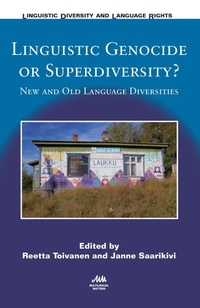
Linguistic Genocide or Superdiversity?
New and Old Language Diversities
Published on 26. July 2016
383 pages
978-1-78309-607-7 (ISBN)
Description

Are we facing an immense wave of language death or a period of remarkable new linguistic variation? Or both? This book answers this question by analysing studies of language endangerment and loss along with those of language change, revitalization and diversity. Using case studies from Russia and the EU, the authors compare historical language variation to that of the present day, arguing that accelerated language extinction can be considered a result of colonization, modernization and globalization, but so too can many new creoles, intertwined and mixed languages, new ethnic identities, new groups of urban dwellers or migrant groups, all with their own distinct cultural traits. The book therefore surmises that the linguistic heritage of today is simultaneously more endangered and more diverse than ever before.
Reviews / Votes
This inspiring collection of chapters thematizes ethnic and linguistic variation as they are experienced today in a variety of contexts characterized by accelerating urbanization, rising literacy and the spread of new media. The book campaigns successfully for a freshly optimistic perspective on the future of the world's linguistic diversity. * Anneli Sarhimaa, Johannes Gutenberg-Universitaet Mainz, Germany * This innovative collection provides a ground-breaking look at not only language loss, but also the emergence of new kinds of linguistic variation that develop in the context of language ecologies undergoing shift. An emphasis on case studies in the under-researched arena of languages in contact with Russian provides fresh perspectives in this invaluable volume. * Lenore Grenoble, The University of Chicago, USA * In the mainstream of today's research of language endangerment, Linguistic Genocide or Superdiversity? is a refreshing and optimistic read against the gloomy background of dozens of books predicting the inevitable disappearance of all languages except English. With Foley's metaphor of 'language birth' in mind, the authors suggest interesting alternatives to another widespread metaphor, that of 'language death'. -- Nikolai Vakhtin, European University at St Petersburg, Russia This volume constitutes an important intervention into linguistic and linguistic anthropological discussions about the nature of and prospects for linguistic diversity in a context of globalization. The editors of the book have worked to draw together the two primary - and seemingly opposite - approaches to understanding the contemporary global sociolinguistic landscape, and convincingly articulate the case for unifying the two ideas. -- Sarah Shulist, MacEwan University, Canada * LINGUIST List 28.2314 * The book, with its multitude of case studies, represents a useful resourcefor anyonewanting to gain a detailed insight into the wide range of diversities across
Europe. -- Katharina Prochazka, University of Vienna, Austria * Language in Society 47:2 (2018) *
More details
Series
Language
English
Place of publication
Bristol
United Kingdom
Publishing group
Channel View Publications Ltd
Target group
Professional and scholarly
ISBN-13
978-1-78309-607-7 (9781783096077)
Copyright in bibliographic data and cover images is held by Nielsen Book Services Limited or by the publishers or by their respective licensors: all rights reserved.
Schweitzer Classification
Other editions
Additional editions
Reetta Toivanen | Janne Saarikivi
Linguistic Genocide or Superdiversity?
New and Old Language Diversities
Book
07/2016
Multilingual Matters
€163.50
Shipment within 10-20 days
Persons
Reetta Toivanen is an Adjunct Professor for social and cultural anthropology and a Finnish Academy Research Fellow at the Erik Castren Institute of International Law and Human Rights at the University of Helsinki, Finland. Her main research interests are ethnic and language minorities, indigenous peoples, minority rights, revitalization and politics of recognition.
Janne Saarikivi is a Fellow at the Helsinki Collegium for Advanced Studies, University of Helsinki, Finland. His research interests include historical linguistics, sociolinguistics and Finno-Ugrian languages.
Janne Saarikivi is a Fellow at the Helsinki Collegium for Advanced Studies, University of Helsinki, Finland. His research interests include historical linguistics, sociolinguistics and Finno-Ugrian languages.
Content
0. Reetta Toivanen and Janne Saarikivi: Introduction to New and Old Language Diversities in
Russia and Europe: Language Endangerment, Variation and Change in Minority Communities in Flux
I Language Communities or Networks of Communication? Old and New Linguistic Diversity
1. Niko Partanen and Janne Saarikivi: Fragmentation of the Karelian Language and Its Community: Growing Variation at the Threshold of Language Shift
2. Heini Lehtonen: What's Up Helsinki? New Linguistic Diversity Among Adolescents
3. Boglarka Janurik: Varieties of Erzya-Russian Code-Switching In Radio Vaygel Broadcasts
4. Christian Pischloeger: Udmurt and Welsh on Social Network Sites
II Standardizing Languages and Ethnicities: Mission Impossible?
5. Hanna Lantto: A Tale of a City and Its Two Languages: A History of Bilingual Practices In the City Of Bilbao
6. Oksana Myshlovska: Nationalizing Fluid and Ambiguous Identities: Russia, Western Ukraine and their Ukrainian and Russian Minorities, Diasporas and 'Compatriots Abroad'
7. Erika Sarivaara: Emergent Sami Identities - From Assimilation towards Revitalization
8. Reetta Toivanen: Localizing the Global In the Superdiverse Municipalities in The
Artic: The Case of Inari
III Language Revitalization: Protection Standards or Tolerance for Variation
9. Konstantin Zamyatin: Russia's Minority Education and the European Language Charter
10. Johanna Laakso: Metadiversity, Or the Uniqueness of the Lambs
11. Ulriikka Puura and Outi Tanczos: Division of Responsibility in Karelian and Veps Language Revitalization Discourse
12. Svetlana Edygarova: Standard Language Ideology and Minority Languages: The Case Of The Permian Languages of Russia
Russia and Europe: Language Endangerment, Variation and Change in Minority Communities in Flux
I Language Communities or Networks of Communication? Old and New Linguistic Diversity
1. Niko Partanen and Janne Saarikivi: Fragmentation of the Karelian Language and Its Community: Growing Variation at the Threshold of Language Shift
2. Heini Lehtonen: What's Up Helsinki? New Linguistic Diversity Among Adolescents
3. Boglarka Janurik: Varieties of Erzya-Russian Code-Switching In Radio Vaygel Broadcasts
4. Christian Pischloeger: Udmurt and Welsh on Social Network Sites
II Standardizing Languages and Ethnicities: Mission Impossible?
5. Hanna Lantto: A Tale of a City and Its Two Languages: A History of Bilingual Practices In the City Of Bilbao
6. Oksana Myshlovska: Nationalizing Fluid and Ambiguous Identities: Russia, Western Ukraine and their Ukrainian and Russian Minorities, Diasporas and 'Compatriots Abroad'
7. Erika Sarivaara: Emergent Sami Identities - From Assimilation towards Revitalization
8. Reetta Toivanen: Localizing the Global In the Superdiverse Municipalities in The
Artic: The Case of Inari
III Language Revitalization: Protection Standards or Tolerance for Variation
9. Konstantin Zamyatin: Russia's Minority Education and the European Language Charter
10. Johanna Laakso: Metadiversity, Or the Uniqueness of the Lambs
11. Ulriikka Puura and Outi Tanczos: Division of Responsibility in Karelian and Veps Language Revitalization Discourse
12. Svetlana Edygarova: Standard Language Ideology and Minority Languages: The Case Of The Permian Languages of Russia
