

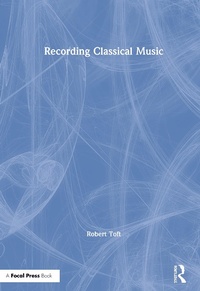
Recording Classical Music
1st Edition
Published on 4. September 2019
180 pages
978-1-351-21376-9 (ISBN)
Description

Recording Classical Music presents the fundamental principles of digitally recording and editing acoustic music in ambient spaces, focusing on stereo microphone techniques that will help musicians understand how to translate "live" environments into recorded sound.
The book covers theory and the technical aspects of recording from sound source to delivery: the nature of soundwaves and their behavior in rooms, microphone types and the techniques of recording in stereo, proximity and phase, file types, tracking and critical listening, loudness, meters, and the post-production processes of EQ, control of dynamic range (compressors, limiters, dynamic EQ, de-essers), and reverberation (both digital reflection simulation and convolution), with some discussion of commercially available digital plugins. The final part of the book applies this knowledge to common recording situations, showcasing not only strategies for recording soloists and small ensembles, along with case studies of several recordings, but also studio techniques that can enhance or replace the capture of performances in ambient spaces, such as close miking and the addition of artificial reverberation.
Recording Classical Music provides the tools necessary for anyone interested in classical music production to track, mix, and deliver audio recordings themselves or to supervise the work of others.
The book covers theory and the technical aspects of recording from sound source to delivery: the nature of soundwaves and their behavior in rooms, microphone types and the techniques of recording in stereo, proximity and phase, file types, tracking and critical listening, loudness, meters, and the post-production processes of EQ, control of dynamic range (compressors, limiters, dynamic EQ, de-essers), and reverberation (both digital reflection simulation and convolution), with some discussion of commercially available digital plugins. The final part of the book applies this knowledge to common recording situations, showcasing not only strategies for recording soloists and small ensembles, along with case studies of several recordings, but also studio techniques that can enhance or replace the capture of performances in ambient spaces, such as close miking and the addition of artificial reverberation.
Recording Classical Music provides the tools necessary for anyone interested in classical music production to track, mix, and deliver audio recordings themselves or to supervise the work of others.
Reviews / Votes
"This book is packed with informed and useful information. If you need to know about how sound works, and read tons of information about how classical music is recorded in the real world, then you must read this book. Perfect for anyone interested in classical music." - Paul Baily - classical recording and post production, Re:SoundMore details
Edition
1. Auflage
Language
English
Place of publication
Oxford
United Kingdom
Publishing group
Taylor & Francis Ltd
Target group
College/higher education
Professional and scholarly
Product notice
Reflowable
Illustrations
7 Tables, black and white; 76 Line drawings, black and white; 44 Halftones, black and white
ISBN-13
978-1-351-21376-9 (9781351213769)
Copyright in bibliographic data and cover images is held by Nielsen Book Services Limited or by the publishers or by their respective licensors: all rights reserved.
Schweitzer Classification
Other editions
Additional editions
Robert Toft
Recording Classical Music
Book
12/2019
Taylor & Francis
Unfortunately, price unknown
Available (delivery time upon request)
Robert Toft
Recording Classical Music
Book
09/2019
1st Edition
CRC Press
€204.90
Shipment within 15-20 days
Robert Toft
Recording Classical Music
Book
09/2019
1st Edition
CRC Press
€59.30
Shipment within 15-20 days
Person
Robert Toft teaches in the Don Wright Faculty of Music at Western University, Canada. His interests revolve around the notion of research informing practice, and he specializes in both recording practices and the history of singing. He has written five books on historically informed vocal performance and has given master classes at leading conservatories and universities in Australia, Austria, Britain, Canada, Germany, Ireland, Switzerland, and the USA. Robert's production company, Talbot Records, released its first recording in 2017. Inspired by the intensely dramatic performing styles of the sixteenth to nineteenth centuries, its main series, Radically Hip, connects modern audiences to the impassioned eloquence of the past.
Content
Part 1, Fundamental Principles
1 Soundwaves
Enclosed Spaces
Performance Venues
2 Audio Chain from Sound Source to Listener
Integrity within an Audio Chain
Basic Concepts and Terminology
Part 2, Production
3 Microphone Types
The Behavior of a Pure Diaphragm
Condenser Microphones
Dynamic and Ribbon Microphones
4 Microphone Characteristics
Frequency Response
Directional (Polar) Patterns
Random Energy Efficiency
Distance Factor
Proximity Effect
Phase
5 Stereo Microphone Techniques
Coincident Pairs
Near-Coincident Arrays
Spaced Microphones
6 Tracking
Critical Listening
Setting Levels
Room Ambience
Part 3, Post-Production
7 EQ - Frequency Balance
Digital Filters
Common Practices
8 Control of Dynamic Range
Compressors
Limiters
Dynamic EQ
De-essers
9 Reverberation
Digital Reflection Simulation
Convolution
10 Delivery
File Types
Loudness and Meters
Part 4, Common Recording Strategies
11 Solo Piano
Recording in Stereo
Unfavorable Room Acoustics
12 Soloists with Piano Accompaniment
13 Small Ensembles
14 Sessions
Solo Piano
Solo Cello
Double Bass and Piano
15 Studio Techniques: Re-Creating the Aural Sense of Historic Spaces
Pre-Production
Production
Post-Production
1 Soundwaves
Enclosed Spaces
Performance Venues
2 Audio Chain from Sound Source to Listener
Integrity within an Audio Chain
Basic Concepts and Terminology
Part 2, Production
3 Microphone Types
The Behavior of a Pure Diaphragm
Condenser Microphones
Dynamic and Ribbon Microphones
4 Microphone Characteristics
Frequency Response
Directional (Polar) Patterns
Random Energy Efficiency
Distance Factor
Proximity Effect
Phase
5 Stereo Microphone Techniques
Coincident Pairs
Near-Coincident Arrays
Spaced Microphones
6 Tracking
Critical Listening
Setting Levels
Room Ambience
Part 3, Post-Production
7 EQ - Frequency Balance
Digital Filters
Common Practices
8 Control of Dynamic Range
Compressors
Limiters
Dynamic EQ
De-essers
9 Reverberation
Digital Reflection Simulation
Convolution
10 Delivery
File Types
Loudness and Meters
Part 4, Common Recording Strategies
11 Solo Piano
Recording in Stereo
Unfavorable Room Acoustics
12 Soloists with Piano Accompaniment
13 Small Ensembles
14 Sessions
Solo Piano
Solo Cello
Double Bass and Piano
15 Studio Techniques: Re-Creating the Aural Sense of Historic Spaces
Pre-Production
Production
Post-Production
