

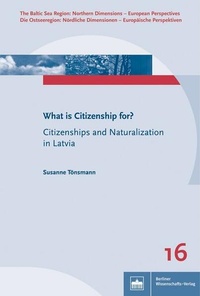
What is Citizenship for?
Citizenships and Naturalization in Latvia
1st Edition
Published on 22. June 2017
218 pages
978-3-8305-2187-7 (ISBN)
Description

Citizenship is considered a core ingredient of democracy and provides an indeed valuable status: Having citizenship means, amongst other things, having the right to vote, belonging to a state and being able to show a passport when crossing a border. What happens, though, when citizenship is not a given but an option? After the collapse of the Soviet Union, a sizeable part of Latvia's population was left without citizenship. Their willingness to naturalize has been lower than expected - a situation that challenges our understanding of citizenship as a desirable status.°°°°What makes citizenship attractive for people? Why does the state want to have citizens and not only residents? Conceiving citizenship as a relation between an individual and a particular state, this book addresses different dimensions of citizenship. Firmly rooted in citizenship theory, the author presents answers to the question "What is citizenship for?" and provides a nuanced analysis of the development of Latvian citizenship policies.°°
More details
Other editions
Additional editions
Book
03/2017
1st Edition
Berliner Wissenschafts-Verlag
€49.00
Shipment within 7-9 days
Person
Content
- Intro
- Acknowledgments
- Contents
- List of figures
- List of abbreviations
- Chapter One: Introduction
- The problem
- Approach and methods
- Results and contribution
- Structure of the book
- Chapter Two: The puzzle
- What happens to citizens when a state ceases to exist?
- What happens when citizenship becomes an option?
- Puzzle No. 1
- Puzzle No. 2
- Chapter Three: Integrating the 'what' and the 'why'
- Citizenship is an instrument of inclusion and exclusion
- Citizenship is a bundle of rights, membership, practices, and duties
- The 'why' lens: Naturalization
- Naturalization as something that states do
- Socioeconomic and non-socioeconomic approaches
- Qualities of naturalization
- Chapter Four: Asking 'why' about 'what'
- Assumptions, concepts and terms
- Why I look at both the state and people
- Dimensions of citizenship and hypotheses
- Conclusion
- Chapter Five: Methods and data
- Researching the state's use of citizenship
- Perspectives of non-citizens
- Chapter Six: Rights
- The establishment of the citizenry
- The establishment of the non-citizenry
- Rights matter, not the status they are tied to
- Is non-citizenship rights-granting or rights-limiting?
- Becoming a citizen: Naturalization
- Differences in rights between Latvian citizens and Latvian non-citizens
- Conclusion
- Chapter Seven: Membership
- Membership/citizenship for special merit
- Dual citizenship
- The old exile
- The new exile
- Does a sense of membership influence people's naturalization?
- Conclusion
- Chapter Eight: Duties
- Language
- History
- Loyalty/Patriotism
- Conclusion
- Chapter Nine: It's (just) the benefits, stupid
- Benefits of citizenship: Officials' perspectives
- Benefits of non-citizenship: Officials' perspectives
- Benefits of citizenship: Non-citizens' perspectives
- Benefits of non-citizenship: Non-citizens' perspectives
- Chapter Ten: How naturalization prevents naturalization
- How institutions and officials encourage naturalization
- How citizens are made
- Citizenship prestige
- Naturalization is so easy, why don't they do it?
- Is naturalization really so liberal and accessible?
- Naturalization from the perspective of non-citizens
- Chapter Eleven: Conclusion
- References
- List of Interviews
