

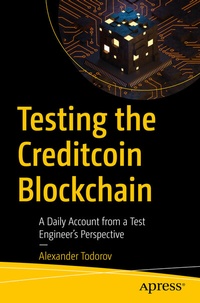
Testing the Creditcoin Blockchain
Description

Follow the quality engineering journey of the Creditcoin blockchain across four distinct implementation versions and a myriad of technologies. Through the eyes of a test engineer, this book discusses testing implementations with the Hyperledger Sawtooth and Substrate frameworks, testing switch from proof-of-work to proof-of-stake consensus algorithm, and testing an Ethereum Virtual Machine compatibility layer.
You'll traverse several years of fast-paced multiple blockchain implementations and technological changes including an explanation of all major components involved, and the approach taken. You'll also look at examples of test automation approaches and tools, interesting bugs, and testing challenges.
Most everything discussed in Testing the Creditcoin Blockchain is open source, ensuring easy access, and multiple references to source code and GitHub are included throughout.
Who This Book Is For
Software testers and quality engineers with limited experience working on a blockchain implementation.
What You Will Learn
- Study the many of the components of a distributed blockchain network.
- See how components work and where testing can be plugged into a distributed blockchain network environment.
- Glimpse into the daily blockchain testing activities of a principal test engineer.
- Become familiar with a fast-paced technical software development project.
More details
Other editions
Additional editions
Person
Alex is quality assurance engineer and ISTQB and Red Hat Certified professional with two decades of industry experience as an open source hacker with thousands of contributions, a Python instructor, and co-organizer of FOSDEM's Testing and Continuous Delivery devroom. He's also tested multiple components of Red Hat Enterprise Linux, was a test lead for the entire lifecycle of its version 5 family, and later tested various components of the Creditcoin blockchain.
Alex holds a Master's degree in Computer Engineering from the Technical University of Sofia, Bulgaria and loves public speaking and riding fast motorcycles. In his spare time, he's the lead engineer behind Kiwi TCMS, a popular open source test management system.
You can find Alex on LinkedIn, www.linkedin.com/in/alextodorov/ and follow his work directly on GitHub via www.github.com/atodorov.
Content
Part 1 Introduction to blockchain.- Chapter 1: Introduction to blockchain.- Chapter 2: Blockchain development frameworks.- Part 2 The Creditcoin Blockchain - Aims and objectives.- Chapter 3: The Creditcoin Blockchain.- Part 3 Testing the Creditcoin Blockchain.- Chapter 4: Creditcoin 1.x.- Chapter 5: Creditcoin 2.0.- Chapter 6: Creditcoin 2.3.- Chapter 7: Creditcoin 3.0.- Part 4 Blockchain testing approaches.- Chapter 8: My blockchain testing approach.- Chapter 9: Conclusions.
