

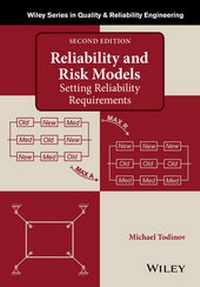
Reliability and Risk Models
Description

More details
Other editions
Additional editions
Person
Content
Series Preface xvii
Preface xix
1 Failure Modes: Building Reliability Networks 1
1.1 Failure Modes 1
1.2 Series and Parallel Arrangement of the Components in a Reliability Network 5
1.3 Building Reliability Networks: Difference between a Physical and Logical Arrangement 6
1.4 Complex Reliability Networks Which Cannot Be Presented as a Combination of Series and Parallel Arrangements 10
1.5 Drawbacks of the Traditional Representation of the Reliability Block Diagrams 11
1.5.1 Reliability Networks Which Require More Than a Single Terminal Node 11
1.5.2 Reliability Networks Which Require the Use of Undirected Edges Only,
Directed Edges Only or a Mixture of Undirected and Directed Edges 13
1.5.3 Reliability Networks Which Require Different Edges Referring to the Same Component 16
1.5.4 Reliability Networks Which Require Negative-State Components 17
2 Basic Concepts 21
2.1 Reliability (Survival) Function, Cumulative Distribution and Probability Density Function of the Times to Failure 21
2.2 Random Events in Reliability and Risk Modelling 23
2.2.1 Reliability and Risk Modelling Using Intersection of Statistically Independent Random Events 23
2.2.2 Reliability and Risk Modelling Using a Union of Mutually Exclusive Random Events 25
2.2.3 Reliability of a System with Components Logically Arranged in Series 27
2.2.4 Reliability of a System with Components Logically Arranged in Parallel 29
2.2.5 Reliability of a System with Components Logically Arranged in Series and Parallel 31
2.2.6 Using Finite Sets to Infer Component Reliability 32
2.3 Statistically Dependent Events and Conditional Probability in Reliability and Risk Modelling 33
2.4 Total Probability Theorem in Reliability and Risk Modelling. Reliability of Systems with Complex Reliability Networks 36
2.5 Reliability and Risk Modelling Using Bayesian Transform and Bayesian Updating 43
2.5.1 Bayesian Transform 43
2.5.2 Bayesian Updating 44
3 Common Reliability and Risk Models and Their Applications 47
3.1 General Framework for Reliability and Risk Analysis Based on Controlling Random Variables 47
3.2 Binomial Model 48
3.2.1 Application: A Voting System 52
3.3 Homogeneous Poisson Process and Poisson Distribution 53
3.4 Negative Exponential Distribution 56
3.4.1 Memoryless Property of the Negative Exponential Distribution 57
3.5 Hazard Rate 58
3.5.1 Difference between Failure Density and Hazard Rate 60
3.5.2 Reliability of a Series Arrangement Including Components with Constant Hazard Rates 61
3.6 Mean Time to Failure 61
3.7 Gamma Distribution 63
3.8 Uncertainty Associated with the MTTF 65
3.9 Mean Time between Failures 67
3.10 Problems with the MTTF and MTBF Reliability Measures 67
3.11 BX% Life 68
3.12 Minimum Failure-Free Operation Period 69
3.13 Availability 70
3.13.1 Availability on Demand 70
3.13.2 Production Availability 71
3.14 Uniform Distribution Model 72
3.15 Normal (Gaussian) Distribution Model 73
3.16 Log-Normal Distribution Model 77
3.17 Weibull Distribution Model of the Time to Failure 79
3.18 Extreme Value Distribution Model 81
3.19 Reliability Bathtub Curve 82
4 Reliability and Risk Models Based on Distribution Mixtures 87
4.1 Distribution of a Property from Multiple Sources 87
4.2 Variance of a Property from Multiple Sources 89
4.3 Variance Upper Bound Theorem 91
4.3.1 Determining the Source Whose Removal Results in the Largest Decrease of the Variance Upper Bound 92
4.4 Applications of the Variance Upper Bound Theorem 93
4.4.1 Using the Variance Upper Bound Theorem for Increasing the Robustness of Products and Processes 93
4.4.2 Using the Variance Upper Bound Theorem for Developing Six-Sigma Products and Processes 97
Appendix 4.1: Derivation of the Variance Upper Bound Theorem 99
Appendix 4.2: An Algorithm for Determining the Upper Bound of the Variance of Properties from Sampling Multiple Sources 101
5 Building Reliability and Risk Models 103
5.1 General Rules for Reliability Data Analysis 103
5.2 Probability Plotting 107
5.2.1 Testing for Consistency with the Uniform Distribution Model 109
5.2.2 Testing for Consistency with the Exponential Model 109
5.2.3 Testing for Consistency with the Weibull Distribution 110
5.2.4 Testing for Consistency with the Type I Extreme Value Distribution 111
5.2.5 Testing for Consistency with the Normal Distribution 111
5.3 Estimating Model Parameters Using the Method of Maximum Likelihood 113
5.4 Estimating the Parameters of a Three-Parameter Power Law 114
5.4.1 Some Applications of the Three-Parameter Power Law 116
6 Load-Strength (Demand-Capacity) Models 119
6.1 A General Reliability Model 119
6.2 The Load-Strength Interference Model 120
6.3 Load-Strength (Demand-Capacity) Integrals 122
6.4 Evaluating the Load-Strength Integral Using Numerical Methods 124
6.5 Normally Distributed and Statistically Independent Load and Strength 125
6.6 Reliability and Risk Analysis Based on the Load-Strength Interference Approach 130
6.6.1 Influence of Strength Variability on Reliability 130
6.6.2 Critical Weaknesses of the Traditional Reliability Measures 'Safety Margin' and 'Loading Roughness' 134
6.6.3 Interaction between the Upper Tail of the Load Distribution and the Lower Tail of the Strength Distribution 136
7 Overstress Reliability Integral and Damage Factorisation Law 139
7.1 Reliability Associated with Overstress Failure Mechanisms 139
7.1.1 The Link between the Negative Exponential Distribution and the Overstress Reliability Integral 141
7.2 Damage Factorisation Law 143
8 Solving Reliability and Risk Models Using a Monte Carlo Simulation 147
8.1 Monte Carlo Simulation Algorithms 147
8.1.1 Monte Carlo Simulation and the Weak Law of Large Numbers 147
8.1.2 Monte Carlo Simulation and the Central Limit Theorem 149
8.1.3 Adopted Conventions in Describing the Monte Carlo Simulation Algorithms 149
8.2 Simulation of Random Variables 151
8.2.1 Simulation of a Uniformly Distributed Random Variable 151
8.2.2 Generation of a Random Subset 152
8.2.3 Inverse Transformation Method for Simulation of Continuous Random Variables 153
8.2.4 Simulation of a Random Variable following the Negative Exponential Distribution 154
8.2.5 Simulation of a Random Variable following the Gamma Distribution 154
8.2.6 Simulation of a Random Variable following a Homogeneous Poisson Process in a Finite Interval 155
8.2.7 Simulation of a Discrete Random Variable with a Specified Distribution 156
8.2.8 Selection of a Point at Random in the N-Dimensional Space Region 157
8.2.9 Simulation of Random Locations following a Homogeneous Poisson Process in a Finite Domain 158
8.2.10 Simulation of a Random Direction in Space 158
8.2.11 Generating Random Points on a Disc and in a Sphere 160
8.2.12 Simulation of a Random Variable following the Three-Parameter Weibull Distribution 162
8.2.13 Simulation of a Random Variable following the Maximum Extreme Value Distribution 162
8.2.14 Simulation of a Gaussian Random Variable 162
8.2.15 Simulation of a Log-Normal Random Variable 163
8.2.16 Conditional Probability Technique for Bivariate Sampling 164
8.2.17 Von Neumann's Method for Sampling Continuous Random Variables 165
8.2.18 Sampling from a Mixture Distribution 166
Appendix 8.1 166
9 Evaluating Reliability and Probability of a Faulty Assembly Using Monte Carlo Simulation 169
9.1 A General Algorithm for Determining Reliability Controlled by Statistically Independent Random Variables 169
9.2 Evaluation of the Reliability Controlled by a Load-Strength Interference 170
9.2.1 Evaluation of the Reliability on Demand, with No Time Included 170
9.2.2 Evaluation of the Reliability Controlled by Random Shocks on a Time Interval 171
9.3 A Virtual Testing Method for Determining the Probability of Faulty Assembly 173
9.4 Optimal Replacement to Minimise the Probability of a System Failure 177
10 Evaluating the Reliability of Complex Systems and Virtual Accelerated Life Testing Using Monte Carlo Simulation 181
10.1 Evaluating the Reliability of Complex Systems 181
10.2 Virtual Accelerated Life Testing of Complex Systems 183
10.2.1 Acceleration Stresses and Their Impact on the Time to Failure of Components 183
10.2.2 Arrhenius Stress-Life Relationship and Arrhenius-Type Acceleration Life Models 185
10.2.3 Inverse Power Law Relationship and Inverse Power Law-Type Acceleration Life Models 185
10.2.4 Eyring Stress-Life Relationship and Eyring-Type Acceleration Life Models 185
11 Generic Principles for Reducing Technical Risk 189
11.1 Preventive Principles: Reducing Mainly the Likelihood of Failure 191
11.1.1 Building in High Reliability in Processes, Components and Systems with Large Failure Consequences 191
11.1.2 Simplifying at a System and Component Level 192
11.1.2.1 Reducing the Number of Moving Parts 193
11.1.3 Root Cause Failure Analysis 193
11.1.4 Identifying and Removing Potential Failure Modes 194
11.1.5 Mitigating the Harmful Effect of the Environment 194
11.1.6 Building in Redundancy 195
11.1.7 Reliability and Risk Modelling and Optimisation 197
11.1.7.1 Building and Analysing Comparative Reliability Models 197
11.1.7.2 Building and Analysing Physics of Failure Models 198
11.1.7.3 Minimising Technical Risk through Optimisation and Optimal Replacement 199
11.1.7.4 Maximising System Reliability and Availability by Appropriate Permutations of Interchangeable Components 199
11.1.7.5 Maximising the Availability and Throughput Flow Reliability by Altering the Network Topology 199
11.1.8 Reducing Variability of Risk-Critical Parameters and Preventing them from Reaching Dangerous Values 199
11.1.9 Altering the Component Geometry 200
11.1.10 Strengthening or Eliminating Weak Links 201
11.1.11 Eliminating Factors Promoting Human Errors 202
11.1.12 Reducing Risk by Introducing Inverse States 203
11.1.12.1 Inverse States Cancelling the Anticipated State with a Negative Impact 203
11.1.12.2 Inverse States Buffering the Anticipated State with a Negative Impact 203
11.1.12.3 Inverting the Relative Position of Objects and the Direction of Flows 204
11.1.12.4 Inverse State as a Counterbalancing Force 205
11.1.13 Failure Prevention Interlocks 206
11.1.14 Reducing the Number of Latent Faults 206
11.1.15 Increasing the Level of Balancing 208
11.1.16 Reducing the Negative Impact of Temperature by Thermal Design 209
11.1.17 Self-Stability 211
11.1.18 Maintaining the Continuity of a Working State 212
11.1.19 Substituting Mechanical Assemblies with Electrical, Optical or Acoustic Assemblies and Software 212
11.1.20 Improving the Load Distribution 212
11.1.21 Reducing the Sensitivity of Designs to the Variation of Design Parameters 212
11.1.22 Vibration Control 216
11.1.23 Built-In Prevention 216
11.2 Dual Principles: Reduce Both the Likelihood of Failure and the Magnitude of Consequences 217
11.2.1 Separating Critical Properties, Functions and Factors 217
11.2.2 Reducing the Likelihood of Unfavourable Combinations of Risk-Critical Random Variables 218
11.2.3 Condition Monitoring 219
11.2.4 Reducing the Time of Exposure or the Space of Exposure 219
11.2.4.1 Time of Exposure 219
11.2.4.2 Length of Exposure and Space of Exposure 220
11.2.5 Discovering and Eliminating a Common Cause: Diversity in Design 220
11.2.6 Eliminating Vulnerabilities 222
11.2.7 Self-Reinforcement 223
11.2.8 Using Available Local Resources 223
11.2.9 Derating 224
11.2.10 Selecting Appropriate Materials and Microstructures 225
11.2.11 Segmentation 225
11.2.11.1 Segmentation Improves the Load Distribution 225
11.2.11.2 Segmentation Reduces the Vulnerability to a Single Failure 225
11.2.11.3 Segmentation Reduces the Damage Escalation 226
11.2.11.4 Segmentation Limits the Hazard Potential 226
11.2.12 Reducing the Vulnerability of Targets 226
11.2.13 Making Zones Experiencing High Damage/Failure Rates Replaceable 227
11.2.14 Reducing the Hazard Potential 227
11.2.15 Integrated Risk Management 227
11.3 Protective Principles: Minimise the Consequences of Failure 229
11.3.1 Fault-Tolerant System Design 229
11.3.2 Preventing Damage Escalation and Reducing the Rate of Deterioration 229
11.3.3 Using Fail-Safe Designs 230
11.3.4 Deliberately Designed Weak Links 231
11.3.5 Built-In Protection 231
11.3.6 Troubleshooting Procedures and Systems 232
11.3.7 Simulation of the Consequences from Failure 232
11.3.8 Risk Planning and Training 233
12 Physics of Failure Models 235
12.1 Fast Fracture 235
12.1.1 Fast Fracture: Driving Forces behind Fast Fracture 235
12.1.2 Reducing the Likelihood of Fast Fracture 241
12.1.2.1 Basic Ways of Reducing the Likelihood of Fast Fracture 242
12.1.2.2 Avoidance of Stress Raisers or Mitigating Their Harmful Effect 244
12.1.2.3 Selecting Materials Which Fail in a Ductile Fashion 245
12.1.3 Reducing the Consequences of Fast Fracture 247
12.1.3.1 By Using Fail-Safe Designs 247
12.1.3.2 By Using Crack Arrestors 250
12.2 Fatigue Fracture 251
12.2.1 Reducing the Risk of Fatigue Fracture 257
12.2.1.1 Reducing the Size of the Flaws 257
12.2.1.2 Increasing the Final Fatigue Crack Length by Selecting Material with a Higher Fracture Toughness 257
12.2.1.3 Reducing the Stress Range by an Appropriate Design 257
12.2.1.4 Reducing the Stress Range by Restricting the Springback of Elastic Components 258
12.2.1.5 Reducing the Stress Range by Reducing the Magnitude of Thermal Stresses 259
12.2.1.6 Reducing the Stress Range by Introducing Compressive Residual Stresses at the Surface 261
12.2.1.7 Reducing the Stress Range by Avoiding Excessive Bending 262
12.2.1.8 Reducing the Stress Range by Avoiding Stress Concentrators 263
12.2.1.9 Improving the Condition of the Surface and Eliminating Low-Strength Surfaces 263
12.2.1.10 Increasing the Fatigue Life of Automotive Suspension Springs 264
12.3 Early-Life Failures 265
12.3.1 Influence of the Design on Early-Life Failures 265
12.3.2 Influence of the Variability of Critical Design Parameters on Early-Life Failures 266
13 Probability of Failure Initiated by Flaws 269
13.1 Distribution of the Minimum Fracture Stress and a Mathematical Formulation of the Weakest-Link Concept 269
13.2 The Stress Hazard Density as an Alternative of the Weibull Distribution 274
13.3 General Equation Related to the Probability of Failure of a Stressed Component with Complex Shape 276
13.4 Link between the Stress Hazard Density and the Conditional Individual Probability of Initiating Failure 278
13.5 Probability of Failure Initiated by Defects in Components with Complex Shape 279
13.6 Limiting the Vulnerability of Designs to Failure Caused by Flaws 280
14 A Comparative Method for Improving the Reliability and Availability of Components and Systems 283
14.1 Advantages of the Comparative Method to Traditional Methods 283
14.2 A Comparative Method for Improving the Reliability of Components Whose Failure is Initiated by Flaws 285
14.3 A Comparative Method for Improving System Reliability 289
14.4 A Comparative Method for Improving the Availability of Flow Networks 290
15 Reliability Governed by the Relative Locations of Random Variables in a Finite Domain 293
15.1 Reliability Dependent on the Relative Configurations of Random Variables 293
15.2 A Generic Equation Related to Reliability Dependent on the Relative Locations of a Fixed Number of Random Variables 293
15.3 A Given Number of Uniformly Distributed Random Variables in a Finite Interval (Conditional Case) 297
15.4 Probability of Clustering of a Fixed Number Uniformly Distributed Random Events 298
15.5 Probability of Unsatisfied Demand in the Case of One Available Source and Many Consumers 302
15.6 Reliability Governed by the Relative Locations of Random Variables following a Homogeneous Poisson Process in a Finite Domain 304
Appendix 15.1 305
16 Reliability and Risk Dependent on the Existence of Minimum Separation Intervals between the Locations of Random Variables on a Finite Interval 307
16.1 Applications Requiring Minimum Separation Intervals and Minimum Failure-Free Operating Periods 307
16.2 Minimum Separation Intervals and Rolling MFFOP Reliability Measures 309
16.3 General Equations Related to Random Variables following a Homogeneous Poisson Process in a Finite Interval 310
16.4 Application Examples 312
16.4.1 Setting Reliability Requirements to Guarantee a Specified MFFOP 312
16.4.2 Reliability Assurance That a Specified MFFOP Has Been Met 312
0002547085.indd 13 8/18/2015 6:29:01 PM
xiv Contents
16.4.3 Specifying a Number Density Envelope to Guarantee Probability
of Unsatisfied Random Demand below a Maximum Acceptable Level 314
16.4.4 Insensitivity of the Probability of Unsatisfied Demand to the Variance of the Demand Time 315
16.5 Setting Reliability Requirements to Guarantee a Rolling MFFOP Followed by a Downtime 317
16.6 Setting Reliability Requirements to Guarantee an Availability Target 320
16.7 Closed-Form Expression for the Expected Fraction of the Time of Unsatisfied Demand 323
17 Reliability Analysis and Setting Reliability Requirements Based on the Cost of Failure 327
17.1 The Need for a Cost-of-Failure-Based Approach 327
17.2 Risk of Failure 328
17.3 Setting Reliability Requirements Based on a Constant Cost of Failure 330
17.4 Drawbacks of the Expected Loss as a Measure of the Potential Loss from Failure 332
17.5 Potential Loss, Conditional Loss and Risk of Failure 333
17.6 Risk Associated with Multiple Failure Modes 336
17.6.1 An Important Special Case 337
17.7 Expected Potential Loss Associated with Repairable Systems Whose Component Failures Follow a Homogeneous Poisson Process 338
17.8 A Counterexample Related to Repairable Systems 341
17.9 Guaranteeing Multiple Reliability Requirements for Systems with Components Logically Arranged in Series 342
18 Potential Loss, Potential Profit and Risk 345
18.1 Deficiencies of the Maximum Expected Profit Criterion in Selecting a Risky Prospect 345
18.2 Risk of a Net Loss and Expected Potential Reward Associated with a Limited Number of Statistically Independent Risk-Reward Bets in a Risky Prospect 346
18.3 Probability and Risk of a Net Loss Associated with a Small Number of Opportunity Bets 348
18.4 Samuelson's Sequence of Good Bets Revisited 351
18.5 Variation of the Risk of a Net Loss Associated with a Small Number of Opportunity Bets 352
18.6 Distribution of the Potential Profit from a Limited Number of Risk-Reward Activities 353
19 Optimal Allocation of Limited Resources among Discrete Risk Reduction Options 357
19.1 Statement of the Problem 357
19.2 Weaknesses of the Standard (0-1) Knapsack Dynamic Programming Approach 359
19.2.1 A Counterexample 359
19.2.2 The New Formulation of the Optimal Safety Budget Allocation Problem 360
19.2.3 Dependence of the Removed System Risk on the Appropriate Selection of Combinations of Risk Reduction Options 361
19.2.4 A Dynamic Algorithm for Solving the Optimal Safety Budget Allocation Problem 365
19.3 Validation of the Model by a Recursive Backtracking 369
Appendix A 373
A.1 Random Events 373
A.2 Union of Events 375
A.3 Intersection of Events 376
A.4 Probability 378
A.5 Probability of a Union and Intersection of Mutually Exclusive Events 379
A.6 Conditional Probability 380
A.7 Probability of a Union of Non-disjoint Events 383
A.8 Statistically Dependent Events 384
A.9 Statistically Independent Events 384
A.10 Probability of a Union of Independent Events 385
A.11 Boolean Variables and Boolean Algebra 385
Appendix B 391
B.1 Random Variables: Basic Properties 391
B.2 Boolean Random Variables 392
B.3 Continuous Random Variables 392
B.4 Probability Density Function 392
B.5 Cumulative Distribution Function 393
B.6 Joint Distribution of Continuous Random Variables 393
B.7 Correlated Random Variables 394
B.8 Statistically Independent Random Variables 395
B.9 Properties of the Expectations and Variances of Random Variables 396
B.10 Important Theoretical Results Regarding the Sample Mean 397
Appendix C: Cumulative Distribution Function of the Standard Normal Distribution 399
Appendix D: ¿2-Distribution 401
References 407
Index 413
Preface
A common tendency in many texts devoted to reliability is to choose either a statistical-based approach to reliability or engineering-based approach. Reliability engineering, however, is neither reliability statistics nor solely engineering principles underlying reliable designs. Rather, it is an amalgam of reliability statistics, theoretical principles and techniques and engineering principles for developing reliable products and reducing technical risk. Furthermore, in the reliability literature, the emphasis is commonly placed on reliability prediction than reliability improvement. Accordingly, the intention of this second edition is to improve the balance between the statistical-based approach and the engineering-based approach.
To demonstrate the necessity of a balanced approach to reliability and engineering risk, a new chapter (Chapter 11) has been devoted exclusively to principles and techniques for improving reliability and reducing engineering risk. The need for unity between the statistical approach and the engineering approach is demonstrated by the formulated principles, some of which are rooted in reliability statistics, while others rely on purely engineering concepts. The diverse risk reduction principles prompt reliability and risk practitioners not to limit themselves to familiar ways of improving reliability and reducing risk (such as introducing redundancy) which might lead to solutions which are far from optimal.
Using appropriate combinations of statistical and physical principles brings a considerably larger effect. The outlined key principles for reducing the risk of failure can be applied with success not only in engineering but in diverse areas of the human activity, for example in environmental sciences, financial engineering, economics, medicine, etc.
Critical failures in many industries (e.g. in the nuclear or deep-water oil and gas industry) can have disastrous environmental and health consequences. Such failures entail loss of production for very long periods of time and extremely high costs of the intervention for repair. Consequently, for industries characterised by a high cost of failure, setting quantitative reliability requirements must be driven by the cost of failure. There is a view held even by some risk experts that there is no need for setting reliability requirements. The examples in Chapter 16 demonstrate the importance of reliability requirements not only for minimising the probability of unsatisfied demand below a maximum acceptable level but also for providing an optimal balance between reliability and cost. Furthermore, many technical failures with disastrous consequences to the environment could have been easily prevented by adopting cost-of-failure-based reliability requirements for critical components.
Common, as well as little known reliability and risk models and their applications are discussed. Thus, a powerful generic equation is introduced for determining the probability of safe/failure states dependent on the relative configuration of random variables, following a homogeneous Poisson process in a finite domain. Seemingly intractable reliability problems can be solved easily using this equation which reduces a complex reliability problem to simpler problems. The equation provides a basis for the new reliability measure introduced in Chapter 16, which consists of a combination of specified minimum separation distances between random variables in a finite interval and the probability with which they must exist. The new reliability measure is at the heart of a technology for setting quantitative reliability requirements based on minimum event-free operating periods or minimum failure-free operating periods (MFFOP). A number of important applications of the new reliability measure are also considered such as limiting the probability of a collision of demands from customers using particular resource for a specified time and the probability of overloading of supply systems from consumers connecting independently and randomly.
It is demonstrated that even for a small number of random demands in a finite time interval, the probability of clustering of two or more random demands within a critical distance is surprisingly high and should always be accounted for in risk assessments.
Substantial space in the book has been allocated for load-strength (demand-capacity) models and their applications. Common problems can easily be formulated and solved using the load-strength interference concept. On the basis of counterexamples, a point has been made that for non-Gaussian distributed load and strength, the popular reliability measures 'reliability index' and 'loading roughness' can be completely misleading. In Chapter 6, the load-strength interference model has been generalised, with the time included as a variable. The derived equation is in effect a powerful model for determining reliability associated with an overstress failure mechanism.
A number of new developments made by the author in the area of reliability and risk models since the publication of the first edition in 2005 have been reflected in the second edition. Such is, for example, the revision of the Weibull distribution as a model of the probability of failure of materials controlled by defects. On the basis of probabilistic reasoning, thought experiments and real experiments, it is demonstrated in Chapter 13 that contrary to the common belief for more than 60 years, the Weibull distribution is a fundamentally flawed model for the probability of failure of materials. The Weibull distribution, with its strictly increasing function, is incapable of approximating a constant probability of failure over a loading region. The present edition also features an alternative of the Weibull model based on an equation which does not use the notions 'flaws' and 'locally initiated failure by flaws'. The new equation is based on the novel concept 'hazard stress density'. A simple and easily reproduced experiment based on artificial flaws provides a strong and convincing experimental proof that the distribution of the minimum breaking strength associated with randomly distributed flaws does not follow a Weibull distribution.
Another important addition in the second edition is the comparative method for improving reliability introduced in Chapter 14. Calculating the absolute reliability built in a product is often an extremely difficult task because in many cases reliability-critical data (failure frequencies, strength distribution of the flaws, fracture mechanism, repair times) are simply unavailable for the system components. Furthermore, calculating the absolute reliability may not be possible because of the complexity of the physical processes and physical mechanisms underlying the failure modes, the complex influence of the environment and the operational loads, the variability associated with reliability-critical design parameters and the non-robustness of the prediction models. Capturing and quantifying these types of uncertainty, necessary for a correct prediction of the reliability of the component, is a formidable task which does not need to be addressed if a comparative reliability method is employed, especially if the focus is on reliability improvement. The comparative methods do not rely on reliability data to improve the reliability of components and are especially suited for developing new designs, with no failure history.
In the second edition, the coverage of physics-of-failure models has been increased by devoting an entire chapter (Chapter 12) to 'fast fracture' and 'fatigue' - probably the two failure modes accounting for most of the mechanical failures.
The conditions for the validity of common physics-of-failure models have also been presented. A good example is the Palmgren-Miner rule. This is a very popular model in fatigue life predictions, yet no comments are made in the reliability literature regarding the cases for which this rule is applicable. Consequently, in Chapter 7, a discussion has been provided about the conditions that must be in place so that the empirical Palmgren-Miner rule can be applied for predicting fatigue life.
A new chapter (Chapter 18) has been included in the second edition which shows that the number of activities in a risky prospect is a key consideration in selecting a risky prospect. In this respect, the maximum expected profit criterion, widely used for making risk decisions, is shown to be fundamentally flawed, because it does not consider the impact of the number of risk-reward activities in the risky prospects.
The second edition also includes a new chapter on optimal allocation of resources to achieve a maximum reduction of technical risk (Chapter 19). This is an important problem facing almost all industrial companies and organisations in their risk reduction efforts, and the author felt that this problem needs to be addressed. Chapter 19 shows that the classical (0-1) knapsack dynamic programming approach for optimal allocation of safety resources could yield highly undesirable solutions, associated with significant waste of resources and very little improvement in the risk reduction. The main reason for this problem is that the standard knapsack dynamic programming approach has been devised to maximise the total value derived from items filling space with no intrinsic value. The risk reduction budget however, does have...
