

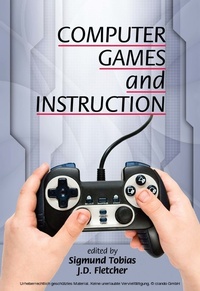
Computer Games and Instruction
1st Edition
Published on 1. May 2011
565 pages
978-1-61735-410-6 (ISBN)
Description

There is intense interest in computer games. A total of 65 percent of all American households play computer games, and sales of such games increased 22.9 percent last year. The average amount of game playing time was found to be 13.2 hours per week. The popularity and market success of games is evident from both the increased earnings from games, over $7 Billion in 2005, and from the fact that over 200 academic institutions worldwide now offer game related programs of study.
In view of the intense interest in computer games educators and trainers, in business, industry, the government, and the military would like to use computer games to improve the delivery of instruction. Computer Games and Instruction is intended for these educators and trainers. It reviews the research evidence supporting use of computer games, for instruction, and also reviews the history of games in general, in education, and by the military. In addition chapters examine gender differences in game use, and the implications of games for use by lower socio-economic students, for students' reading, and for contemporary theories of instruction. Finally, well known scholars of games will respond to the evidence reviewed.
All prices
More details
Other editions
Additional editions
Sigmund Tobias | J. D. Fletcher
Computer Games and Instruction
Book
03/2011
Information Age Publishing
€84.60
Article not available at the moment
Content
- Cover
- Computer Games and Instruction
- Computer Games and Instruction
- Copyright Page
- Dedication Page
- CONTENTS
- PREFACE
- I: INTRODUCTION TO COMPUTER GAMES
- 1: INTRODUCTION
- POPULARITY OF COMPUTER GAMES
- GAMES AND SIMULATIONS
- OVERVIEW OF CHAPTERS
- CONCLUSION
- REFERENCES
- 2: SEARCHING FOR THE FUN IN LEARNING
- INTRODUCTION
- THE 1970S: FROM PLATO TO THE FIRST HOME CONSOLE GAMES
- Oregon Trail
- Logo and the Microworlds Idea
- EARLY EDUCATIONAL GAMES FOR HOME CONSOLESAND COMPUTERS
- THE 1980S: EARLY COMPUTER GAME DESIGN ANDCONSTRUCTION AS EDUCATIONAL PLAY
- SIMULATION GAMES: PLAYING EXPLORERS, PIRATES,WORLD LEADERS
- CONSTRUCTION AS GAME PLAY: SIM CITY ANDCONSTRUCTIONISM
- THE 1990S: EARLY SOCIOCULTURAL RESEARCH ANDDEVELOPMENT OF GAMES AND LEARNING
- Entertainment Edutainment
- CONSTRUCTION EDUTAINMENT: GAME DESIGN AS A VIABLE PEDAGOGY
- GAMES IN SCHOOLS: RISE AND FALL OF ACADEMICEDUTAINMENT
- THE 2000S TO TODAY: GAMING AS A MASSIVELY MULTIPLAYER PHENOMENON, SERIOUS GAMES, ANDNEW TRENDS IN GAME-BASED LEARNING RESEARCH
- CONCLUSIONS
- REFERENCES
- 3: USING VIDEO GAMES ASEDUCATIONAL TOOLSIN HEALTHCARE
- INTRODUCTION
- INITIAL TRAINING AND CONTINUING EDUCATION FOR HEATH CARE PROVIDERS
- Games for Teaching in Medical School
- Simulated Cases and Virtual Patients
- Developing Surgical Skills with Games
- Continuing Education, Specialty Training, and Practice for Medical Professionals
- Skill and Knowledge Improvement
- Procedure Practice and Planning
- GAMES IN TREATMENT, THERAPY ANDDISEASE MANAGEMENT
- Applications of Games to Specific Diseases
- Diabetes
- Respiratory Disorders
- Cancer
- Rehabilitation
- GAMES USED IN PREVENTION AND TO PROMOTE HEALTH AND WELLNESS
- Exergaming
- CONCLUSIONS AND FUTURE RESEARCH
- REFERENCES
- 4: AFTER THE REVOLUTION
- INTRODUCTION: GAMES, A REVOLUTION, AND MYTHS
- The DOD Training Problem, or Why Bother with Games
- The 20th Century Training Revolution
- THREE EXAMPLES OF DEPLOYED AND WELL-USEDGAME-INFORMED TRAINING
- America's Army
- DARWARS Ambush!
- Origins
- Characteristics and Development of DARWARS Ambush!
- User Authoring Dramatically Changed DARWARS Ambush!
- User-Created Applications
- Usability Testing Before Release to Users
- Follow-up to DARWARS Ambush!: RealWorld
- Tactical Language and Culture Trainers
- Tactical Language and Culture Tutor Basics
- Why, and Why Not, a Game
- Good Training Is Not Cheap
- ASSESSMENT
- COMPUTER GAMES AFFECT COGNITIVE PROCESSINGAND ACTION GAMES AFFECT VISUAL ATTENTION
- Action Video Games
- Strategy Computer Games
- Emotion in Game-Like Simulations May Improve Learning on Unrelated Tasks
- TRANSFER OF GAME-LIKE TRAINING TO REAL-WORLDMILITARY PROFICIENCY
- Anecdotes, AA, and Training Transfer
- Clearing Rooms in a "shoot House"
- Recruit Training Flood Control Trainer
- Neither the Game Nor the Shoot House Is a Perfect Simulation
- FINAL WORDS
- Four Game-Derived Trainers: Five Ways to Train
- How These Game-Informed Training Tools Succeeded
- A Common Cause for Success: Adequate Funding
- Today's Successes May Not Lead the Way to Tomorrow's
- NOTES
- REFERENCES
- 5: MULTI-USER GAMESAND LEARNING
- INTRODUCTION
- OVERVIEW OF THIS CHAPTER
- FRAMING THE REVIEW: MULTI-USER AND MASSIVELY MULTI-USER GAMES
- DEFINING MULTI-USER GAMES IN EDUCATION
- Example 1: World of Warcraft
- Example 2: Revolution
- Example 3: Quest Atlantis and the River City Project
- WHY PEOPLE DO, OR DO NOT, PLAY MULTI-USER GAMES
- DESIGN AFFORDANCES OF MULTI-USER GAMES ANDTHEIR IMPACTS ON LEARNING
- Presence and Interaction in Multi-User Games
- Informal Learning in Multi-User Games
- Affordances of Multi-User Games to Support Educational Outcomes
- OUTCOME-BASED RESEARCH ON MULTI-USER GAMESFOR PEDAGOGY AND PRACTICE
- EMERGING ISSUES FOR CONDUCTING RESEARCH IN MULTI-USER GAMES
- Multi-User Games Break Free: Leaving the Desktop
- Alternate Reality Gaming: Games as Performance
- CONCLUSIONS
- REFERENCES
- II: REVIEW OF THE LITERATURE AND REACTIONS
- 6: REVIEW OF RESEARCH ON COMPUTER GAMES
- INTRODUCTION
- DEFINING GAMES AND SIMULATIONS
- REVIEW OF RESEARCH
- Transfer
- Far Transfer
- Games and Surgery
- Transfer to School Subjects
- Near Transfer
- Games Designed for Transfer to Similar School Subjects
- Summary: Transfer from Games
- EFFECTS ON COGNITIVE PROCESSES
- FACILITATING PERFORMANCE, LEARNING,AND TRANSFER
- Research Using Space Fortress
- Research Using Quest Atlantis
- ANIMATED AGENTS AND GUIDANCE
- Guidance
- EFFECTS OF VARIOUS PEDAGOGICAL APPLICATIONSAND USES OF GAMES
- CHARACTERISTICS OF GAME PLAYERS
- Aggression, Hostility, Motivation, and Other Student Variables
- Attitudes and Attitude Changes
- DISCUSSION
- Transfer and Improvement in Cognitive Processes
- Space Fortress Studies
- General Issues
- Time
- Modifying Games
- Evaluation of Game Learning
- Game Design Issues
- Guidance and Instructional Support
- Personalizing Interactions
- Relationships to Student Characteristics
- Interactions with Prior Knowledge
- Attitudinal, Motivational, and Affective Outcomes
- Aggression and Violence
- Miscellaneous Effects
- Using Teams to Develop Games
- FINAL WORD
- REFERENCES
- 7: REFLECTIONS ON EMPIRICAL EVIDENCE ON GAMESAND LEARNING
- GAMES AND LEARNING
- VIDEO GAMES
- LEARNING
- TWO TYPES OF GAMES
- CONCLUSION
- REFERENCES
- 8: DEVELOPING A RESEARCH AGENDA FOR EDUCATIONAL GAMES AND SIMULATIONS
- FUNDAMENTAL ASSUMPTIONS
- Usable Knowledge
- Collective Research
- What Works
- Treatment Effects
- Scalability
- A CONCEPTUAL FRAMEWORK
- Illustrative Thoughts About Research Questions
- Illustrative Thoughts About Research Strategies
- Illustrative Thoughts About Research Designs
- Illustrative Thoughts About Research Methodologies
- Illustrative Thoughts About Research Issues
- CONCLUSION
- REFERENCES
- 9: COMMENTS ON RESEARCH COMPARING GAMES TO OTHER INSTRUCTIONAL METHODS
- WHY IS THIS?
- RESEARCH
- WHAT ABOUT STATISTICAL AVERAGES AND"META-ANALYSES"?
- WHY NOT?
- GAME COMPLEXITY NOT DISTINGUISHED
- EQUAL QUALITY?
- LOW TO LOW?
- A BETTER APPROACH FOR RESEARCH
- CREATING HIGH-QUALITY LEARNING GAMES
- DESIGNING FOR QUALITY
- CRITERIA FOR A HIGH-QUALITY COMPLEX LEARNING GAME
- An instructional game is high quality:
- MEASURING QUALITY
- MEASURING TEACHING
- HAPHAZARD VS. SYSTEMATIC
- IS THERE A "TOOLKIT"?
- RUBRIC VS. TAXONOMY
- ON TO COMPARISONS
- OTHER ISSUES
- TRANSFER?
- ADAPTIVITY
- DOES THE CONTENT MATTER?
- DESIGNING GAMES FOR ENGAGEMENT
- 1. Focus on Engagement
- 2. Make Players Heroes
- 3. Make Players Decide and See the Results
- 6. Provide a Strong Emotional Connection
- 7. Level-Up for Evaluation
- 8. Balance Cooperation and Competition
- AGGRESSION?
- EFFECTIVENESS
- CONCLUSION
- REFERENCES
- III: COMPUTER GAME ISSUES
- 10: MULTIMEDIA LEARNINGAND GAMES
- INTRODUCTION
- Objective
- What Is an Educational Computer Game?
- The Case for Educational Games
- The Need for Game Research
- Three Genres of Game Research
- VALUE-ADDED APPROACH: WHICH FEATURESINCREASE THE INSTRUCTIONAL EFFECTIVENESSOF A COMPUTER GAME?
- Which Features of the Design-A-Plant Game Improve Learning?
- What is the Design-A-Plant game?
- What is the effect of using printed text rather than spoken text?
- What is the effect of adding redundant printed text to spoken text?
- What is the effect of using personal conversational style rather than formal conversational style?
- What is the effect of including or excluding the pedagogical agent's image from the screen?
- Which Features of the Profile Game Improve Learning?
- What is the Profile game?
- What is the effect of adding pretraining to the Profile game?
- Which Features of the Virtual Factory Game Improve Learning?
- What is the Virtual Factory game?
- What is the effect of using polite rather than direct conversational style?
- Which Features of the Circuit Game Improve Learning?
- What is the Circuit game?
- What is the effect of requiring learners to engage in self-explanation during the game?
- COGNITIVE CONSEQUENCES APPROACH: WHAT ISLEARNED FROM OFF-THE-SHELF GAMES?
- What Are the Cognitive Consequences of Learning with Off-The-Shelf Games?
- What Are the Cognitive Consequences of Participating in an After-School Computer Club?
- MEDIA COMPARISON APPROACH:DO PEOPLE LEARN BETTER WITH GAMES THAN WITH CONVENTIONAL MEDIA?
- Do People learn better from Playing the Design-a-Plant Game or from a Conventional lesson?
- ADVANTAGES AND DISADVANTAGES OF EACH GENRE OF GAME RESEARCH
- THREE NON-RECOMMENDED GENRESOF GAME RESEARCH
- NOTES
- REFERENCES
- 11: ACTION GAME PLAY ASA TOOL TO ENHANCE PERCEPTION, ATTENTION AND COGNITION
- INTRODUCTION
- VISUAL CHANGES
- Changes to Resolution of Vision
- Change in Sensitivity of Vision
- CHANGES IN ATTENTION
- Spatial and Temporal Control of Attention
- Attention to Objects
- Visual Search
- Not All Aspects of Visual Attention Change: the Case of Exogenous Attention
- COGNITIVE CHANGES
- Task Switch and Multi-Tasking
- Visual STM and Working Memory
- Proactive Interference
- Cognitive Decision Making
- WHY DO ACTION VIDEO GAMES LEADTO IMPROVED SKILLS?
- Changes in Speed of Processing
- Increase in Resources
- Improved Sensitivity
- DISCUSSION
- REFERENCES
- 12: DEVELOPING AN ELECTRONICGAME FOR VOCABULARY LEARNING
- PLAN FOR THE CHAPTER
- TECHNOLOGY, GAMES AND LEARNING:SOME DEFINITIONS AND BACKGROUND
- EMPIRICAL RESEARCH ON COMPUTER GAMESAND READING
- CONCLUSIONS ABOUT THE CURRENT STATE OF RESEARCH
- The JUMP Project
- Vocabulary Instruction
- Word Selection
- Overview of the Game Design
- Game Development Process
- EVALUATION STUDY OF COSMOS CHAOS!
- SUMMARY
- CONCLUSION
- NOTE
- ACKNOWLEDGEMENT
- REFERENCES
- 13: INSTRUCTIONAL SUPPORTIN GAMES
- SUPPORT IN SIMULATIONS
- SUPPORT IN GAMES
- SYNTHESIS
- REFERENCES
- 14: IMPLICATIONSOF CONSTRUCTIVISM FOR THE DESIGN AND USE OF SERIOUS GAMES
- INTRODUCTION
- HOW WE LEARN: A CONSTRUCTIVIST LENS
- FROM THEORY TO PRACTICE:CONSTRUCTIVIST PRINCIPLES FOR LEARNING
- The problem should be designed to engage learners in the domain area that is the focus of learning.
- Instructional guidance and support is provided in response to learners'needs for sense making, as well as to support learner inquiry, problem analysis, and proposed resolution.
- The structures, tools and resources used to support the learning process are defined as part of the design of the overall learning environment.
- INSTRUCTIONAL DESIGN FROM THE CONSTRUCTIVIST PERSPECTIVE
- CASE STUDY: ASTROENGINEER: MOON ROVER
- Game Play Overview
- Applying the Inquiry Process
- Stage 1: Situation
- Stage 2: Issues Identification Stage
- Stage 3: Inquiry Stage
- Stage 4: Action Stage
- Stage 5: Assessment Stage
- GUIDELINES FOR USING CONSTRUCTIVIST THEORY TO DESIGN AND USE GAMES TO SUPPORT LEARNING
- SUMMARY
- NOTE
- REFERENCES
- 15: IMPLICATIONS OF GAME USE FOR EXPLICIT INSTRUCTION
- DISCOVERY-BASED INSTRUCTION
- DIRECT INSTRUCTION
- HUMAN COGNITIVE ARCHITECTURE
- MODALITY EFFECT AND INSTRUCTIONAL CONSIDERATIONS
- SPLIT-ATTENTION EFFECT AND INSTRUCTIONAL CONSIDERATIONS
- REDUNDANCY EFFECT AND INSTRUCTIONAL CONSIDERATIONS
- LEARNERS' PRIOR KNOWLEDGE AND INSTRUCTIONAL CONSIDERATIONS
- WORKED EXAMPLES AND INSTRUCTIONAL CONSIDERATIONS
- GUIDANCE FADING
- DIRECT GUIDANCE AND LEARNING WITH COMPUTERIZEDSIMULATIONS AND GAMES
- CONCLUSION
- REFERENCES
- 16: COST ANALYSISIN ASSESSING GAMESFOR LEARNING
- COST ANALYSIS
- Five Forms of Cost Analysis
- Cost-Benefit Analysis (CBA)
- Cost-Utility Analysis (CUA)
- Cost-Effectiveness Analysis (CEA)
- Return on Investment (ROI)
- Net Present Value (NPV)
- COST ANALYSIS FRAMEWORK FOR CHOOSING AMONGTRAINING ALTERNATIVES
- Identifying the Objectives
- Identifying Requirements for Scale
- Identifying the Cost Model to Be Used
- Identifying the Alternatives
- Designing the Analysis
- Establishing Metrics
- Performing the Analysis
- Performing a Sensitivity Analysis
- Reporting the Results
- COST ANALYSES OF COMPUTER GAMES USEDFOR INSTRUCTION
- FINAL WORD
- REFERENCES
- 17: USING COMPUTER GAMESTO TEACH ADULT LEARNERSPROBLEM SOLVING
- COMPUTER GAMES AS AN INSTRUCTIONAL MEDIUM
- PROBLEM SOLVING MODEL AND EVALUATION OF PROBLEM SOLVING IN COMPUTER GAMES
- COGNITIVE LOAD THEORY AND PROBLEM SOLVINGIN COMPUTER GAMES
- Use of Worked Examples to Reduce Cognitive Load
- Use of Just-In-Time Information to Promote Learning
- STUDIES USING A COMPUTER GAME TO TEACH PROBLEM SOLVING
- OVERALL CONCLUSION
- SUGGESTIONS FOR FUTURE STUDIES
- AUTHOR NOTE
- REFERENCES
- 18: GENDER AND GAMING
- INTRODUCTION
- SEX AND GENDER
- THE GENDERED LANDSCAPE OF VIDEO GAMING
- GAMING AS GENDERED:REPRESENTATIONS, PLAY AND CONTEXT
- REPRESENTATIONS OF WOMEN IN GAMES
- GAME PLAY: ARE THERE WOMEN'S GAMES?
- GAMING AND GENDER IN CONTEXT
- FROM ENTERTAINMENT TO LEARNING
- GENDER, GAMES, AND LEARNING
- UNDERSTANDING GENDER IN THE CONTEXTOF GAME-BASED LEARNING
- GENDER AND THE DESIGN OF GAME-BASED LEARNING
- CHALLENGING GENDERED PRACTICESTHROUGH GAMING
- SUMMARY AND PARTING THOUGHTS
- REFERENCES
- 19: COMPUTER GAMES ANDOPPORTUNITY TO LEARN
- COMPUTER GAMES AND "OPPORTUNITY TO LEARN"
- Affordances and Constraints of Computer Games for Learning Gains
- "Digital Divide": Equitable Access and Effective Use
- Computer Games as New Opportunities for Learning
- Distinction Between Learning Games and Entertainment Games
- A CONCEPTUAL MODEL
- SES
- Access to Hardware and Educational Software and Computer Skills/literacy
- Content and Cultural Knowledge
- Affordances
- Instructional Mediation and Guidance
- Learning Gains
- Judgment Criteria
- FUTURE RESEARCH DIRECTIONS
- CONCLUSION
- REFERENCES
- IV: EVALUATION AND SUMMING UP
- 20: STEALTH ASSESSMENTIN COMPUTER-BASED GAMESTO SUPPORT LEARNING
- INTRODUCTION
- Stealth Assessment, Generally Speaking
- Why Stealth Assessment Is Needed
- BRIEF DEFINITION OF TERMS
- Computer-Based Games
- Learning in Games
- Assessment in Games
- HOW TO DESIGN AND DEVELOP GOODSTEALTH ASSESSMENT
- Evidence-Centered Design
- Bayesian Networks
- EXAMPLES OF STEALTH ASSESSMENT SYSTEMS
- Thinking in Taiga Park-Example 1
- Creative Problem Solving in Oblivion-Example 2
- DISCUSSION
- NOTE
- REFERENCES
- 21: COMPUTER GAMES, PRESENT AND FUTURE
- WHERE WE ARE
- Inert Knowledge and Prompts
- Learning and Transfer
- Formative and Summative Evaluations of Games
- Multimedia Learning and Games
- Using Games for Evaluation
- Taxonomies
- WHERE WE ARE HEADED
- Games and Instructional Systems Design
- Instructional Game Theory and Instructional Theory
- RECOMMENDED RESEARCH
- Training Processes with Games
- Games and Schooling
- FINAL WORD
- REFERENCES
- AUTHOR IDENTIFICATION

