

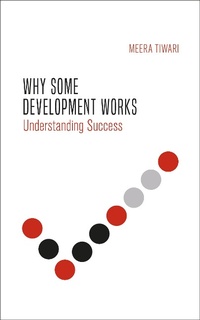
Why Some Development Works
Understanding Success
1st Edition
Published on 12. August 2021
176 pages
978-1-78699-362-5 (ISBN)
Description

Why do some development projects succeed where others fail? This book looks at some macro and some less known micro success stories and considers what enabled them to bring change in some of the world's most deprived communities. Using case studies from ten countries across Latin America, Africa, and Asia, Tiwari's innovative approach offers a multi-layered understanding of poverty which provides insights into causal, enabling and impeding factors. While a macro level analysis of development is a common feature of the current literature, there has been little attempt to develop a micro level understanding of development at the grassroots.
Tiwari's work fills this important gap while drawing attention to the importance of engaging local actors at an individual, collective, and state level, demonstrating how achieving a "convergence" of goals among all actors is a crucial component to a development project's success.
Looking beyond the case studies to consider how this unique "convergence framework" might be usefully applied to other contexts, the book has profound implications for how we view fragile states and conflict zones, and the ability of the international agencies to take effective action. A unique study based on extensive empirical research, Why Some Development Works will make essential reading for students and researchers studying international development across the social sciences, as well as humanitarian and development practitioners and policy makers.
Tiwari's work fills this important gap while drawing attention to the importance of engaging local actors at an individual, collective, and state level, demonstrating how achieving a "convergence" of goals among all actors is a crucial component to a development project's success.
Looking beyond the case studies to consider how this unique "convergence framework" might be usefully applied to other contexts, the book has profound implications for how we view fragile states and conflict zones, and the ability of the international agencies to take effective action. A unique study based on extensive empirical research, Why Some Development Works will make essential reading for students and researchers studying international development across the social sciences, as well as humanitarian and development practitioners and policy makers.
Reviews / Votes
In contrast to prevailing narratives of environmental doom and social division, Meera Tiwari explores the politics of developmental success in recent decades. She shows that a combination of individual and collective agency and the ability to bring together state and non-state actors in pursuit of a common goal underlies both macro and micro breakthroughs, and even shows promising signs in fragile and conflict-affected states. A valuable contribution to understanding how change happens. * Dr Duncan Green, Professor in Practice in International Development at the London School of Economics, UK * This book, by an authority on multidimensional poverty, represents a significant contribution to understanding what really works. In an era when many development programmes fail to make an impact, the convergence hypothesis explored by Meera Tiwari is much needed. Drawing on comprehensive research and expertise, this book takes as its premise that the energy, participation and aspirations of micro actors can play a critical role in the success of international development. * Diana Skelton, Policy and Practice Co-Editor at the Journal of Poverty and Social Justice, and National Coordination Team of ATD Fourth World *More details
Series
Edition
1. Auflage
Language
English
Place of publication
United Kingdom
Publishing group
Bloomsbury Publishing PLC
Target group
College/higher education
ISBN-13
978-1-78699-362-5 (9781786993625)
Copyright in bibliographic data and cover images is held by Nielsen Book Services Limited or by the publishers or by their respective licensors: all rights reserved.
Schweitzer Classification
Other editions
Additional editions
Book
09/2021
Zed Books Ltd
€112.85
Shipment within 3-4 weeks
Person
Meera Tiwari is an associate professor of international development studies at the University of East London, where she leads the MSC in NGO and Development Management. She has also played an active role in a number of development projects around the world, including work with the NGO Childreach International in India. Her previous books include After 2015: International Development Policy at a Crossroads (co-authored with Andrew Sumner, 2009) and The Capability Approach: From Theory to Practice (co-edited with Solava Ibrahim, 2014).
Content
1. Introduction
2. The Story So Far
3. The Convergence Framework
4. The Macro
5. The Micro
6. The Fragile context
7. Conclusion
2. The Story So Far
3. The Convergence Framework
4. The Macro
5. The Micro
6. The Fragile context
7. Conclusion
