

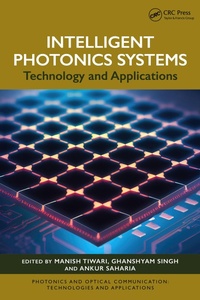
Intelligent Photonics Systems
Technology and Applications
Published on 27. March 2025
164 pages
978-1-040-30765-6 (ISBN)
Description

The text comprehensively discusses the implementation of sensor systems using artificial intelligence, quantum device and circuit with artificial intelligence, and biomedical implementation of artificial intelligence-based optoelectronic circuits. It covers important topics such as photonic communication, optical and photonics neural networks, neuromorphic computing, quantum optics, and artificial intelligence leap in optical sensors, including biophotonics.
This book:
* Provides insights about the advancement in optoelectronics devices using artificial intelligence.
* Discusses artificial intelligence-integrated photonic crystal fiber-based devices.
* Covers artificial intelligence-integrated quantum networks for 6G communication and artificial intelligence-enhanced quantum optical devices.
* Presents neuromorphic computing for photonic circuits and deep learning-enabled optical sensors.
* Showcases development in artificial intelligence for biophotonics applications, deep learning revolution in optical networks.
It is primarily written for senior undergraduate students, graduate students, and academic researchers in the fields of electrical engineering, electronics and communications engineering, and computer engineering.
This book:
* Provides insights about the advancement in optoelectronics devices using artificial intelligence.
* Discusses artificial intelligence-integrated photonic crystal fiber-based devices.
* Covers artificial intelligence-integrated quantum networks for 6G communication and artificial intelligence-enhanced quantum optical devices.
* Presents neuromorphic computing for photonic circuits and deep learning-enabled optical sensors.
* Showcases development in artificial intelligence for biophotonics applications, deep learning revolution in optical networks.
It is primarily written for senior undergraduate students, graduate students, and academic researchers in the fields of electrical engineering, electronics and communications engineering, and computer engineering.
More details
Series
Language
English
Place of publication
London
United Kingdom
Publishing group
Taylor & Francis Ltd
Target group
College/higher education
Professional and scholarly
Illustrations
5 Tables, black and white; 28 Line drawings, black and white; 9 Halftones, black and white; 37 Illustrations, black and white
File size
11,36 MB
ISBN-13
978-1-040-30765-6 (9781040307656)
Copyright in bibliographic data and cover images is held by Nielsen Book Services Limited or by the publishers or by their respective licensors: all rights reserved.
Schweitzer Classification
Other editions
Additional editions
Manish Tiwari | Ghanshyam Singh | Ankur Saharia
Intelligent Photonics Systems
Technology and Applications
Book
approx. 07/2026
1st Edition
CRC Press
€66.00
Not yet published
Manish Tiwari | Ghanshyam Singh | Ankur Saharia
Intelligent Photonics Systems
Technology and Applications
Book
03/2025
1st Edition
CRC Press
€132.70
Shipment within 10-20 days

Manish Tiwari | Ghanshyam Singh | Ankur Saharia
Intelligent Photonics Systems
Technology and Applications
Book
03/2025
CRC Press
Unfortunately, price unknown
Available (delivery time upon request)
Persons
Manish Tiwari received Ph.D. in ECE in the field of Photonics from MNIT Jaipur. Presently, he is Professor and Head of Department of ECE at Manipal University Jaipur. He has more than 25 years of professional experience in various colleges and universities of repute. He has published more than 100+ research papers in reputed journals and conferences, and book chapters. He has also authored and edited more than a dozen books. He has also supervised more than 30 projects sponsored by DST Rajasthan. He is principal investigator in a BRICS project on Quantum Satellite and Fiber Communication (QuSaF) along with research partners in UKZN Durban, PSUTI Samara and USTC Shanghai. He has also served on panel of experts and editor in various workshops by CSTT, MHRD, Govt. of India. He has been visiting as a researcher to City University, London under UKIERI project in Microstructured Optical Fibers during 2010 and 2011 and Tsinghua University, Beijing during 2016. Dr. Tiwari has presented talks in PIERS at NTU Singapore, APMP at PolyU-Hong Kong, TJMW at KMUT-Bangkok and Kasetsart University-Bangkok, City University- London and several UKIERI workshops. He is on the panel of Traveling Lecturer Program of reputed societies like SPIE (USA) and OSA (USA) under which he has delivered invited talks in USTC Shanghai, UESTC Chengdu, Tsinghua University Beijing, ITS Indonesia, University of KwaZulu-Natal, Durban (SA) on photonics technologies and career development. He is a Senior Member of IEEE and IEEE Photonics Society, Life Fellow of the Optical Society of India (OSI-India), Senior Member of OSA, Member of SPIE and Fellow of Institution of Electronics and Telecommunication Engineers (IETE) India. He has been a Technical Program Committee member of many IEEE conferences and reviewer of IEEE/Elsevier/OSA/Springer/T&F journals. His current research interest includes Free Space and Optical Fiber Communication, Photonics, Nonlinear Optics, Optical Sensors, Specialty Optical Fibers, Space Division Multiplexing, Structured Light, Photonic Crystal Fiber for nonlinear applications, Space Division Multiplexing and Sensing. Photonic Switching.
Ghanshyam Singh received the B. Tech. from NIT Silchar, India, M. Tech. and PhD degrees in Electronics and Comm. Engg. from MNIT Jaipur, India. Currently, he is a Full Professor with the department of ECE, MNIT Jaipur, India. He worked as visiting research scholar/professor at HW University Edinburgh, UK, University of Eastern Finland Joensuu and Keio University Japan. He has published over 150 research articles in peer reviewed journals/conference proceedings. He is a senior member of SPIE, OSA, IEEE and a Fellow of OSI and IETE. He is the recipient of the 2017 IEEE Distinguished Lecturer Award of the Photonics Society. He is Chair (Elect) for OSA TG on Optics in Digital Systems and Member for SPIE Fellowship Committee. He is also serving as Secretary for IEEE Photonics Society Rajasthan Chapter (PHO36), faculty advisor to OSA and IEEE Sensor Council Student Chapters of MNIT Jaipur. In the past, he had joint research collaborations with the researchers from Keio University (Japan), University of Vienna (Austria), LNPU (Ukraine) and Cairo University (Egypt). He is presently collaborating on a multi- institutional research project with researchers from University of KwaZulu-Natal (South Africa), PSUTI Samara (Russia) and University of Science and Technology of China, Shanghai (China) for a BRICS STI Framework Program (2020-2023). His current research interest includes Micro and Nano-structured Photonic devices for Integrated Photonics, Signal processing in optical circuits.
Ankur Saharia is currently working as an Assistant Professor at Manipal University Jaipur, India. He has completed his PhD and M. Tech from Malaviya National Institute of Technology Jaipur, India in the domain of integrated optics. He has more than 50 publications in the field of integrated photonics, optical sensors and quantum logic circuit and has many international collaborations for his research. He has been an academic for eight years at Poornima Group of Colleges where he has been recognised several times for producing outstanding contributions. He has organized many conferences and workshops and has also received couple of travel grants to attend the prestigious annual SLC (student leadership conference) organized by OSA at Washington D.C. (USA) and leadership Conference in 2021 at USA. Since the beginning of his tenure at MUJ, he has organized numerous international events such as webinars, conferences and workshops with the participation of several distinguished speakers and renowned scientists as well as hundreds of scholars from all over the globe and has inspired them to work in the domain of photonics and optics.
Ghanshyam Singh received the B. Tech. from NIT Silchar, India, M. Tech. and PhD degrees in Electronics and Comm. Engg. from MNIT Jaipur, India. Currently, he is a Full Professor with the department of ECE, MNIT Jaipur, India. He worked as visiting research scholar/professor at HW University Edinburgh, UK, University of Eastern Finland Joensuu and Keio University Japan. He has published over 150 research articles in peer reviewed journals/conference proceedings. He is a senior member of SPIE, OSA, IEEE and a Fellow of OSI and IETE. He is the recipient of the 2017 IEEE Distinguished Lecturer Award of the Photonics Society. He is Chair (Elect) for OSA TG on Optics in Digital Systems and Member for SPIE Fellowship Committee. He is also serving as Secretary for IEEE Photonics Society Rajasthan Chapter (PHO36), faculty advisor to OSA and IEEE Sensor Council Student Chapters of MNIT Jaipur. In the past, he had joint research collaborations with the researchers from Keio University (Japan), University of Vienna (Austria), LNPU (Ukraine) and Cairo University (Egypt). He is presently collaborating on a multi- institutional research project with researchers from University of KwaZulu-Natal (South Africa), PSUTI Samara (Russia) and University of Science and Technology of China, Shanghai (China) for a BRICS STI Framework Program (2020-2023). His current research interest includes Micro and Nano-structured Photonic devices for Integrated Photonics, Signal processing in optical circuits.
Ankur Saharia is currently working as an Assistant Professor at Manipal University Jaipur, India. He has completed his PhD and M. Tech from Malaviya National Institute of Technology Jaipur, India in the domain of integrated optics. He has more than 50 publications in the field of integrated photonics, optical sensors and quantum logic circuit and has many international collaborations for his research. He has been an academic for eight years at Poornima Group of Colleges where he has been recognised several times for producing outstanding contributions. He has organized many conferences and workshops and has also received couple of travel grants to attend the prestigious annual SLC (student leadership conference) organized by OSA at Washington D.C. (USA) and leadership Conference in 2021 at USA. Since the beginning of his tenure at MUJ, he has organized numerous international events such as webinars, conferences and workshops with the participation of several distinguished speakers and renowned scientists as well as hundreds of scholars from all over the globe and has inspired them to work in the domain of photonics and optics.
Content
1. Photonic integrated circuits with artificial intelligence: An introduction. 2. AI integrated photonic crystal fibre-based devices. 3. AI-integrated quantum networks for 6G. 4. Development in AI for biophotonics applications. 5. AI-enhanced quantum optical devices. 6. Deep learning enabled optical sensors. 7. An introduction to neuromorphic computing.
