

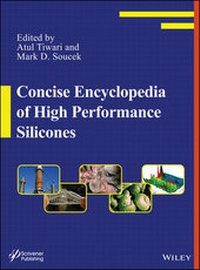
Concise Encyclopedia of High Performance Silicones
Description

More details
Other editions
Additional editions
Persons
Content
1 Room Temperature Vulcanized Silicone Rubber Coatings: Application in High Voltage Substations 3 Kiriakos Siderakis and Dionisios Pylarinos 1.1 Introduction 3 1.2 Pollution of High Voltage Insulators 4 1.3 Silicone Coatings for High Voltage Ceramic Insulators 5 1.4 RTV SIR Coatings Formulation 6 1.5 Hydrophobicity in RTV SIR 10 1.6 Electrical Performance of RTV SIR Coatings 13 1.7 Conclusions 13 References 13 2 Silicone Copolymers: Enzymatic Synthesis and Properties 19 Yadagiri Poojari 2.1 Introduction 19 2.2 Polysiloxanes 20 2.3 Silicone Aliphatic Polyesters 20 2.4 Silicone Aliphatic Polyesteramides 21 2.5 Silicone Fluorinated Aliphatic Polyesteramides 21 2.6 Silicone Aromatic Polyesters and Polyamides 21 2.7 Silicone Polycaprolactone 22 2.8 Silicone Polyethers 23 2.9 Silicone Sugar Conjugates 24 2.10 Stereo-Selective Esterification of Organosiloxanes 24 2.11 Conclusion and Outlook 25 Acknowledgments 25 References 25 3 Phosphorus Containing Siliconized Epoxy Resins 27 S. Ananda Kumar, M. Alagar and M. Mandhakini 3.1 Introduction 27 3.2 Preparation of Siliconized Epoxy-Bismaleimide Intercrosslinked Matrices 29 3.3 Phosphorus-Containing Siliconized Epoxy Resin as Thermal and Flame Retardant Coatings 31 3.4 High Functionality Resins for the Fabrication of Nanocomposites 33 3.5 Anticorrosive and Antifouling Coating Performance of Siloxane- and Phosphorus-Modified Epoxy Composites 39 3.6 Summary and Conclusion 46 Acknowledgement 48 References 49 4 Nanostructured Silicone Materials 51 Joanna Lewandowska-Lañcucka, Mariusz Kepczynski and Maria Nowakowska 4.1 Introduction 51 4.2 Solid Particles 52 4.3 Nanocapsules 56 4.4 Ultra-Thin Silicone Films 60 4.5 Conclusion and Outlook 61 References 62 5 High Refractive Index Silicone 65 Zulkifli Ahmad 5.1 Introduction 65 5.2 Theory of RI 66 5.3 High Refractive Index Silicone 69 5.4 Applications 71 5.5 Conclusion and Outlook 74 6 Irradiation Induced Chemical and Physical Effects in Silicones 75 R. Huszank 6.1 Introduction 75 6.2 Sources of Irradiation 76 6.3 Irradiation-Induced Chemical Effects in Silicones 77 6.4 Irradiation-Induced Physical Effects in Silicones 81 6.5 Conclusion and Outlook 83 7 Developments and Properties of Reinforced Silicone Rubber Nanocomposites 85 Suneel Kumar Srivastava and Bratati Pradhan 7.1 Introduction 85 7.2 Different Types of Nanofillers Used in Silicone Rubber (SR) 86 7.3 Preparation of Silicone Rubber (SR) Nanocomposites 89 7.4 Morphology of Silicone Rubber (SR) Nanocomposites 90 7.5 Properties of Silicone Rubber Nanocomposites 94 7.6 Conclusion and Outlook 105 References 105 8 Functionalization of Silicone Rubber Surfaces towards Biomedical Applications 111 Lígia R. Rodrigues and Fernando Dourado 8.1 Introduction 111 8.2 Silicone Rubber - Material of Excellence for Biomedical Applications? 111 8.3 Surface Modification of Silicone Rubber 113 8.4 Conclusion and Outlook 119 References 120 9 Functionalization of Colloidal Silica Nanoparticles and Their Use in Paint and Coatings 123 Peter Greenwood and Anders Törncrona 9.1 Introduction to Colloidal Silica 123 9.2 Chemistry of Silica Surface Functionalization by Organosilanes 124 9.3 Characterization and Product Properties of Silane-Modified Silica Dispersions 125 9.4 Applications for Silanized Silica Nanoparticles in Paint and Coatings 130 9.5 Conclusion and Outlook 139 References 139 10 Surface Modification of PDMS in Microfluidic Devices 141 Wenjun Qiu, Chaoqun Wu and Zhigang Wu 10.1 Introduction 141 10.2 PDMS Surface Modification Techniques 142 10.3 Characterization Techniques 147 10.4 Discussion and Perspectives 148 Part 2: Characterization 151 11 The Development and Application of NMR Methodologies for the Study of Degradation in Complex Silicones 153 Robert S. Maxwell, James Lewicki, Brian P. Mayer, Amitesh Maiti and Stephen J. Harley 11.1 Introduction 153 11.2 Applications of NMR for Characterizing Silicones 155 11.3 Highlights of Recent Advances in NMR Methodology 159 11.4 Conclusions and Outlook 173 Acknowledgements 173 12 Applications of Some Spectroscopic Techniques on Silicones and Precursor to Silicones 177 Atul Tiwari 12.1 Introduction 177 12.2 Fourier Transformation Infrared and Spectroscopy of Silicones 178 12.3 Raman Spectroscopy of Silicones 181 12.4 FTIR-Assisted Chemical Component Analysis in Thermal Degradation of Silicones 182 12.5 X-ray Photoelectron Spectroscopy of Silicones 183 12.6 Secondary Ion Mass Spectroscopy 187 12.7 Conclusion and Outlook 187 Acknowledgement 187 References 188 13 Degradative Thermal Analysis of Engineering Silicones 191 James P. Lewicki and Robert S. Maxwell 13.1 Degradative Thermal Analysis of Engineering Silicones 191 13.2 Conclusions and Outlook 209 Acknowledgments 209 References 209 14 High Frequency Properties and Applications of Elastomeric Silicones 211 Charan M. Shah, Withawat Withayachumnankul, Madhu Bhaskaran and Sharath Sriram 14.1 Introduction 211 14.2 Silicone Microdevice Fabrication 212 14.3 Properties of Silicone at Radio Frequencies (1-20 GHz) 213 14.4 Properties of Silicone at Terahertz Frequencies (0.2 THz - 4.0 THz) 220 14.5 Conclusion and Outlook 223 Acknowledgements 223 References 223 15 Mathematical Modeling of Drug Delivery from Silicone Devices Used in Bovine Estrus Synchronization 225 Ignacio M. Helbling, Juan C.D. Ibarra and Julio A. Luna 15.1 Introduction 225 15.2 Bovine Estrous Cycle 226 15.3 Bovine Estrus Synchronization 228 15.4 Controlled Release Silicone Devices 230 15.5 Mathematical Modeling 232 15.6 Conclusion and Outlook 237 References 238 16 Safety and Toxicity Aspects of Polysiloxanes (Silicones) Applications 243 Krystyna Mojsiewicz-Pieñkowska 16.1 Introduction 243 16.2 Business Strategy for Manufacturing and Sale of Polysiloxanes 243 16.3 Chemical Aspects 244 16.4 Speciation Analysis 245 16.5 Application Areas and Direct Human Contact with Polysiloxanes (Silicones) 246 16.6 Toxicological Aspects 247 16.7 Conclusion and Outlook 249 References 249 17 Structure Properties Interrelations of Silicones for Optimal Design in Biomedical Prostheses 253 Petroula A. Tarantili 17.1 Introduction 253 17.2 Materials and Methods 259 17.3 Discussion of Results 260 17.4 Conclusions and Outlook 267 References 269 Part 3: Applications 273 18 Silicone-Based Soft Electronics 275 Shi Cheng 18.1 Introduction 275 18.2 Silicone-Based Passive Soft Electronics 276 18.3 Silicone-Based Integrated Active Soft Electronics 284 18.4 Conclusion 292 Acknowledgements 292 References 292 19 Silicone Hydrogels Materials for Contact Lens Applications 293 José M. González-Meijome, Javier González-Pérez, Paulo R.B. Fernandes, Daniela P. Lopes-Ferreira, Sergio Mollá and Vicente Compañ 19.1 Introduction 293 19.2 Synthesis and Development of Materials 294 19.3 Surface Properties 295 19.4 Bulk Properties 298 19.5 Biological Interactions 301 19.6 Load and Release of Products from Contact Lenses 304 19.7 Conclusions 305 Disclosure 306 References 306 20 Silicone Membranes for Gas, Vapor and Liquid Phase Separations 309 Paola Bernardo, Gabriele Clarizia, Johannes Carolus Jansen 20.1 Introduction 309 20.2 Material 309 20.3 Membrane Type and Configuration 310 20.4 Membrane Unit Operations Based on Silicones 314 20.5 Conclusions and Outlook 318 References 318 21 Polydimethyl Siloxane Elastomers in Maxillofacial Prosthetic Use 321 H. Serdar Çötert 21.1 Introduction 321 21.2 Facial Prostheses 322 21.3 Polydimethyl Siloxane Elastomers 328 21.4 Reinforcement 333 21.5 Biocompatibility and the Microbiological Features 334 21.6 Future Studies 335 Acknowledgements 335 References 335 22 Silicone Films for Fiber-Optic Chemical Sensing Guillermo Orellana, Juan López-Gejo and Bruno Pedras 22.1 Introduction 339 22.2 Silicone Chemistry and Technology Related to Optical Chemical Sensing 340 22.3 Gas Permeability and Optical Sensing 342 22.4 Optical Properties of Silicone Thin Films 345 22.5 Silicone Films for Optical Oxygen Sensing 346 22.6 Silicone Films for Optical Sensing of Other Species 349 22.7 Conclusion 350 Acknowledgements 350 References 350 23 Surface Design, Fabrication and Properties of Silicone Materials for Use in Tissue Engineering and Regenerative Medicine 355 Nisarg Tambe, Jing Cao, Kewei Xu and Julie A. Willoughby 23.1 Introduction 355 23.2 Silicone Biomaterials 357 23.3 Silicones in Tissue Engineering 359 23.4 Surface Characterization Techniques 366 23.5 Conclusion and Outlook 368 Acknowledgement 368 References 369 24 Silicones for Microfluidic Systems 371 Anna Kowalewska and Maria Nowacka 24.1 Introduction 371 24.2 Fabrication of Microfluidic Devices 372 24.3 Application of PDSM-Based Microfluidic Devices 376 24.4 Summary and Outlook 376 References 376 25 Silicone Oil in Biopharmaceutical Containers: Applications and Recent Concerns 381 Nitin Dixit and Devendra S. Kalonia 25.1 Introduction 381 25.2 Lubrication of Pharmaceutical Containers and Devices 381 25.3 Silicone Oil: A Molecular Perspective 382 25.4 Silicone Oil Coatings in Pharmaceutical Devices 383 25.5 Protein Adsorption to Hydrophobic Interfaces 386 25.6 Physical Stability of Biologics in the Presence of Silicone Oil 389 25.7 Conclusions and Outlook 392 List of Abbreviations 392 References 392 Index
Chapter 1
Room Temperature Vulcanized Silicone Rubber Coatings: Application in High Voltage Substations
Kiriakos Siderakis* and Dionisios Pylarinos
Department of Electrical Engineering, Technological Educational Institute of Crete, Crete, Greece
*Corresponding author: ksiderakis@staff.teicrete.gr
Abstract
Silicone rubber has brought a new era in the field of outdoor insulation, providing improved performance in comparison to the ceramic materials that were traditionally employed. Its primary advantage occurs as a result of its surface behavior in respect to water, with silicone rubber being able to maintain hydrophobic characteristics in field conditions, even after the deposition of contaminants on the surface. This improved behavior correlates with the material formulation employed, with the properties and capabilities of the base polymer and the included fillers. Room temperature vulcanized silicone rubber (RTV SIR) is one of the forms of silicone rubber implemented in outdoor insulating systems, usually in order to improve the pollution performance of ceramic insulation. This chapter is a review of the basic features and properties of RTV SIR coatings applied on ceramic insulators in high voltage substations.
Keywords: High voltage insulators, silicone rubber, room temperature vulcanization, pollution, substations
1.1 Introduction
High voltage transmission and distribution systems constitute critical infrastructures for the development and the prosperity of today’s society. Substations and transmission lines form a network responsible for interconnecting the power generation facilities, from conventional and renewable sources, with the power consumption centers. In addition, further requirements are set, demanding the optimized operation of these installations with the highest degree of reliability and, at the same time, with the minimum possible cost.
For the majority of these systems, the primary insulating component is the surrounding atmospheric air. This choice is made while considering that the use of increased voltage levels is necessary in an effort, firstly, to reduce the correlated transmission power losses, and further to improve additional features of the transmission performance, such as system stability [1]. Furthermore, the necessity of adequate insulating systems is evident and the surrounding atmospheric air has to demonstrate considerable advantages, starting from the fact that it is free of charge. A significant disadvantage on the other hand, as for any gas or liquid dielectric, is its incapability to mechanically support the high voltage conductors. Consequently, the use of solid insulators capable of providing the required mechanical features is required [2]. Therefore an insulation system is formed combining a gas dielectric, which is the atmospheric air and solid dielectrics in the form of insulators.
The performance of the gas solid interface formed is quite critical [3, 4]. It will determine the efficiency of the insulator in respect to the experienced service conditions and, furthermore, the reliability of the high voltage installation, considering that a single insulator failure is sufficient to set an installation such as a transmission line out of service for many hours.
A major concern for the operators of many high voltage installations is the change of the insulator surface behavior due to the deposition of contaminants that are or can become conductive [4, 5]. It is a problem known as “pollution of high voltage insulators,” and is responsible for the majority of power outages in many transmission and distribution systems, especially those that are near the sea coast [5, 6]. Under the influence of pollution, the behavior of an insulator is degraded, resulting to a complete loss of the dielectric capability, although the applied voltage stress remains within the nominal limits.
The surface performance under pollution conditions is the comparative advantage of composite materials, and especially silicone rubber, in respect to the ceramic materials, porcelain and glass, which were traditionally employed for the manufacture of insulators [3, 7, 8]. In fact, the introduction of silicone compounds brought a new era in the field of outdoor transmission and distribution insulating systems. This change occurs mainly due to the surface behavior of silicone rubber, and especially due to a property known as hydrophobicity [6–8].
Hydrophobic surfaces resist wetting, which is necessary in most cases, and especially in coastal systems, for the surface contamination to develop electrical conductivity. Consequently, silicone rubber insulators demonstrate a hydrophobic surface behavior and thus a quite improved performance, in comparison to the ceramic insulators. Porcelain and glass are hydrophilic materials and therefore are vulnerable to the action of the pollution phenomenon [3].
Nevertheless, by exploiting silicone technology, and especially the vulcanization process of silicone rubber, it is also possible to develop improved ceramic insulators, and this solution is Room Temperature Vulcanized Silicone Rubber (RTV SIR) coatings. These coatings can be applied on the surface of a ceramic insulator and ascribe a behavior similar to silicone rubber insulators, and therefore ensure an improved performance in the case of pollution [9, 10]. The coating properties, capabilities and efficiency are correlated with the formulation and the fillers incorporated, to the application conditions and procedures, and certainly with the service conditions experienced [11–16].
1.2 Pollution of High Voltage Insulators
Pollution of high voltage insulators is a problem experienced in many outdoor high voltage installations worldwide, and in most cases is the primary cause of power outages. It is usually considered as a six stages mechanism, as shown in Figure 1.1 [5]. The first stage is the deposition of contaminants on the insulation surface, experienced mainly due to the wind but also other mechanisms such as acid rain. The amount accumulated and the electrical behavior of the film formed, are critical for the mechanism development. Usually there are substances within the accumulated contaminants that have or may develop electrical conductivity. The second is true in the case of coastal systems, where the primary source of contamination is the sea and the majority of contaminants are sea salts, which become conductive when diluted in water. The wetting agent is available on the insulation surface as the result of mechanisms such as fog, dew, condensation and light rain. Wetting is the second stage of the mechanism and leads to the third stage, which is the formation of surface conductivity and the flow of current, known as leakage current.
Figure 1.1 Development of the pollution phenomenon in stages.
The flow of current unfolds a counterbalancing mechanism as far as the surface conductivity formation is concerned. The contaminants’ film behaves as a resistance distributed on the insulator surface, with a value determined by the amount of contamination accumulated and the degree of wetting. The flow of current, through the development of joule losses, is capable of changing the degree of surface wetting and thus the conductivity value. This change is not uniform on the surface, but it appears to be relevant to the insulator geometry and in fact is more intense in areas with small radius from the insulator axis of symmetry [17]. Along these areas drying is intense, resulting in zones of increased resistance known as dry bands. The formation of the dry bands is considered stage four.
Consequently, the initial insulating surface, where only a small capacitive current was observed, can now be considered as a series combination of electrolytic resistances, with values that vary and depend on the accumulated contamination, the degree of wetting and the joule losses experienced due to the flow of leakage current. As a result, the voltage distribution along the insulator leakage path is changed and the stress distribution is now dependent on the value of conductivity achieved. This change of the surface behavior, and further the voltage distribution that occurs, result in the application of intense stress along parts of the leakage path. Thus surface discharging appears, known as dry band arcing, and this is stage five.
Dry band arcs bridge parts of the leakage path and not the complete leakage distance. Thus, they are present on the insulator surface, but a flashover is not achieved. Only under favorable conditions, and especially an optimum combination between the conductivity values of the surface film and the gas discharge, will the discharge propagate and a complete flashover occur. These favorable conditions are not always present and usually stages one to five are experienced. Dry band arcing and, finally, a flashover on a 150 kV post porcelain insulator during an artificial pollution test is illustrated in Figure 1.2. The considered test took place at the Talos High Voltage Test Station in Crete, Greece [18].
Figure 1.2 Flashover of a 150kV post-porcelain insulator at Talos Test Station [18].
1.3 Silicone Coatings for High Voltage Ceramic Insulators
It is evident from the pollution mechanism analysis, that the demonstrated surface behavior is a key factor regarding the vulnerability of an outdoor insulator to the action of the pollution phenomenon. Therefore, imparting the surface with properties that could postpone the mechanism development is a way to increase the system’s efficiency and reliability. The concept of...
