

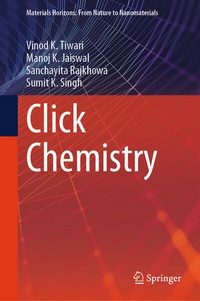
Click Chemistry
Description

This book comprehensively covers the fundamentals and latest advancements in the area of click chemistry. It discusses notable applications of click chemistry in various emerging areas ranging from chemical biology to catalysis and from medicinal chemistry to material sciences. Various topics covered in this book are catalysis in regioselectivity in click chemistry, organocatalysis in triazole synthesis, Bertozzi's Bioorthogonal Concept, photo-triggered click chemistry, SuFFEx Click, Thiol-Ene Click, MCR Click, Intramolecular Click Chemistry, synthesis of diverse triazoles and their applications, Click's Post Functionalization, etc. The book is a valuable reference for beginners, researchers and professionals interested in sustainable click concept and its diverse applications in allied fields.
More details
Other editions
Additional editions
Persons
Vinod K. Tiwari is Professor of Organic Chemistry at the Department of Chemistry, Banaras Hindu University (BHU, since 2005). He earned his M.Sc. degree in 1998 from BHU, Ph.D. from CSIR-Central Drug Research Institute, Lucknow (in 2004, Mentor: Dr. R. P. Tripathi), and had postdoctoral experience at University of Florida (Mentor: Prof. Alan R. Katritzky), University of California-Davis (Mentor: Prof. Xi Chen), and Guest Scientist at Universitat Konstanz-Germany (Mentor: Prof. Richard R. Schmidt). Dr. Tiwari has completed 11 projects, 16 Ph.Ds., 25 M.S. dissertations, and significantly contributed 179 peer-reviewed publications (Citations: 8321, h-index: 44, i10-index: 121), 8 patents, 25 book chapters, and 4 books. He is highly traveled Scientist and delivered > 265 invited lectures in India and abroad. Dr. Tiwari's research is recognized by various academic/scientific societies including ISCA, CRSI, ICC, ICS, DST, UPCTS, IAPS, ACCT(I), BHU, Elsevier, ACS, RSC, Wiley, Thiem, Bentham, Holkar Science College, etc. At present, he is Hony. Secretary, Association of Carbohydrate Chemists & Technologists of India; Council Member of the Chemical Research Society of India (CRSI); and Editorial Board Member of ten national and international journals. His current research is highly focused on ' Synthetic Carbohydrate Chemistry and Organic Synthesis' .
Manoj K. Jaiswal is CSIR-Extended Senior Research Fellow at the Department of Chemistry, Institute of Science, Banaras Hindu University. He completed his doctoral research under the supervision of Prof. V. K. Tiwari. He earned his M.Sc. degree from Shri Baldev P.G. College, Varanasi, India, in 2014. He worked on the synthesis of drug candidates and active pharmaceutical ingredients (API) at Chembiotek Research International, Kolkata, and at CSIR-Central Drug Research Institute, Lucknow, before joining his doctoral research as CSIR-JRF in the laboratory of Prof. V. K. Tiwari at BHU. He significantly contributed to 16 peer-reviewed publications including Chemical Reviews and 3 book chapters of high repute. His current research is mainly focused on ' Novel Glycosidation Methodology and Click Diversification in Glycoscience' .
Sanchayita Rajkhowa is Assistant Professor of Chemistry at The Haflong Govt. College (affiliated to Assam University), Assam. She earned her M.Sc. degree from the University of Delhi (in 2008) and doctoral degree from NEHU-Shillong (in 2017). She qualified UGC-JRF and worked at CSIR-NEIST, Jorhat. Dr. Rajkhowa taught Chemistry to UG/PG students at Gauhati University (2017-2019), JIST-Jorhat (2020-2021), and Royal Global University, Guwahati (2021-2022), before being appointed in The Haflong Govt. College-Haflong, Assam (2023). Dr. Rajkhowa contributed 24 peer-reviewed publications of high repute. She was awarded 'CONIAPS-Young Scientist Award-2019' and Best Oral Presentation Award-2023 during an international conference at Don Bosco University-Guwahati and delivered over 21 invited lectures. Her current research is focused on surface chemistry, ionic liquids, and carbohydrate chemistry.
Sumit K. Singh is Assistant Professor of Chemistry at Govt. PG College, Amarpatan, M.P. India. He was awarded his Ph.D. degree (in 2023) from Banaras Hindu University (BHU). He earned his B.Sc. (in 2015) and M.Sc. degrees in chemistry (in 2017) from BHU. He qualified GATE-2018 and NET-UGC-JRF and was selected for the prestigious Shyama Prasad Mukherjee (SPM) Fellowship. He significantly contributed to 21 peer-reviewed publications during his doctoral research under the guidance of Prof. V. K. Tiwari at the Department of Chemistry, BHU. His area of research interest is focused on the ' Click Chemistry-mediated Development of Novel Glycohybrids and their application in Catalysis'.
Content
Click Chemistry and Bioorthogonal Chemistry: General Consideration from Discovery to Applications.- CuAAC 'Click Chemistry' Mediated Synthesis of 1,4-Disubstituted 1,2,3-Triazoles.- RuAAC 'Click Chemistry' Mediated Synthesis of 1,5-Disubstituted 1,2,3-Triazole.- Organocatalyzed 1,2,3-Triazoles Forming Click Chemistry.- Catalyst-free 1,2,3-Triazole Forming Greener Approaches.- Bioothogonal Click Chemistry: Invention to Applications in Living Systems.- Thiol-Ene 'Click Chemistry': Discovery to Applications.- SuFEx Click Chemistry: Discovery to Applications .- CuAAC 'Click Chemistry' in Synthesis of Peptide and Protein Conjugates.- Click Chemistry in Dendrimer Synthesis.- Click Chemistry in Polymer Science .- Click Chemistry in Lipid Modification.- Click Chemistry in Glycoscience.- Click Chemistry in Nucleic Acid Chemistry.- Click Mediated 1,2,3-Triazoles in Drug Development.
