

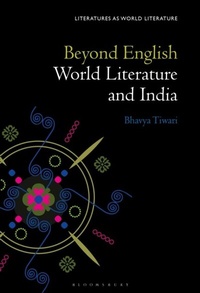
Beyond English
World Literature and India
1st Edition
Published on 4. November 2021
208 pages
978-1-5013-3466-5 (ISBN)
Description

Honorable Mention, Harry Levin Prize, 2022 (American Comparative Literature Association)
Beyond English: World Literature and India radically alters the debates on world literature that hinge on the model of circulation and global capital by deeply engaging with the idea of the world and world-making in South Asia. Tiwari argues that Indic words for world (vishva, jagat, sansar) offer a nuanced understanding of world literature that is antithetical to a commodified and standardized monolingual globe. She develops a comparative study of the concept of "world literature" (vishva sahitya) in Rabindranath Tagore's works, the desire for a new world in the lyrics of the Hindi shadowism (chhayavaad) poets, and world-making in Thakazhi Sivasankara Pillai's Chemmeen (1956) and Arundhati Roy's The God of Small Things (1997).
By emphasizing the centrality of "literature" (sahitya) through a close reading of texts, Tiwari orients world literature toward comparative literature and comparative literature toward a worldliness that is receptive to the poetics of a world in its original language and in translation.
Beyond English: World Literature and India radically alters the debates on world literature that hinge on the model of circulation and global capital by deeply engaging with the idea of the world and world-making in South Asia. Tiwari argues that Indic words for world (vishva, jagat, sansar) offer a nuanced understanding of world literature that is antithetical to a commodified and standardized monolingual globe. She develops a comparative study of the concept of "world literature" (vishva sahitya) in Rabindranath Tagore's works, the desire for a new world in the lyrics of the Hindi shadowism (chhayavaad) poets, and world-making in Thakazhi Sivasankara Pillai's Chemmeen (1956) and Arundhati Roy's The God of Small Things (1997).
By emphasizing the centrality of "literature" (sahitya) through a close reading of texts, Tiwari orients world literature toward comparative literature and comparative literature toward a worldliness that is receptive to the poetics of a world in its original language and in translation.
Reviews / Votes
Tiwari has written a lively riposte to "world literature" mongering that is also a wide-ranging introduction to aspects of twentieth century Indian literature in various languages. Engaging the work of well-known writers like Rabindranath Tagore as well as of writers who should be better known, like the Hindi-language Chhayavaad poet Mahadevi Varma, Tiwari boldly changes the terrain over which the "world literature" debate is conducted by bringing to the fore critical terms through which the non-Anglophone writers that she examines themselves understood this debate. Through this decolonizing move she takes us not just beyond English but beyond "world literature" to what she intriguingly calls a "worldly comparative literature." * S. Shankar, Chair and Professor, Department of English, University of Hawai'i at Manoa, USA, and author of Ghost in the Tamarind: A Novel * Beyond English is a highly original and insightful analysis of world literature from a perspective deeply embedded in a major world literature. Refusing the hegemony of English still evident in many studies of global literature and focusing on Indian texts that invoke and imagine the world in far-reaching and provocative ways, Tiwari truly vernacularizes the concept of world literature to offer a fresh take on postcolonial studies, literary studies, and South Asian letters. * Ulka Anjaria, Professor of English, Brandeis University, USA, and author of Reading India Now: Contemporary Formations in Literature and Popular Culture * Beyond English is an important contribution to the ongoing recalibration of relations among comparative, postcolonial, and world literary studies. Attending to the politics and poetics of translation within and across Indian languages, Bhavya Tiwari advances a worldly comparative literature that is open to the poetics of different worlds, as we savor 'the sap' of literary works both in the original and in translation. Exemplifying its own theme, Beyond English is itself a highly original translation across the conflictual worlds of literary studies today. * David Damrosch, Ernest Bernbaum Professor and Chair, Department of Comparative Literature, Director, Institute for World Literature, Harvard University, USA *More details
Series
Edition
1. Auflage
Language
English
Place of publication
New York
United States
Publishing group
Bloomsbury Publishing PLC (Digital)
Target group
Professional and scholarly
ISBN-13
978-1-5013-3466-5 (9781501334665)
Copyright in bibliographic data and cover images is held by Nielsen Book Services Limited or by the publishers or by their respective licensors: all rights reserved.
Schweitzer Classification
Other editions
Additional editions
Book
06/2023
Bloomsbury Academic USA
€44.40
Shipment within 15-20 days
Book
12/2021
Bloomsbury Academic USA
€141.36
Shipment within 15-20 days
Person
Bhavya Tiwari is Assistant Professor in the Department of Modern and Classical Languages at the University of Houston, USA.
Content
Acknowledgments
Note on Translation
Introduction: Beyond English
1. Why World Literature?
Vishva Sahitya
Universalism, Sahitya, and Sahit
Translation and Vishva Sahitya
2. Here Is World Literature
The World-making of the English Gitanjali
Tagore's Translations, World-making, and Gitanjali in Prose-poems
World-making of Gitanjali in Spanish
3. The World Is in the Lyrics
The World in Lyrics
The World-making of Chhayavaad
World vs. Vishva Sahitya in Hindi
4. (Woman) Author and the World
World-making vs. Vishva
Varma's Sahitya and Vishva
5. World in Translation, World in the Original
Chemmeen's Vishva in India and Beyond
To Compare, To World
World-making of Small Things
India in the Original, India in Translation
Coda: World Literature and India
Endnotes
Bibliography
Index
Note on Translation
Introduction: Beyond English
1. Why World Literature?
Vishva Sahitya
Universalism, Sahitya, and Sahit
Translation and Vishva Sahitya
2. Here Is World Literature
The World-making of the English Gitanjali
Tagore's Translations, World-making, and Gitanjali in Prose-poems
World-making of Gitanjali in Spanish
3. The World Is in the Lyrics
The World in Lyrics
The World-making of Chhayavaad
World vs. Vishva Sahitya in Hindi
4. (Woman) Author and the World
World-making vs. Vishva
Varma's Sahitya and Vishva
5. World in Translation, World in the Original
Chemmeen's Vishva in India and Beyond
To Compare, To World
World-making of Small Things
India in the Original, India in Translation
Coda: World Literature and India
Endnotes
Bibliography
Index
