

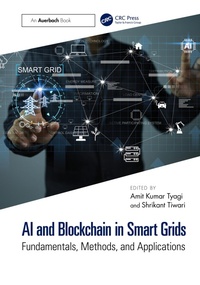
AI and Blockchain in Smart Grids
Fundamentals, Methods, and Applications
1st Edition
Published on 28. March 2025
373 pages
978-1-040-32709-8 (ISBN)
Description

AI and Blockchain in Smart Grids: Fundamentals, Methods, and Applications examines the cutting-edge solution that combines artificial intelligence (AI), blockchain technology, and digital twin concepts to innovate the management and optimization of electrical power distribution. This innovative approach enhances the resilience, efficiency, and security of electricity grids while providing real-time insights for grid operators and stakeholders. The book covers such key elements as using:
Digital twins in smart grids to gather real-time data from various grid components
AI-powered analytics to process the data generated by digital twins and to analyze this information to detect patterns, predict grid failures, and recommend adjustments to enhance a grid's performance
Blockchain-based security to ensure the secure and transparent management of data within a smart grid, especially a tamper-resistant ledger to store information related to energy production, distribution, and consumption
Decentralized data sharing to allow grid data to be shared securely among various stakeholders, including utilities, regulators, and consumers
Grid optimization techniques to improve electricity distribution, reduce energy waste, and balance supply and demand efficiently
Select real-world case studies and practical examples demonstrate how AI and blockchain are currently being applied to enhance grid management, energy distribution, and sustainability. By explaining to researchers, academics, and students how AI and blockchain can revolutionize electricity distribution and make grids smarter, more secure, and environmentally friendly, the book points to a future where grid operators, regulators, and consumers will benefit from real-time data and a resilient, efficient energy ecosystem.
Digital twins in smart grids to gather real-time data from various grid components
AI-powered analytics to process the data generated by digital twins and to analyze this information to detect patterns, predict grid failures, and recommend adjustments to enhance a grid's performance
Blockchain-based security to ensure the secure and transparent management of data within a smart grid, especially a tamper-resistant ledger to store information related to energy production, distribution, and consumption
Decentralized data sharing to allow grid data to be shared securely among various stakeholders, including utilities, regulators, and consumers
Grid optimization techniques to improve electricity distribution, reduce energy waste, and balance supply and demand efficiently
Select real-world case studies and practical examples demonstrate how AI and blockchain are currently being applied to enhance grid management, energy distribution, and sustainability. By explaining to researchers, academics, and students how AI and blockchain can revolutionize electricity distribution and make grids smarter, more secure, and environmentally friendly, the book points to a future where grid operators, regulators, and consumers will benefit from real-time data and a resilient, efficient energy ecosystem.
More details
Edition
1. Auflage
Language
English
Place of publication
London
United Kingdom
Publishing group
Taylor & Francis Ltd
Target group
College/higher education
Illustrations
148 Line drawings, black and white; 148 Illustrations, black and white
File size
19,49 MB
ISBN-13
978-1-040-32709-8 (9781040327098)
Copyright in bibliographic data and cover images is held by Nielsen Book Services Limited or by the publishers or by their respective licensors: all rights reserved.
Schweitzer Classification
Other editions
Additional editions
Shrikant Tiwari | Amit Kumar Tyagi
AI and Blockchain in Smart Grids
Fundamentals, Methods, and Applications
Book
approx. 07/2026
1st Edition
Auerbach
€77.50
Not yet published
Shrikant Tiwari | Amit Kumar Tyagi
AI and Blockchain in Smart Grids
Fundamentals, Methods, and Applications
Book
03/2025
1st Edition
Auerbach
€272.70
Shipment within 10-20 days
Persons
Amit Kumar Tyagi is an assistant professor, Department of Fashion Technology, National Institute of Fashion Technology, New Delhi. He earned a PhD degree from Pondicherry Central University, India. He has worked as an assistant professor and senior researcher at the School of Computer Science and Engineering, Vellore Institute of Technology, Chennai, India. He is a regular member of the ACM and senior member of IEEE.
Shrikant Tiwari received a PhD degree from the Department of Computer Science & Engineering at the Indian Institute of Technology (Banaras Hindu University), Varanasi, India. Currently, he is an associate professor in the School of Computing Science and Engineering (SCSE), Galgotias University, Greater Noida, India. He has authored or co-authored more than 50 national and international journal publications, book chapters, and conference articles. He has five patents filed to his credit. His research interests include machine learning, deep learning, computer vision, medical image analysis, pattern recognition, and biometrics. Dr. Tiwari is a FIETE, a senior member of the IEEE, and member of ACM, IET, CSI, ISTE, IAENG, and SCIEI.
Shrikant Tiwari received a PhD degree from the Department of Computer Science & Engineering at the Indian Institute of Technology (Banaras Hindu University), Varanasi, India. Currently, he is an associate professor in the School of Computing Science and Engineering (SCSE), Galgotias University, Greater Noida, India. He has authored or co-authored more than 50 national and international journal publications, book chapters, and conference articles. He has five patents filed to his credit. His research interests include machine learning, deep learning, computer vision, medical image analysis, pattern recognition, and biometrics. Dr. Tiwari is a FIETE, a senior member of the IEEE, and member of ACM, IET, CSI, ISTE, IAENG, and SCIEI.
Content
1. Machine Learning Fundamentals 2. Machine Learning and Predictive Maintenance in Smart Grids 3. Machine Learning, Deep Learning and Internet of Things-Based Smart Grids and Power Systems 4. Integration of AI and Blockchain with Digital Twins for Smart Grid 5. WattNext: Decoding for Tomorrow's Energy Demands 6. A Blockchain-Based Authentication Scheme/Framework for Secure Data Sharing 7. Security and Privacy Issues in AI- Blockchain-Enabled Digital Twin-Based Smart Grid 8. AI and Blockchain Applications in Smart Grids/Energy Sector 9. Leading AI Applications in the Sustainable Energy Sector 10. Unveiling the World with Precision: A Journey into Semantic Segmentation 11. Blockchain-Based Authentication Scheme/Framework for Secure Data Sharing 12. Node Identification Algorithm in Cluster Based on Fog Computing in VANET Using Normal Distribution 13. Analysis of FOREX Forecasting Using Machine Learning and Deep Learning Techniques 14. Energy Management Approaches Using Artificial Intelligence and Blockchain 15. An Improved Object Detection Algorithm for Maritime Search and Rescue Based on Drone Imagery 16. Blockchain Controlled Offline IoT Data Stream Secured Using Identity-Based Proxy Re-Encryption Technique 17. Analysis of AI For Optimization of Smart Grids 18 Powering Up e-Health: AI and Blockchain for a Smarter and Safer e-Health System 19 A Blockchain-Based Architecture for Secure and Decentralized Agricultural Supply Chain Management 20. A Vital Research and State-of-the-Art Application in Artificial Intelligence into Smart Grids 21. An Intelligent Digital Twin Framework for Condition Monitoring of Aircraft Engines
