

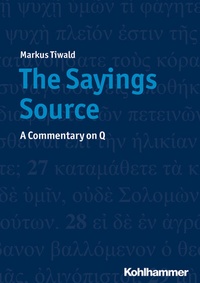
The Sayings Source
A Commentary on Q
1st Edition
Published on 11. March 2020
238 pages
978-3-17-037439-3 (ISBN)
Description

The so-called "Sayings Source" ("Q") contains traditions that can be found in the narrative gospels of Matthew and Luke. Situated within both early Judaism and the burgeoning Jesus movement, the sayings waver somewhere between the historical Jesus and the Christian communities. Following the reconstructed text of the "Critical Edition of Q", Tiwald brings a new study on the narratology of Q as a coherent attempt to answer the question: Who is Jesus?
More details
Other editions
Additional editions
Book
03/2020
1st Edition
Kohlhammer
€49.00
Shipment within 5-7 days
Person
Content
- Cover
- Titlepage
- Imprint
- Content
- Acknowledgements
- Part I: Introduction to this Commentary
- 1. Preliminary Questions
- 1.1 The Existence of the Sayings Source
- 1.2 The Reconstruction of Q
- 1.2.1 The Critical Edition of Q
- 1.2.2 Narratological Access to Q
- 1.2.3 Consequences for this Commentary
- 1.2.4 Textual Fluidity as an Essential Feature of Q
- 1.2.5 Textual Basis for this Commentary
- 2. Positioning this Commentary among other Ümlbreak(off)ÝQ-CommentariesÜmlbreak(on)Ý
- 2.1 Status Quaestionis
- 2.2 Aliquid Novi?
- Part II: Introductory Questions to Q
- 1. The Time and Place of Q' Composition
- 1.1 The Time of Q' Literal Composition
- 1.2 The Place of Composition
- 2. The Community behind the Sayings Source
- 2.1 Q and Early Judaism
- 2.1.1 Jesus vs. Torah?
- 2.1.2 Anti-Jewish Polemics in Q?
- 2.1.3 Gentile Mission in Q?
- 2.2 The Authors of Q
- 2.2.1 Itinerant Prophets ...
- 2.2.2 ... and Village Scribes
- 2.3 The Heritage Contained in Q
- 2.3.1 Q as Witness to Early Jesus Traditions
- 2.3.2 The Heritage of Q
- 3. Extent and Structure of Q
- 3.1 Deviations from the Lukan Sequence
- 3.1.1 The Q-Order Proposed by the CEQ
- 3.1.2 Modifications of the CEQ-Sequence
- 3.2 Extent of the Q-Text
- 3.3 The Structure of the Q-Text
- 3.4 The Narrative Plot of Q
- 3.4.1 Narrative Cycle 1: The Main Actors ÜqlJohn the Baptist and Jesus of Nazareth (Q 3:2b-7:35)
- 3.4.2 Narrative Cycle 2: The Missionaries ÜqlThe Messengers of the Son of Man (Q 9:57-11:13)
- 3.4.3 Narrative Cycle 3: The Adversaries ÜqlNatural and Supernatural Opponents (Q 11:14-52
- 16:17-18)
- 3.4.4 Narrative Cycle 4: Consequences for the Community Confidence in Distress (Q 12:2-13:21)
- 3.4.5 Narrative Cycle 5: Consequences for the Opponents Announcement of Judgement (Q 13:24-14:23)
- 3.4.6 Narrative Cycle 6: Instructions for the End Times ÜqlThe Disciples in Attendance at the Parousia (Q 14:26-17:6)
- 3.4.7 Narrative Cycle 7: The Impending End (Q 17:23-22:30)
- 3.5 Q' Plot and the Stages of Salvation History
- 3.6 Oral Performance and Literal Framing
- Part III: Commentary to the Sayings Source
- Title and Introduction of Q?
- Narrative Cycle 1: The Main Actors John the Baptist and Jesus of Nazareth (Q 3:2b-7:35)
- Narrative Unit 1: The Message of John (Q 3:2b-17)
- The Introduction of John (Q 3:2b-3a)
- John' Announcement of Judgement (Q 3:7-9)
- John and the One to Come (Q 3:16b-17)
- Narrative Unit 2: The Baptism and Testing of Jesus (Q 3:21-22
- 4:1-13.16)
- The Baptism of Jesus (Q 3:21-22)
- The Temptations of Jesus (Q 4:1-13)
- Nazara (Q 4:16)
- Narrative Unit 3: Jesus'Programmatic Address (Q 6:20-49)
- Beatitudes (Q 6:20-23)
- Love Your Enemies &Renounce Violence (Q 6:27-28.35cd.29-30)
- The Golden Rule &Being Full of Mercy (Q 6:31-32.34.36)
- Not Judging (Q 6:37-38)
- The Blind Leading the Blind (Q 6:39)-he Disciple and the Teacher (Q 6:40)
- The Speck and the Beam (Q 6:41-42)
- The Tree is Known by its Fruit (Q 6:43-45)
- Not Just Saying »Master, Master« (Q 6:46)
- Built on Rock or Sand (Q 6:47-49)
- Narrative Unit 4: The Gentile Officer' Faith in Jesus'Word (Q 7:1-10)
- Narrative Unit 5: John and Jesus (Q 7:18-35 and 16:16)
- John' Inquiry about the One to Come (Q 7:18-19.22-23)
- John-ore than a Prophet (Q 7:24-28)
- The Reign of God is Violated (Q 16:16)
- For and Against John (Q 7:29-30)
- This Generation and the Children of Wisdom (Q 7:31-35)
- Narrative Cycle 2: The Missionaries ÜqlThe Messengers of the Son of Man (Q 9:57-11:13)
- Narrative Unit 1: Radical Discipleship (Q 9:57-60)
- Foxes and Birds (Q 9:57-58)
- Leave the Dead to Bury their Own Dead! (Q 9:59-60)
- Narrative Unit 2: Instruction for Mission (Q 10:2-16)
- Workers for the Harvest (Q 10:2)
- Sheep among Wolves (Q 10:3)
- Rule for Provisions: Mission in Emblematic Poverty (Q 10:4)
- House-Mission and Town-Mission (Q 10:5-12)
- Woes against Galilean Towns (Q 10:13-15)
- Whoever Takes You in Takes Me in (Q 10:16)
- Narrative Unit 3: The Special Revelation of the Son (Q 10:21-24)
- Hidden from Sages, Revealed to Children (Q 10:21)
- Knowing the Father through the Son (Q 10:22)
- Blessed are the Eyes that See What You See (Q 10:23-24)
- Narrative Unit 4: The Trustful Prayer of the Disciples Ümlbreak(off)Ý(Q 11:2b-4.9-13)Ümlbreak(on)Ý
- The Lord' Prayer (Q 11:2b-4)
- Ask and It will be Given to You (Q 11:9-13)
- ÜtbÜdc8ÝNarrative Cycle 3: The Adversaries ÜqlNatural and Supernatural Opponents (Q 11:14-52
- 16:17-18)
- Narrative Unit 1: Jesus'Victory over the Demons (Q 11:14-26)
- Casting out Demons by the Finger of God (Q 11:14-15.17-20)
- Burgling a Strong Person (Q 11:21-22)
- The One not with Me (Q 11:23)
- The Return of the Unclean Spirit (Q 11:24-26)
- Narrative Unit 2: The Judgement over »This Generation« (Q 11:16.29-32)
- The Sign of Jonah (Q 11:16.29-30)
- The Queen of the South and the Men of Nineveh (Q 11:31-32)
- Narrative Unit 3: Let your Light Shine! (Q 11:33-35)
- The Light on the Lampstand (Q 11:33)
- The Light within You (Q 11:34-35)
- Narrative Unit 4: Against Pharisees and Scribes of the Law (Q 16:17-18
- 11:39-52)
- No Iota and no Serif of the Law to Fall (Q 16:17)
- Prohibition of Divorce and Remarriage (Q 16:18)
- Woes against the Pharisees (Q 11:42.39b.41.43-44)
- Woes against the Scribes of the Law (Q 11:46b.52.47-48)
- Wisdom' Judgment on »This Generation« (Q 11:49-51)
- Narrative Cycle 4: Consequences for the Community ÜqlConfidence in Distress (Q 12:2-13:21)
- Narrative Unit 1: Proclaiming Jesus without Fear (Q 12:2-12)
- Uncovering What Is Hidden (Q 12:2-3)
- Not Fearing the Body' Death (Q 12:4-5)
- More Precious than Many Sparrows (Q 12:6-7)
- Confessing the Son of Man (Q 12:8-9)
- Speaking against the Holy Spirit (Q 12:10)
- Hearings before Synagogues (Q 12:11-12)
- Narrative Unit 2: Search for the Reign of God! (Q 12:22b-34)
- Free from Anxiety like Ravens and Lilies (Q 12:22b-31)
- Storing up Treasures in Heaven (Q 12:33-34)
- Narrative Unit 3: The Coming of the Son of Man (Q 12:39-59)
- The Son of Man Comes as a Robber (Q 12:39-40)
- The Faithful or Unfaithful Slave (Q 12:42-46)
- Fire on the Earth (Q 12:49)
- Children against Parents (Q 12:51.53)
- Settling out of Court (Q 12:58-59)
- Narrative Unit 4: Parables of the Reign of God (Q 13:18-21)
- The Parable of the Mustard Seed (Q 13:18-19) and the Yeast (Q 13:20-21)
- Narrative Cycle 5: Consequences for the Opponents ÜqlAnnouncement of Judgement (Q 13:24-14:23)
- Locked Out (Q 13:24-29)
- The Reversal of the Last and the First (Q 13:30)
- Judgment over Jerusalem (Q 13:34-35)
- The Exalted are Humbled and the Humble are Exalted (Q 14:11)
- The Parable of the Invited Dinner Guests (Q 14:16-18.21.23)
- Narrative Cycle 6: Instructions for the End Times ÜqlThe Disciples in Attendance at the Parousia Ümlbreak(off)Ý(Q 14:26-17:21)Ümlbreak(on)Ý
- Narrative Unit 1: Discipleship without Compromise Ümlbreak(off)Ý(Q 14:26-17:2)Ümlbreak(on)Ý
- Hating One' Family &Taking Up One' Cross (Q 14:26-27)
- Losing One' Life (Q 17:33)
- Tasteless Salt (Q 14:34-35)
- God or Mammon (Q 16:13)
- Against Tempting Little Ones (Q 17:1-2)
- Narrative Unit 2: The Forgiveness of God and of One Another (Q 15:4-10
- 17:4)
- The Lost Sheep (Q 15:4.5a.7)
- The Lost Coin (Q 15:8-10)
- Forgiving Seven Times (Q 17:3-4)
- Narrative Unit 3: Faith Like a Mustard Seed (Q 17:6)
- Faith Like a Mustard Seed (Q 17:6)
- Narrative Cycle 7: The Impending End (Q 17:23-22:30)
- Narrative Unit 1: The Day of the Son of Man (Q 17:23-37
- Ümlbreak(off)Ý19:12-26)Ümlbreak(on)Ý
- The Son of Man Like Lightning (Q 17:23-24)
- Vultures around a Corpse (Q 17:37)
- As in the Days of Noah (Q 17:26-27.30)
- One Taken, One Left (Q 17:34-35)
- The Parable of the Entrusted Money (Q 19:12-13.15-24.26)
- Narrative Unit 2: Judging the Twelve Tribes of Israel (Q 22:28.30)
- Part IV: Excursi
- Excursus 1: Reign of God, Disempowerment of Satan, Son of Man
- 1.1 The Reign of God
- 1.1.1 The Term »Reign of God«
- 1.1.2 Origins of the Term
- 1.2 The Disempowerment of Satan
- 1.3 The Son of Man
- 1.4 Reading Q Against the Backdrop of Early Jewish Assumptions
- 1.4.1 The Expectations of the Baptist
- 1.4.2 Jesus'Paradigm Shift
- 1.4.3 Jesus'Experience
- 1.4.4 Jesus'Continuation of the Baptist' Ideas
- 1.4.5 The Restitution of Humanity
- 1.4.6 The Son of Man in Jesus'Thought and in Q
- Excursus 2: The Use of Scripture in Q
- 2.1 The Sacred Scriptures of the Authors behind Q
- 2.1.1 The >anon
ible< - 2.1.2 Aramaic Sources of Q
- 2.1.3 The so-called >eptuagint<
- 2.2 Scriptural Quotations in Q
- 2.2.1 Direct and Indirect Quotations
- 2.2.2 Direct Quotations in Q
- 2.2.3 Indirect Quotations in Q
- 2.2.4 Index of Direct and Indirect Quotations in Q
- 2.3 Results
- Excursus 3: God' Advocacy for the Poor and the »Violent Fate of Prophets«
- 3.1 God' Advocacy for the Poor
- 3.1.1 Piety in Poverty in Early Judaism
- 3.1.2 Jesus'Advocacy for the Poor
- 3.1.3 Advocacy for the Poor in the Sayings Source
- 3.2 The »Violent Fate of Prophets«
- 3.3 Textual Pragmatics of Piety in Poverty and the »Violent Fate of Prophets«
- Excursus 4: Apocalyptic Patterns in Q
- 4.1 Eschatological Chaos
- 4.1.1 The Eschatological Testing
- 4.1.2 »This Generation«
- 4.1.3 Eschatological War and Disruption of Families
- 4.1.4 Imagery of Violence and Insistence
- 4.2 The Eschatological Peace of God
- 4.2.1 Restitution of the Peace of Paradise
- 4.2.2 The Materially Noticeable Peace of God
- 4.2.3 Emblematic Non-Violence and Confidence in God
- 4.3 Jesus'Optimism vs. Judgement in Q?
- 4.3.1 Ambivalent Eschatological Expectations
- 4.3.2 A Comparison with Other Early Jewish Writings
- Excursus 5: Parables and Metaphorical Imagery in Q
- 5.1 General Considerations on the Parables of Jesus
- 5.1.1 Parables and the Historical Jesus
- 5.1.2 Parables in the Sayings Source
- 5.1.3 The Message of Q-Parables
- 5.2 Gendered Couplets in Q' Imagery
- 5.2.1 Gendered Couplets ...
- 5.2.2 ... and their Interpretation in Feminist Exegesis
- Bibliography
- 1. Primary Literature
- 1.1 Classic Literature
- 1.1.1 Early Jewish Apocrypha and Pseudepigrapha
- 1.1.2 Qumran Manuscripts
- 1.1.3 Philo and Josephus
- 1.1.4 Pagan Authors
- 1.1.5 Rabbinic Literature
- 1.1.6 Early Christian Apocrypha and Pseudepigrapha
- 1.1.7 Patristic Literature
- 1.2 Edition of the Sayings Source
- 2. Tools
- 3. Secondary Literature
- Index
- 1. Subject Index
- 2. Index of Primary Sources
- 2.1 Old Testament
- 2.2 Early Jewish Apocrypha and Pseudepigrapha
- 2.3 Dead Sea Scrolls
- 2.4 Philo of Alexandria
- 2.5 Josephus
- 2.6 Greek and Roman Authors
- 2.7 New Testament (including the Sayings Source)
- 2.8 Targums
- 2.9 Rabbinic Writings
- 2.10 Patristic Writings
- 2.11 Early Christian Apocrypha and Pseudepigrapha
