

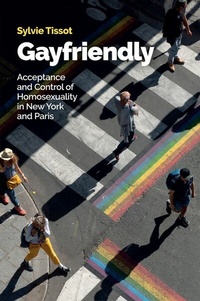
Gayfriendly
Description

Acceptance of homosexuality has undeniably grown, and homosexuality is increasingly seen as one form of sexuality among others. But embedded in this liberal vision is a perspective that is more troubling. Based on interviews with gayfriendly straight people in the liberal neighbourhoods of Park Slope in New York and the Marais in Paris, Sylvie Tissot shows that stereotypes remain and control of gays and lesbians has not disappeared. Acceptance is directed towards those who are of the same socioeconomic background, who proclaim their wish to emulate traditional norms of family life, and who do not make any other demands.
Gays must be normal but not completely so, similar and at the same time different, in order to meet the not always conscious conditions of acceptability.
Gayfriendliness has managed to dispel violence and discrimination and has accompanied the invention of less conventional lives. But, as Tissot shows, it has not yet liberated itself from the clutches of heterosexual domination which still structures our society and our ways of thinking.
More details
Other editions
Additional editions
Persons
Content
Introduction
Chapter 1. Becoming Gayfriendly
Reticence, recognition, indifference: three different generations
'It simply didn't exist'
'It would be un-cool to be un-gayfriendly'
'A non-issue'
The learning processes
Atypical heterosexuals
The ordeal of coming out
Chapter 2. Gay Respectability
The right to love each other American-style and sexual freedom in France
The Power of the Law
Sexual Liberalism
Gay marriage, heterosexual relief
Republican universalism and the difference between the sexes
Good neighbours, good husbands and wives, good parents
Appropriating an area in the name of diversity
Progressive synagogues and churches in Park Slope
A cause for gentrifiers
From lesbian enclave to gayfriendly district
Family integration, class integration
Gayfriendliness within the family
You shall be gayfriendly, my child
Integration and surveillance of same-sex families
You will (perhaps) be gay, my child
The guide for gayfriendly parents
From tomboy to invisible lesbian
Chapter 3. Heterosexuals as allies
Feminine Compassion
The division of moral labour
Male unease
The 'Cruisers' of the Parisian night scene
The 'fag hag' and her 'gay best friend'
Disillusions, safe haven and substitute
The Prism of femininity
Gayfriendliness and lesbophobia
Women rebelling against marriage
(Re)-building your life when living alone
Sexual experiments
Chapter 4. The frontiers of gayfriendliness
A race and class norm
Homophobia as bad taste
Talking about space, not race
The Southern United States as a deterrent
Visibilities and invisibilities
Keeping the streets clean
My gay friends
The home of heterosexuality
Conclusion
Bibliography
Notes
INTRODUCTION
Late 2012: in France, hundreds of thousands of people were protesting against the draft bill to legalize same-sex marriage which would finally be approved in 2013. I was in New York at that time, where this movement, known as 'La manif pour tous' ('Protest for all),1 was viewed with an astonishment that tarnished American perceptions of France's reputation for sexual progressiveness. In the course of my research, I encountered many Brooklyn residents, such as Isabelle, a 38-year-old lesbian, French like myself, but settled in New York on a permanent basis. She was living in the southern part of Park Slope, an area still in the process of gentrification, where she and her wife had bought an apartment. When I asked her if she had ever found herself on the receiving end of insults, or violence, she replied:
No. Never in New York. In fact, the only time it happened was when some people were making fun of us - 'Ah, the two lesbians at the next table' - and they were French people in a restaurant! I didn't say anything, although I could have said 'Look, I can understand what you're saying.' It wasn't very nice. They weren't saying anything really bad, but when people are making fun of you and you're right next to them, it's not very pleasant. But that's the only time it's ever happened. Here it's more a matter of complete indifference.
Her reply could have brought an abrupt end to the question which this book sets out to explore: is acceptance of homosexuality more advanced in Paris or in New York? The everyday acceptance which prevails in the famous American city, the rights which have been successfully won and, even more, the enthusiastic celebration of a certain gayfriendliness contrast not only with the reactionary movement of the Manif pour tous in 2012-13 but also with the fact that, in France, the cause of gays and lesbians is associated with more reservations, less enthusiasm and a lower level of institutionalization. Yet, in their own way, Parisians are also gayfriendly and are undoubtedly becoming ever more so, as demonstrated, for example, by the fact that, on the initiative of the city's mayor, rainbows were painted on the pavements of some streets in the gay district of the Marais. Indeed, in both cities, on an institutional level and among many of the residents, there is a condemnation of homophobia which seems to mark the end of decades of stigmatization, hatred and persecution. Rather than establishing winners and losers, in this book I set another objective - that of understanding the individual journeys each country has undertaken in order to achieve this social progress by focusing on what are essentially two different ways of being tolerant. I am not, however, simply proposing a comparison. My research aims to explore the profound ambiguity of this progress, which it seems is no sooner celebrated than immediately challenged. Indeed, as early as the 1990s, when demands relating to marriage, family or joining the army were first beginning to be voiced, certain writers had pointed out the pernicious effect of these victories. Using terms such as 'normalization' or 'homonormativity',2 a barrage of criticism targeted the changes in gay lifestyles and the end of the subversiveness previously associated with them. Gone were radical protests against society, in conjunction with black, feminist or anti-capitalist movements. Relegated to invisibility, from then onwards, were the places where people could meet up for recreational sex and alternative forms of sociability. Instead, mainstream organizations, supported by affluent white gays, thanks to the efforts of large-scale fundraising operations, were demanding social integration through access to marriage and family life,3 and large-scale campaigns, referred to as 'homonationalism' or 'pinkwashing', were reclaiming the LGBT cause for commercial or imperialistic ends.4
In comparison with these studies, my ambition was twofold and, as will become evident, necessitated a sociological investigation. My first objective was to understand the exact nature of a social progress which, as is often the case (take the achievements of the civil rights movements or indeed of feminism), is not a linear phenomenon. It cannot be described simply in terms of a shift from intolerance to tolerance, from hatred to acceptance, but rather as a process in which new boundaries are mapped out. In its wake come new rights and, at the same time, new constraints. Considerable advances have certainly been made in the legal approach to homosexuality. In 1981, France rejected the World Health Organization's definition of homosexuality as a mental disorder. Repression had officially ended, and the last documents discriminating against homosexuals had been scrapped. In the USA, a similar process occurred, although it was not until 2013 that the Supreme Court declared as anti-constitutional the so-called anti-sodomy laws still in force in fourteen states. In both countries, the battle against various forms of discrimination had taken over from the fight against criminalization, and, until it was eventually legalized, same-sex marriage was a high-profile legal and political issue. In France, the law on the Pacs (Pacte civil de solidarité)5 in 1999 paved the way for the recognition, in 2013, of the right to marry and adopt children. On the other side of the Atlantic, where same-sex marriage had been recognized by several states since 2003, the Supreme Court declared in 2015 that any attempt to forbid such unions was anti-constitutional.
If then, in spite of this progress, the era of equality has still failed to arrive, could it be because a certain resistance persists at the heart of public opinion? In reality, public perception has evolved in parallel with legal changes, as numerous surveys and investigations indicate.6 In Paris and in New York (but the same could also be said of many other cities), rejection of homosexuality seems even to be considered an outlawed attitude, relegated to ancient history. In the districts of the Marais and Park Slope where I carried out my research, the presence of gays and lesbians among the friends, colleagues and neighbours of heterosexual residents had become commonplace, and support for same-sex marriage was often self-evident and even enthusiastic. In short, these heterosexuals were (and often declared themselves to be) gayfriendly. This gayfriendliness nevertheless brings with it considerable ambiguity, as is evident from the comments of some of the residents I encountered, in spite of the fact that all of them were adamant in their rejection of homophobia. Take, for example, the case of a Parisian man, formerly an enthusiastic connoisseur and client of the bars in the Marais, who voiced his support for same-sex marriage (though at the same time describing the institution as 'outdated' and 'tacky') but then expressed reservations about same-sex parenting, a view shared by his partner, who stressed the idea of a necessary 'difference'. Or a woman from New York who had made a donation to the campaign for same-sex marriage and expressed her delight about living in an area where the schools her son might attend were 'gayfriendly', but who nevertheless mentioned that her lesbian friends, of whom she had many, all living as couples, did not adopt a 'stereotyped' look (such as short hair). The comments made by these two interviewees, both of whom we shall encounter at a later stage, indicate two things. Firstly, they reveal the existence of two national models, based on different combinations of the elements defining respectability (marriage, sexuality, family, etc.). Secondly, as is apparent, there are multiple criteria associated with gayfriendliness, and the attitudes involved are not always coherent. Rather than defining the exact nature of gayfriendliness and casting light on any divergencies from such an ideal, I have instead set myself the goal of demonstrating how acceptance and distancing can coexist within the same person and how a particular neighbourhood can be inclusive while still excluding certain groups or individuals. What exactly are the constituents of this new and, in some respects, surprising attitude, which no sooner seems to eliminate rejection than it imposes a new set of distances? Readers will have to decide whether the transformations it has generated are welcome or disappointing, whether they should be celebrated or deplored. And those heterosexuals who consider themselves tolerant, and are determined to be so, might perhaps find some food for thought in all of this.
I am referring to heterosexuals here because, as well as setting out to analyse a new and intriguing approach, the second goal of this book is to demonstrate that, as a result of these new attitudes, not only has the place of homosexuality in contemporary societies changed but heterosexuality too is in the process of being reconfigured. A historic change has in fact taken place, and heterosexuals have changed as a result of the emergence of gay and lesbian movements. It is not simply that they have become more tolerant but, rather, that they are heterosexuals in a different way, the result of giving up some of their privileges (exclusive access to marriage and to family life) but also of claiming others (an insistence that gays and lesbians be 'respectable' and a cautious and controlled promotion of sexual tolerance). If interviews with gays and lesbians are included in...
