

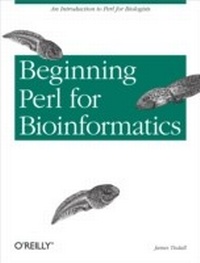
Beginning Perl for Bioinformatics
An Introduction to Perl for Biologists
1st Edition
Published on 22. October 2001
384 pages
978-0-596-51627-7 (ISBN)
Description

With its highly developed capacity to detect patterns in data, Perl has become one of the most popular languages for biological data analysis. But if you're a biologist with little or no programming experience, starting out in Perl can be a challenge. Many biologists have a difficult time learning how to apply the language to bioinformatics. The most popular Perl programming books are often too theoretical and too focused on computer science for a non-programming biologist who needs to solve very specific problems.Beginning Perl for Bioinformatics is designed to get you quickly over the Perl language barrier by approaching programming as an important new laboratory skill, revealing Perl programs and techniques that are immediately useful in the lab. Each chapter focuses on solving a particular bioinformatics problem or class of problems, starting with the simplest and increasing in complexity as the book progresses. Each chapter includes programming exercises and teaches bioinformatics by showing and modifying programs that deal with various kinds of practical biological problems. By the end of the book you'll have a solid understanding of Perl basics, a collection of programs for such tasks as parsing BLAST and GenBank, and the skills to take on more advanced bioinformatics programming. Some of the later chapters focus in greater detail on specific bioinformatics topics. This book is suitable for use as a classroom textbook, for self-study, and as a reference.The book covers:Programming basics and working with DNA sequences and strings Debugging your codeSimulating gene mutations using random number generatorsRegular expressions and finding motifs in dataArrays, hashes, and relational databasesRegular expressions and restriction mapsUsing Perl to parse PDB records, annotations in GenBank, and BLAST output
More details
Other editions
Additional editions
James Tisdall
Beginning Perl for Bioinformatics
Book
11/2001
O'Reilly
€37.50
Article not available at the moment
Content
- Intro
- Table of Contents
- Preface
- What Is Bioinformatics?
- What Bioinformatics Can Do
- About This Book
- Who This Book Is For
- Why Should I Learn to Program?
- Structure of This Book
- Conventions Used in This Book
- Comments and Questions
- Acknowledgments
- Chapter 1. Biology and Computer Science
- The Organization of DNA
- The Organization of Proteins
- In Silico
- Limits to Computation
- Chapter 2. Getting Started with Perl
- A Low and Long Learning Curve
- Perl's Benefits
- Ease of Programming
- Rapid Prototyping
- Portability, Speed, and Program Maintenance
- Versions of Perl
- Installing Perl on Your Computer
- Perl May Already Be Installed!
- No Internet Access?
- Downloading
- Binary Versus Source Code
- Installation
- Unix and Linux
- Macintosh
- Windows
- How to Run Perl Programs
- Unix or Linux
- Macs
- Windows
- Text Editors
- Finding Help
- Chapter 3. The Art of Programming
- Individual Approaches to Programming
- Edit-Run-Revise (and Save)
- Saves and Backups
- Error Messages
- Debugging
- An Environment of Programs
- Open Source Programs
- Programming Strategies
- The Programming Process
- The Design Phase
- Algorithms
- Pseudocode and Code
- Comments
- Chapter 4. Sequences and Strings
- Representing Sequence Data
- A Program to Store a DNA Sequence
- Control Flow
- Comments Revisited
- Command Interpretation
- Statements
- Variables
- Strings
- Assignment
- Exit
- Concatenating DNA Fragments
- Transcription: DNA to RNA
- Using the Perl Documentation
- Calculating the Reverse Complement in Perl
- Proteins, Files, and Arrays
- Reading Proteins in Files
- Arrays
- Scalar and List Context
- Exercises
- Chapter 5. Motifs and Loops
- Flow Control
- Conditional Statements
- Conditional tests and matching braces
- Loops
- open and unless
- Code Layout
- Finding Motifs
- Getting User Input from the Keyboard
- Turning Arrays into Scalars with join
- do-until Loops
- Regular Expressions
- Regular expressions and character classes
- Pattern matching with =~ and regular expressions
- Counting Nucleotides
- Exploding Strings into Arrays
- Operating on Strings
- Writing to Files
- Exercises
- Chapter 6. Subroutines and Bugs
- Subroutines
- Advantages of Subroutines
- Writing Subroutines
- Scoping and Subroutines
- Arguments
- Scoping
- Command-Line Arguments and Arrays
- Passing Data to Subroutines
- Subroutines: Pass by Reference
- Modules and Libraries of Subroutines
- Fixing Bugs in Your Code
- use warnings
- and use strict
- Fixing Bugs with Comments and Print Statements
- The Perl Debugger
- A program with bugs
- How to start and stop the debugger
- Debugger command summary
- Stepping through statements with the debugger
- Setting breakpoints
- Fixing another bug
- use warnings
- and use strict
- redux
- Exercises
- Chapter 7. Mutations and Randomization
- Random Number Generators
- A Program Using Randomization
- Seeding the Random Number Generator
- Control Flow
- Making a Sentence
- Randomly Selecting an Element of an Array
- Formatting
- Another Way to Calculate the Random Position
- A Program to Simulate DNA Mutation
- Pseudocode Design
- Select a random position in a string
- Choose a random nucleotide
- Place a random nucleotide into a random position
- Improving the Design
- Combining the Subroutines to Simulate Mutation
- A Bug in Your Program?
- Generating Random DNA
- Bottom-up Versus Top-down
- Subroutines for Generating a Set of Random DNA
- Turning the Design into Code
- Analyzing DNA
- Some Notes About the Code
- Exercises
- Chapter 8. The Genetic Code
- Hashes
- Data Structures and Algorithms for Biology
- A Gene Expression Database
- Gene Expression Data Using Unsorted Arrays
- Gene Expression Data Using Sorted Arrays and Binary Search
- Gene Expression Data Using Hashes
- Relational Databases
- DBM
- The Genetic Code
- Background
- Translating Codons to Amino Acids
- The Redundancy of the Genetic Code
- Using Hashes for the Genetic Code
- Translating DNA into Proteins
- Reading DNA from Files in FASTA Format
- FASTA Format
- A Design to Read FASTA Files
- A Subroutine to Read FASTA Files
- Writing Formatted Sequence Data
- A Main Program for Reading DNA and Writing Protein
- Reading Frames
- What Are Reading Frames?
- Translating Reading Frames
- Exercises
- Chapter 9. Restriction Maps and Regular Expressions
- Regular Expressions
- Restriction Maps and Restriction Enzymes
- Background
- Planning the Program
- Restriction Enzyme Data
- Logical Operators and the Range Operator
- Finding the Restriction Sites
- Perl Operations
- Precedence of Operations and Parentheses
- Exercises
- Chapter 10. GenBank
- GenBank Files
- GenBank Libraries
- Separating Sequence and Annotation
- Using Arrays
- Using Scalars
- Pattern modifiers
- Examples of pattern modifiers
- Separating annotations from sequence
- Parsing Annotations
- Using Arrays
- When to Use Regular Expressions
- Main Program
- Parsing Annotations at the Top Level
- Parsing the FEATURES Table
- Features
- Parsing
- Indexing GenBank with DBM
- DBM Essentials
- A DBM Database for GenBank
- Exercises
- Chapter 11. Protein Data Bank
- Overview of PDB
- Files and Folders
- Opening Directories
- Recursion
- Processing Many Files
- PDB Files
- PDB File Format
- SEQRES
- Parsing PDB Files
- Extracting Primary Sequence
- Finding Atomic Coordinates
- Controlling Other Programs
- The Stride Secondary Structure Predictor
- Parsing Stride Output
- Exercises
- Chapter 12. BLAST
- Obtaining BLAST
- String Matching and Homology
- BLAST Output Files
- Parsing BLAST Output
- Extracting Annotation and Alignments
- Parsing BLAST Alignments
- Presenting Data
- The printf Function
- here Documents
- format and write
- Bioperl
- Sample Modules
- Bioperl Tutorial Script
- Exercises
- Chapter 13. Further Topics
- The Art of Program Design
- Web Programming
- Algorithms and Sequence Alignment
- Object-Oriented Programming
- Perl Modules
- Bioperl
- Complex Data Structures
- Relational Databases
- Microarrays and XML
- Graphics Programming
- Modeling Networks
- DNA Computers
- Appendix A. Resources
- Perl
- Web Site
- CPAN: Comprehensive Perl Archive Network
- FAQs: Frequently Asked Questions
- Beginners
- Online Manuals
- Books
- Conference
- Newsgroups
- Computer Science
- Algorithms
- Software Engineering
- Theory of Computer Science
- General Programming
- Linux
- Bioinformatics
- Books
- Governmental Organizations
- Conferences
- Molecular Biology
- Appendix B. Perl Summary
- Command Interpretation
- Comments
- Scalar Values and Scalar Variables
- Strings
- Numbers
- Scalar Variables
- Assignment
- Statements and Blocks
- Arrays
- Hashes
- Operators
- Operator Precedence
- Basic Operators
- Arithmetic Operators
- Bitwise Operators
- String Operators
- File Test Operators
- Conditionals and Logical Operators
- true and false
- Logical Operators
- Using Logical Operators for Control Flow
- The if Statement
- Binding Operators
- Loops
- Input/Output
- Input from Files
- Input from STDIN
- Input from Files Named on the Command Line
- Output Commands
- Output to STDOUT, STDERR, and Files
- Regular Expressions
- Overview
- Metacharacters
- Escaping with \
- Alternation with |
- Grouping with ( )
- Character classes
- Matching any character with .
- Beginning and end of strings with ^ and $
- Quantifiers: * + {MIN,} {MIN,MAX} ?
- Making quantifiers match minimally with ?
- Capturing Matched Patterns
- Metasymbols
- Extending Regular-Expression Sequences
- Pattern Modifiers
- Scalar and List Context
- Subroutines and Modules
- Built-in Functions
- Index
