

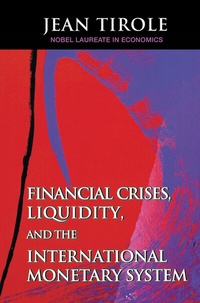
Financial Crises, Liquidity, and the International Monetary System
1st Edition
Published on 5. December 2016
168 pages
978-1-4008-2852-4 (ISBN)
Description

Once upon a time, economists saw capital account liberalization--the free and unrestricted flow of capital in and out of countries--as unambiguously good. Good for debtor states, good for the world economy. No longer. Spectacular banking and currency crises in recent decades have shattered the consensus. In this remarkably clear and pithy volume, one of Europe's leading economists examines these crises, the reforms being undertaken to prevent them, and how global financial institutions might be restructured to this end.
Jean Tirole first analyzes the current views on the crises and on the reform of the international financial architecture. Reform proposals often treat the symptoms rather than the fundamentals, he argues, and sometimes fail to reconcile the objectives of setting effective financing conditions while ensuring that a country "owns" its reform program. A proper identification of market failures is essential to reformulating the mission of an institution such as the IMF, he emphasizes. Next he adapts the basic principles of corporate governance, liquidity provision, and risk management of corporations to the particulars of country borrowing. Building on a "dual- and common-agency perspective," he revisits commonly advocated policies and considers how multilateral organizations can help debtor countries reap enhanced benefits while liberalizing their capital accounts.
Based on the Paolo Baffi Lecture the author delivered at the Bank of Italy, this refreshingly accessible book is teeming with rich insights that researchers, policymakers, and students at all levels will find indispensable.
Jean Tirole first analyzes the current views on the crises and on the reform of the international financial architecture. Reform proposals often treat the symptoms rather than the fundamentals, he argues, and sometimes fail to reconcile the objectives of setting effective financing conditions while ensuring that a country "owns" its reform program. A proper identification of market failures is essential to reformulating the mission of an institution such as the IMF, he emphasizes. Next he adapts the basic principles of corporate governance, liquidity provision, and risk management of corporations to the particulars of country borrowing. Building on a "dual- and common-agency perspective," he revisits commonly advocated policies and considers how multilateral organizations can help debtor countries reap enhanced benefits while liberalizing their capital accounts.
Based on the Paolo Baffi Lecture the author delivered at the Bank of Italy, this refreshingly accessible book is teeming with rich insights that researchers, policymakers, and students at all levels will find indispensable.
All prices
More details
Other editions
Additional editions
Book
06/2015
Princeton University Press
€23.90
Shipment within 10-20 days
Book
07/2002
Princeton University Press
€82.00
Article not available at the moment
Person
Jean Tirole, the winner of the 2014 Nobel Prize in Economics, is chairman of the Foundation Jean-Jacques Laffont at the Toulouse School of Economics, scientific director of Toulouse's Industrial Economics Institute, and annual visiting professor of economics at the Massachusetts Institute of Technology. His books include The Theory of Corporate Finance (Princeton), The Theory of Industrial Organization, Game Theory (with Drew Fudenberg), and A Theory of Incentives in Procurement and Regulation (with Jean-Jacques Laffont).
Content
Acknowledgments vii
Introduction ix
1. Emerging Markets Crises and Policy Responses 1
The pre-crisis period 1
The crisis 7
IMF reforms, regulatory changes, and private sector innovations 18
2. The Economists' Views 23
Consensus view 23
Conflicting advice and the topsy-turvy principle 29
"Unrealistic" encroachments on sovereignty 36
Theories 36
3. Outline of the Argument and Main Message 47
The problem of a standard borrower 48
Why is external borrowing different? 48
Institutional and policy responses to market failure 50
4. Liquidity and Risk-Management in a Closed Economy 53
Corporate financing: key organizing principles 53
Domestic liquidity provision 70
5. Identification of Market Failure: Are Debtor Countries Ordinary Borrowers? 77
The analogy and a few potential differences 77
A dual-agency perspective 81
The government's incentives 86
Discussion 88
A common-agency perspective 92
6. Implications of the Dual- and Common-Agency Perspectives 97
Implication 1: the representation hypothesis 97
Implication 2: policy analysis 102
Cross-country comparisons 108
Is there a need for an international lender of last resort? 110
7. Institutional Implications: What Role for the IMF? 113
From market failure to mission design 113
Governance 116
8. Conclusion 129
References 131
Index 145
Introduction ix
1. Emerging Markets Crises and Policy Responses 1
The pre-crisis period 1
The crisis 7
IMF reforms, regulatory changes, and private sector innovations 18
2. The Economists' Views 23
Consensus view 23
Conflicting advice and the topsy-turvy principle 29
"Unrealistic" encroachments on sovereignty 36
Theories 36
3. Outline of the Argument and Main Message 47
The problem of a standard borrower 48
Why is external borrowing different? 48
Institutional and policy responses to market failure 50
4. Liquidity and Risk-Management in a Closed Economy 53
Corporate financing: key organizing principles 53
Domestic liquidity provision 70
5. Identification of Market Failure: Are Debtor Countries Ordinary Borrowers? 77
The analogy and a few potential differences 77
A dual-agency perspective 81
The government's incentives 86
Discussion 88
A common-agency perspective 92
6. Implications of the Dual- and Common-Agency Perspectives 97
Implication 1: the representation hypothesis 97
Implication 2: policy analysis 102
Cross-country comparisons 108
Is there a need for an international lender of last resort? 110
7. Institutional Implications: What Role for the IMF? 113
From market failure to mission design 113
Governance 116
8. Conclusion 129
References 131
Index 145

