

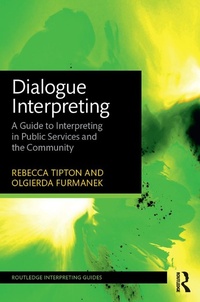
Dialogue Interpreting
A Guide to Interpreting in Public Services and the Community
Published on 5. February 2016
312 pages
978-1-317-28941-8 (ISBN)
Description

Routledge Interpreting Guides cover the key settings or domains of interpreting and equip trainee interpreters and students of interpreting with the skills needed in each area of the field. Concise, accessible and written by leading authorities, they include examples from existing interpreting practice, activities, further reading suggestions and a glossary of key terms.
Drawing on recent peer-reviewed research in interpreting studies and related disciplines, Dialogue Interpreting helps practising interpreters, students and instructors of interpreting to navigate their way through what is fast becoming the very expansive field of dialogue interpreting in more traditional domains, such as legal and medical, and in areas where new needs of language brokerage are only beginning to be identified, such as asylum, education, social care and faith.
Innovative in its approach, this guide places emphasis on collaborative dimensions in the wider institutional and organizational setting in each of the domains covered, and on understanding services in the context of local communities. The authors propose solutions to real-life problems based on knowledge of domain-specific practices and protocols, as well as inviting discussion on existing standards of practice for interpreters. Key features include:
contextualized examples and case studies reinforced by voices from the field, such as the views of managers of language services and the publications of professional associations. These allow readers to evaluate appropriate responses in relation to their particular geo-national contexts of practice and personal experience
activities to support the structured development of research skills, interpreter performance and team-work. These can be used either in-class or as self-guided or collaborative learning and are supplemented by materials on the Translation Studies Portal
a glossary of key terms and pointers to resources for further development.
Dialogue Interpreting is an essential guide for practising interpreters and for all students of interpreting within advanced undergraduate and postgraduate/graduate programmes in Translation and Interpreting Studies, Modern Languages, Applied Linguistics and Intercultural Communication.
Drawing on recent peer-reviewed research in interpreting studies and related disciplines, Dialogue Interpreting helps practising interpreters, students and instructors of interpreting to navigate their way through what is fast becoming the very expansive field of dialogue interpreting in more traditional domains, such as legal and medical, and in areas where new needs of language brokerage are only beginning to be identified, such as asylum, education, social care and faith.
Innovative in its approach, this guide places emphasis on collaborative dimensions in the wider institutional and organizational setting in each of the domains covered, and on understanding services in the context of local communities. The authors propose solutions to real-life problems based on knowledge of domain-specific practices and protocols, as well as inviting discussion on existing standards of practice for interpreters. Key features include:
contextualized examples and case studies reinforced by voices from the field, such as the views of managers of language services and the publications of professional associations. These allow readers to evaluate appropriate responses in relation to their particular geo-national contexts of practice and personal experience
activities to support the structured development of research skills, interpreter performance and team-work. These can be used either in-class or as self-guided or collaborative learning and are supplemented by materials on the Translation Studies Portal
a glossary of key terms and pointers to resources for further development.
Dialogue Interpreting is an essential guide for practising interpreters and for all students of interpreting within advanced undergraduate and postgraduate/graduate programmes in Translation and Interpreting Studies, Modern Languages, Applied Linguistics and Intercultural Communication.
Reviews / Votes
"This is a landmark textbook. Being thoroughly grounded in empirical research on interpreter-mediated interaction and institutional discourse, it deserves a wide readership, not only among students of interpreting and early-career interpreters, but also among those who are dependent on interpreter-services as public-sector professionals." Cecilia Wadensjoe, Stockholm University, Sweden"This book contains a unique blend of theory and practice that is rare in academic publications. Its breadth and depth are truly impressive. Most innovative are the recommended activities in each chapter, focusing on research, performance skills and collaborative dimensions. Instructors and learners alike will find this work extremely useful." Holly Mikkelson, Middlebury Institute of International Studies at Monterey, USA
More details
Series
Language
English
Place of publication
London
United Kingdom
Publishing group
Taylor & Francis Ltd
Target group
Professional and scholarly
College/higher education
Product notice
Reflowable
Illustrations
10 s/w Abbildungen, 7 s/w Tabellen
7 Tables, black and white; 10 Illustrations, black and white
File size
1,92 MB
ISBN-13
978-1-317-28941-8 (9781317289418)
Copyright in bibliographic data and cover images is held by Nielsen Book Services Limited or by the publishers or by their respective licensors: all rights reserved.
Schweitzer Classification
Other editions
Additional editions
Rebecca Tipton | Olgierda Furmanek
Dialogue Interpreting
A Guide to Interpreting in Public Services and the Community
Book
02/2016
1st Edition
Routledge
€241.40
Shipment within 10-20 days
Rebecca Tipton | Olgierda Furmanek
Dialogue Interpreting
A Guide to Interpreting in Public Services and the Community
Book
02/2016
1st Edition
Routledge
€83.00
Shipment within 10-20 days
Persons
Rebecca Tipton is a Lecturer in Interpreting and Translation Studies at the University of Manchester, UK. Her publications include an entry on trust in interpreting in the Routledge Encyclopaedia of Interpreting Studies (Routledge, 2015).
Olgierda Furmanek is an Associate Professor and a Founding Director of a graduate programme in Interpreting and Translation Studies at Wake Forest University, North Carolina, USA. Her publications include Emotions and Language Choices in Multilingual Discourse (2005).
Olgierda Furmanek is an Associate Professor and a Founding Director of a graduate programme in Interpreting and Translation Studies at Wake Forest University, North Carolina, USA. Her publications include Emotions and Language Choices in Multilingual Discourse (2005).
Content
List of figures
List of tables
Acknowledgements
Permissions
List of abbreviations
Introduction
Chapter 1: Foundations for Continuing Professional Development
Chapter 2: Legal Interpreting I: Criminal Procedures
Chapter 3: Legal Interpreting II: Asylum Procedures
Chapter 4: Healthcare Interpreting
Chapter 5: Educational Interpreting
Chapter 6: Social Care Interpreting
Chapter 7: Faith-related InterpretingConcluding Remarks
Glossary
Appendices
Appendix 1
Appendix 2
Appendix 3
Appendix 4
Index
List of tables
Acknowledgements
Permissions
List of abbreviations
Introduction
Chapter 1: Foundations for Continuing Professional Development
Chapter 2: Legal Interpreting I: Criminal Procedures
Chapter 3: Legal Interpreting II: Asylum Procedures
Chapter 4: Healthcare Interpreting
Chapter 5: Educational Interpreting
Chapter 6: Social Care Interpreting
Chapter 7: Faith-related InterpretingConcluding Remarks
Glossary
Appendices
Appendix 1
Appendix 2
Appendix 3
Appendix 4
Index
