

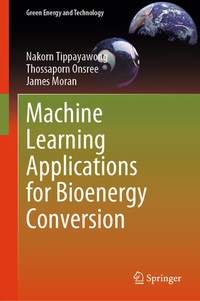
Machine Learning Applications for Bioenergy Conversion
Description

This book explores the integration of machine learning algorithms with bioenergy conversion processes, providing an innovative approach to tackling the challenges of sustainable energy production. The authors have written dozens of peer reviewed papers on this topic over the past 8 years and this book is a culmination of their efforts. It delves into various machine learning techniques tailored to optimize and enhance the efficiency of bioenergy processes, making it a critical resource for researchers, engineers, and students in the fields of renewable energy and machine learning.
More details
Other editions
Additional editions
Persons
Dr. Nakorn Tippayawong received BEng in Mechanical Engineering and PhD in Internal Combustion Engines from Imperial College London, UK. He is a professor at the Department of Mechanical Engineering, Chiang Mai University. His research interests include biomass conversion, energy efficiency improvement, decarbonization technology and emission control.
Dr. James Moran received a Masters degree and PhD degree in Mechanical Engineering from the Massachusetts Institute of Technology. He is currently an Associate Professor at the Department of Mechanical Engineering in Chiang Mai University, Thailand teaching in energy related fields. He is also a consultant to the Energy Research and Development Institute Nakornping, Chiang Mai University. His research interests include biogas upgrading, biomethane grids, biomethane low pressure storage, meso-scale combustion, aerosol generation and pollution modelling.
Dr. Thossaporn Onsree holds a Ph.D. in Mechanical Engineering from Chiang Mai University, Thailand. He is currently a post-doctoral fellow in the Molinaroli College of Engineering and Computing, University of South Carolina, USA. His research interests include catalytic and non-catalytic biomass conversions, hydrogen carriers, high-throughput experimentation, and machine learning and artificial intelligence applications.
Content
1. Introduction.- 2. Machine Learning Algorithms for Bioenergy.- 3. Pre-treatment with Ionic Liquids.- 4. Torrefaction.- 5. Co-Pyrolysis.- 6. Biodiesel Production.- 7. Anaerobic Digestion.- 8. Hydrothermal carbonization.- 9. Hydrothermal Liquids.
