

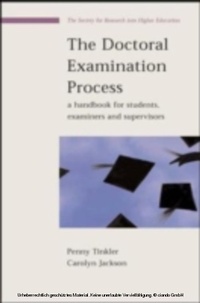
The Doctoral Examination Process
A Handbook For Students, Examiners And Supervisors
1st Edition
Published on 1. March 2004
246 pages
978-0-335-22809-6 (ISBN)
Description

This book stands alone in this field due to the extensive research undertaken by the authors. Real life accounts and case studies are combined with useful advice, tasks and checklists to create an illuminating handbook that sheds new light on the doctoral examination process which can be a common source of anxiety and concern for students, supervisors and examiners alike.
More details
Other editions
Additional editions
Penny Tinkler | Carolyn Jackson
The Doctoral Examination Process: A Handbook for Students, Examiners and Supervisors
Book
03/2004
Open University Press
€39.00
Shipment within 15-20 days
Content
- Front Cover
- Half title
- General Editor
- Title
- Copyright
- Dedication
- Contents
- Acknowledgements
- Chapter 1 Introduction to the Doctoral Examination process
- 1.1 Introduction to this book
- Audiences - who are they and how should theynavigate this book?
- Our approach
- Is not about survival . . .
- Is informed by our empirical research . . .
- Recognizes complexity and variability . . .
- Is long-term . . .
- What this book is based upon - our research
- How this book is designed
- What this book does and does not do
- What the book covers
- What the book does not cover
- 1.2 Introduction to the PhD examinationprocess
- What is a PhD?
- An overview of the PhD examination process
- Stage 1 - the thesis (and sometimes practice)
- Stage 2 - the oral examination (viva)
- Stage 3 - the implications of the examiners' recommendation(s)
- Chapter 2 Understanding the Doctoral Viva - what is it for?
- 2.1 Why an oral examination? Purposes andimportance
- Institutional policy
- The viva is a compulsory part of the PhD examination
- What criteria need to be met for a successful viva performance?
- Can students fail the PhD on the basis of performance in the viva?
- Limits of a policy perspective
- Academics' perspectives of the roles of the viva
- Candidates' perspectives of the roles of the viva
- 2.2 Exploring key purposes of the viva
- Examination
- Authentication of the thesis
- Locate the PhD research in the broader context
- Check understanding and ability to produce and present research to PhD standard
- Defend the thesis
- The viva as a site of final decision making in borderline cases
- Clarification of obscurities and areas of weakness
- Test oral skills
- Gatekeeping
- Development
- Basic development - explore ways in which the thesis could be raised to PhD standard
- Advanced development - when the thesis meets PhD standard
- Ritual/rites of passage
- 2.3 Is the viva always an examination?
- Is the viva usually the key site of decision making?
- 2.4 Summary
- Chapter 3 Understanding the Doctoral Viva - How does it work?
- 3.1 Components of a viva
- 3.2 Skills
- 3.3 Content
- Examiners' assessments of the thesis
- Good thesis
- Borderline/referred thesis
- Failed thesis/award of lower degree
- Examiners' knowledge expectations
- Breadth
- Depth
- 3.4 Conduct
- Examining styles
- The examiners' personal/political agendas
- Interpersonal dynamics
- 3.5 Summary
- Chapter 4 Viva Preparation - Long Term
- 4.1 Reminder of the key components ofthe viva
- Skills
- Content
- Conduct
- 4.2 Academic research cultures
- 4.3 A closer look at academic research cultures:activities that are useful long-term vivapreparation
- Teaching
- Conference attendance and presentation
- Oral exams - upgrading, progress reports etc.
- Publishing
- Other activities
- 4.4 Ways to access academic research cultures
- 4.5 A flexible conclusion
- 4.6 Summary
- Chapter 5 Selecting Examiners
- 5.1 Why are examiners important?
- 5.2 Selection procedures
- How many examiners?
- When should examiners be selected?
- Who selects the examiners?
- Should the candidate be involved?
- 5.3 Factors to consider when selectingexaminers
- Institutional frameworks
- Academic credentials and experience.
- Independence.
- Other factors and issues
- Expertise
- Academic approach - open or closed
- Knowledge expectations
- Examining styles
- Personal/political agendas
- To know or not to know - issues relating tothe selection of 'known' and 'unknown'external examiners
- Unknown examiner, but not an unknown quantity
- 5.4 Summary
- Chapter 6 Who Attends the Viva? Roles and Obligations
- Viva attendance
- Who may attend the viva?
- Reminder - how many examiners are there?
- 6.2 Roles and obligations of attendees
- External and internal examiners
- Core roles
- Roles that vary according to institutional regulations and/or the particular viva
- Supervisor
- Independent chairperson
- University official
- 6.3 Should the supervisor attend the viva?
- Candidates' perspectives
- Reasons why some candidates want their supervisor to attend
- Reasons why some candidates do not want their supervisor to attend
- Supervisors' perspectives
- Supervisors' reasons for attending their student's viva
- Supervisors' reasons for not attending their student's viva
- Examiners' perspectives
- Reasons why some examiners welcome the presence of the candidate's supervisor
- Reasons why some examiners do not welcome the presence of the candidate's supervisor
- 6.4 Summary
- Chapter 7 Examiners - Should You Examine?
- 7.1 What the job entails
- 7.2 Should you serve as an external examiner?
- Potential benefits of agreeing to examine a PhD
- Career development and academic recognition
- Intellectual interest
- Service to academic and/or discipline communities
- Practicalities
- Important considerations when deciding whether toexamine a PhD
- Are you the right person for this particular job?
- Do you have enough time?
- Are you prepared to examine this thesis in the manner specified by theappointing institution?
- 7.3 Should you serve as an internal examiner?
- Reasons to examine a PhD
- Important considerations when deciding whether toexamine a PhD
- In academic terms, can you examine this thesis?
- Are you doing too much PhD examining?
- Can you examine this PhD thesis fairly?
- Do you have experience of examining a PhD?
- 7.4 Unusual examining appointments
- 7.5 Summary
- Chapter 8 Examiners - Assessing a Doctoral Thesis
- 8.1 How to assess a thesis
- Formal guidelines on assessment
- Institutional guidelines
- Discipline guidelines
- Guidelines from research funding bodies and the Quality Assurance Agency
- An examiner's guide to assessing a thesis
- Practice-based PhDs - the relationship between thewritten and practice components of a submission
- 'Originality' and 'a contribution to knowledge'
- 'Originality'
- 'A contribution to knowledge'
- Range of standards
- 8.2 Strategies for reading the thesis
- 8.3 Pre-viva reports
- Purposes of the pre-viva report
- What to include in the report
- 8.4 Summary
- Chapter 9 Viva Preparation - Short Term
- 9.1 Supervisors and peer support
- 9.2 Viva stories and myths
- Supervisors and candidates - six points to remember when thinking aboutviva stories
- 9.3 Mock vivas
- What are mock vivas? What forms can they take?
- Are mock vivas useful?
- What purposes can mock vivas serve?
- Advantages and limitations
- Case studies: examples of different types of mock viva
- Making the most of mock vivas - tips for supervisors
- Making the most of mock vivas - tips for candidates
- 9.4 Summary
- Chapter 10 Viva Preparation - Final Stage
- 10.1 Countdown to the viva
- Practical arrangements
- Supervisor-candidate meeting
- Academic preparations
- 10.2 Rereading the thesis
- 'Know your thesis'
- Know what is written in the thesis
- Know the layout of the thesis
- Understand what is presented in the thesis
- Justify and defend the thesis
- Identify, and be prepared to discuss, weak areas, gaps and mistakes
- Reflect on what could be done differently if starting again
- The limits of 'knowing your thesis'
- Likely questions
- Bored with the thesis
- The limits of rereading
- 10.3 Literature update
- 10.4 Questions to ask examiners
- 10.5 Less than 24 hours to go
- The night before
- The morning before
- Five minutes before
- 10.6 Summary
- Candidates - summary of final-stage preparation
- Supervisors - summary of final-stage preparation
- Chapter 11 In the Viva - Candidates' Perspectives
- 11.1 First few minutes
- Will the provisional decision be released at the outset?
- If the provisional decision was indicated at the outset, what would this mean?
- If the provisional decision was not indicated at the outset, what would this mean?
- Questions - easy openers?
- Summary - what types of questions should candidatesexpect in the first few minutes?
- 11.2 Factors shaping the viva - reminder
- 11.3 Interactions in the viva
- The viva as an 'academic interview'
- Posture
- Listen
- Take time to think
- Working through the thesis
- Answering questions
- Broad questions
- Questions the candidate cannot answer
- How to 'defend'
- 11.4 How long will the viva last?
- Breaks
- 11.5 What does it feel like to have a viva?
- Tough and frazzling
- Nerve-wracking
- Mixed emotions
- Surprisingly all right
- Painful
- 11.6 What happens at the end of the viva?
- Confidential exchange between examiners andcandidate
- Examiners' deliberations
- The examiners' recommendation
- 11.7 Summary
- Chapter 12 The Viva - Tips and Issues for Examiners
- 12.1 Before the day of the viva
- What are the purposes of this particular viva?
- Reminder - key purposes of the viva
- Thinking about your relationship with theco-examiner(s)
- Should the supervisor be allowed to attend?
- Practice-based PhDs - arranging to examine the fullsubmission
- 12.2 Pre-viva meeting
- Content of the viva - producing an agenda
- Conduct of the viva - the behaviour, roles andresponsibilities of viva participants
- Investigating extenuating circumstances
- Post-viva business to consider in the pre-viva meeting
- 12.3 In the viva - first impressions
- Room and layout
- Introductions
- Should you release a provisional decision?
- 12.4 In the viva - a productive exchange
- Opening questions
- Content questions - examination and developmental purposes
- Conduct - promoting a productive exchange
- 12.5 At the end of the viva
- Difficult decisions
- Feedback to candidate
- 12.6 Summary
- Chapter 13 Post-viva
- 13.1 Candidates' post-viva feelings
- Relief
- Delayed reactions . . . but then relieved and happy
- Excited and good
- Delighted but . . . sick, weepy and tired
- Anticlimax
- Do I really deserve this? Am I an academic fraud?
- I'll be happier once the corrections are done . . .
- 13.2 Effects of the viva upon candidates
- 13.3 Post-viva tasks
- Award forthwith with no or minor corrections
- Referral
- Candidates required to have a second viva
- Are candidates allowed access to the examiners'reports?
- 13.4 When candidates are unhappy about theexamination process
- Appeals
- Grounds for appeal
- Possible outcomes of appeals
- 13.5 Summary
- References
- Index
- Back cover
