

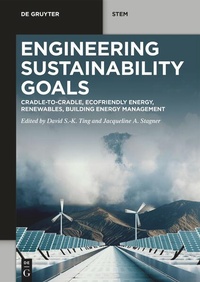
Engineering Sustainability Goals
Description

According to Socrates, "The secret of change is to focus all of your energy not on fighting the old, but on building the new." The new includes healthier living and sounder engineering. Specifically, we strive to generate cleaner energy and spread to to all corners of the world; improve understanding and care for the land, sea, and air; transform waste into useful resources; implement more eco-friendly agriculture and farming; and invigorate humans' minds, bodies, and souls. The emphasis is on bettering tomorrow in an integrated manner, through the knowledge of the interlinkages among technologies, social and behavioral perspectives, the environment and ecology, and policies and governances.
The volume provides the first go-to reference for everyone who wishes to brighten tomorrow by thriving through change. It shows how to capitalize change and hasten the transition into a sustainable tomorrow from various perspectives. To sustainably thrive, we adapt cradle-to-cradle engineering. This closed cycle engineering ensures the end of a product, or an operation, is the beginning of a new one.
The book is essential for researchers including students, professionals, policy makers, and tomorrow's leaders.
More details
Other editions
Additional editions
Persons
David S-K. Ting explored Combustion and Turbulence, and subsequently Convection Heat Transfer and Fluid-Structure Interactions, before joining the University of Windsor and founding the Turbulence & Energy Laboratory. Dr. Ting has been supervising research students primarily on turbulence, energy, and sustainability for twenty-six years. To date, Professor Ting has co/supervised over ninety MASc and PhD students, co-authored more than one hundred and seventy scientific journal papers, co-edited thirty volumes, and authored five textbooks.
Jacqueline A. Stagner is the Undergraduate Programs Coordinator in the Faculty of Engineering at the University of Windsor, and an adjunct faculty member in the Department of Mechanical, Automotive and Materials Engineering. Dr. Stagner co-advises students primarily on sustainable energy in the Turbulence and Energy Laboratory. She has co/edited fourteen volumes.
