
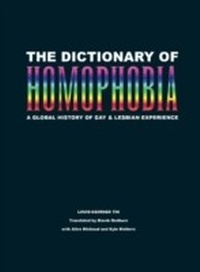
The Dictionary of Homophobia
Description
Alles über E-Books | Antworten auf Fragen rund um E-Books, Kopierschutz und Dateiformate finden Sie in unserem Info- & Hilfebereich.
"Tin's Dictionary of Homophobia is so sweeping in its scope that one can dip into it again and again and learn something, or confront an idea in which even the most well-read queer will find fresh intellectual nourishment and historical illumination."-Gay City News
Based on the work of seventy researchers in fifteen countries, The Dictionary of Homophobia is a mammoth, encyclopedic book that documents the history of homosexuality, and various cultural responses to it, in all regions of the world: a masterful, engaged, and wholly relevant study that traces the political and social emancipation of a culture.
The book is the first English translation of Dictionnaire de L'Homophobie, published in France in 2003 to worldwide acclaim; its editor, Louis-Georges Tin, launched the first International Day Against Homophobia in 2005, now celebrated in more than fifty countries around the world. The Dictionary of Homophobia includes over 175 essays on various aspects of gay rights and homophobia as experienced in all regions in Africa, the Americas, Asia, Europe, and the South Pacific, from the earliest epochs to present day.
Subjects include religious and ideological forces such as the Bible, Communism, Judaism, Hinduism, and Islam; historical subjects, events, and personalities such as AIDS, Stonewall, J. Edgar Hoover, Matthew Shepard, Oscar Wilde, Pat Buchanan, Joseph McCarthy, Pope John Paul II, and Anita Bryant; and other topics such as coming out, adoption, deportation, ex-gays, lesbiphobia, and bi-phobia. In a world where gay marriage remains a hot-button political issue, and where adults and even teens are still being executed by authorities for the "crime" of homosexuality, The Dictionary of Homophobia is a both a revealing and necessary history lesson for us all.
All prices
More details
Other editions
Additional editions
Persons
Content
- Intro
- CONTENTS
- PUBLISHER'S NOTE
- PREFACE TO THE ORIGINAL EDITION
- EDITOR'S PREFACE TO THE ENGLISH LANGUAGE EDITION
- INTRODUCTION
- THE ANTI-ANTHOLOGY
- CONTRIBUTORS
- Entries
- PHOTO CREDITS
- ACKNOWLEDGMENTS

System requirements
File format: ePUB
Copy protection: Adobe-DRM (Digital Rights Management)
System requirements:
- Computer (Windows; MacOS X; Linux): Install the free reader Adobe Digital Editions prior to download (see eBook Help).
- Tablet/smartphone (Android; iOS): Install the free app Adobe Digital Editions or the app PocketBook before downloading (see eBook Help).
- E-reader: Bookeen, Kobo, Pocketbook, Sony, Tolino and many more (not Kindle).
The file format ePub works well for novels and non-fiction books – i.e., „flowing” text without complex layout. On an e-reader or smartphone, line and page breaks automatically adjust to fit the small displays.
This eBook uses Adobe-DRM, a „hard” copy protection. If the necessary requirements are not met, unfortunately you will not be able to open the eBook. You will therefore need to prepare your reading hardware before downloading.
Please note: We strongly recommend that you authorise using your personal Adobe ID after installation of any reading software.
For more information, see our ebook Help page.
File format: ePUB
Copy protection: Watermark-DRM (Digital Rights Management)
System requirements:
- Computer (Windows; MacOS X; Linux): Use a reading software that can process the file format ePUB: e.g., Adobe Digital Editions or FBReader – both free (see eBook Help).
- Tablet/Smartphone (Android; iOS): Before downloading, install the free app Adobe Digital Editions (see eBook Help).
- E-reader: Bookeen, Kobo, Pocketbook, Sony, Tolino and many more (not Kindle).
The file format ePUB works well for novels and non-fiction books – i.e., „flowing” text without complex layout. On an e-reader or smartphone, line and page breaks automatically adjust to fit the small displays.
This eBook uses Watermark-DRM, a „soft” copy protection. This means that there are no technical restrictions to prevent illegal distribution. However, there is a personalised watermark embedded in the eBook that can be used to identify the purchaser of the eBook in the event of misuse and to provide evidence for legal purposes.
For more information, see our eBook Help page.