

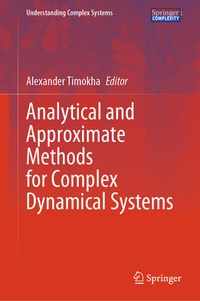
Analytical and Approximate Methods for Complex Dynamical Systems
Description

This book presents Analytical and Approximate Methods for Complex Dynamical Systems and introduces ideas of discontinuous mapping treated as complex dynamical systems. Mathematicians of world-recognized Ukrainian scientific schools established by M.Krylov, M.Bogolyubov, Yu.Mitropolskiy, and A.Sharkovsky used to cooperate for writing the collective book whose purpose consists of illustrating a synergy of combining diverse (by idea and technique) constructive analytical and approximate approaches and methods in complex dynamical systems which are herein associated with mathematical models of networks, conflict/economic theories, sloshing, soft matter, and even levitating drops. Readers are facilitated to learn contemporary insights, fundamentals (Parts I and III), applications (Part II), and components of theories of bifurcation, synchronization/self-organization, collective dynamics, chaos, solitons, fractional differential equations, symmetry, reduced order modelling, and many others, that makes the book useful for both graduate and postgraduate students, lecturers, researchers, and even engineers dealing with multidimensional dynamic systems.
More details
Other editions
Additional editions
Person
Content
Part I: General and specific problems of complex dynamical systems.- Organising centres in a 2D discontinuous map.- Phase models for coupled oscillator networks.- The conflict problem and opinion formation models.- Dynamics of conflict interaction in terms of minimal players.- Generalised intermittency in non-ideal and "classical" dynamical systems.- Lanchester's equations in conflicting sides using ODEINT Python library.- Reversible saddle-node separatrix-loop bifurcation.- Stationary and travelling synchronisation patterns in systems of coupled active rotators.- Part II: Continuum media modelling.- Complex dynamical systems of two-dimensional sloshing in rectangular tank.- Swirling-type sloshing in square base tank due to orbital excitations.- Towards kinetic equations of open systems of active soft matter.- Freely oscillating drop.- Nonlinear WKB method, asymptotic soliton-like solutions of variable coefficients Korteweg-de Vries equations with singular perturbation and Rankine-Hugoniot-type conditions.- Part III: Auxiliary problems of complex dynamical systems.- On group classification of nonlinear heat equation: algebraic approach.- Mathematical modelling of the interconnected boundary-value problems in the Hilbert space.- Averaging in a generalised multifrequency system with a delay.- Exponentially convergent method for Hardy-Titchmarsh-type equation with unbounded operator coefficient in Banach space.- Regularization of linear impulsive boundary value problem for systems of integro-differential equations.- Interconnected system for the Lyapunov equation with control and boundary conditions.- Lyapunov function and smooth periodic solutions to quasilinear 1D hyperbolic systems.
