

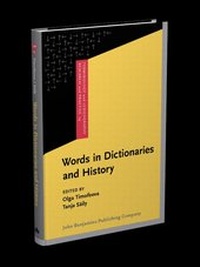
Words in Dictionaries and History
Essays in honour of R.W. McConchie
1st Edition
Published on 12. May 2011
XVI, 292 pages
978-90-272-8690-1 (ISBN)
Description

Bringing together fifteen articles by scholars in Europe and North America, this collection aims to represent and advance studies in historical lexis. It highlights the significance of the understanding of dictionary-making and language-making as important socio-cultural phenomena. With its general focus on England and English, the book investigates the reception and development of historical and modern English vocabulary and culture in different periods, social and professional strata, geographical varieties of English, and other national cultures. The volume is based on individual (meta)lexicographical, etymological, lexicosemantic and corpus studies, representing two large areas of research: the first part focuses on the history of dictionaries, analysing them in diachrony from the first professional dictionaries of the Baroque period via Enlightenment and Romanticism to exploring the possibilities of the new online lexicographical publications; and the second part looks at the interfaces between etymology, semantic development and word-formation on the one hand, and changes in society and culture on the other.
More details
Other editions
Additional editions
Book
05/2011
John Benjamins Publishing Co
€104.94
Shipment within 10-15 days
Persons
Content
- Words in Dictionaries and History
- Editorial page
- Title page
- LCC data
- Table of contents
- Tabula gratulatoria
- Preface
- Introduction
- Part I. History of dictionaries
- The Flores of Ouide (1513): An early Tudor Latin-English textbook
- Ovidian pedagogy
- Dr. John Colet and "blotterature"
- Who was Walter?
- References
- "Halles Lanfranke" and its most excellent and learned expositive table
- Introduction
- John Halle
- Most excellent and learned
- The expositive table
- Final words
- References
- John Lane's Verball: A lost Elizabethan dictionary project
- Introduction: The First Booke of the Preservation
- The identity of the author
- The projected Verball
- References
- The linking of lemma to gloss in Elyot's Dictionary (1538)
- Elyot's dictionary in its historical context
- Linking lemma and gloss in Old and Middle English word lists
- Elyot's linking of lemma and gloss
- References
- Music amidst the tumult
- Johnson and literary coinage
- Johnson in practice
- Johnson's self-omissions
- References
- Chaos and old night: A case study in quotation usage
- Chaos and old night in dictionaries of quotations
- Chaos and old night: Individual word elements
- Variation of elements
- Conscious or explicit quotation
- Political usages
- Wordplay (1): Chaos and cold night
- Wordplay (2): Chaos and old Knight
- Conclusion
- Acknowledgements
- References
- Online dictionaries of English slang
- Introduction
- Static and dynamic online dictionaries
- The dictionaries
- The online dictionaries' coverage
- Conclusions
- References
- Part II. Word history and cultural history
- Old English etymologies in Christfrid Ganander's Nytt Finskt Lexicon (1787)
- 1. Introduction
- 1.1 A survey of Ganander's life and works
- 1.2 The sources of the Nytt Finskt Lexicon
- 1.3 Collaboration with Porthan and the fate of the NFL after Ganander's death
- 2. The Old English material in the etymological sections of the NFL
- 2.1 Attested and possible sources for Ganander's Old English etymologies
- 2.2 Principles followed in presenting and discussing the material in Ganander's entries
- 2.3 Old English etymologies which are correct
- 2.4 Old English etymologies which are partly correct
- 2.5 Old English etymologies which are erroneous
- 3. Final remarks
- References
- The origin of the word yeoman
- The state of the art
- Previous attempts to explain the origin of yeoman
- The most likely etymology of yeoman: yeoman and yeomath
- the rise of yeomanry
- References
- Early East India Company merchants and a rare word for sex
- 1. Introduction
- 2. Lapidable: Text and context
- 2.1 Dictionary evidence
- 2.2 Contextual evidence
- 2.3 An attempt at an explanation
- 3. Ale, toast, and literary allusions: EIC merchants and playful language
- 4. Unanswered questions, promising sources: A conclusion
- References
- Appendix 1
- Appendix 2
- Appendix 3
- From denominal to deverbal: Action nouns in the English suffix al
- 1. Introduction
- 2. History and morphology
- 2.1 Morphological types
- 3. Productivity and analysability
- 4. Semantics
- 4.1 1150-1300
- 4.2 The 14th century
- 4.3 The 15th century
- 4.4 Semantics of ME nouns in -al: Summary
- 5. Semantics of -al in the 16th and 17th centuries
- 5.1 Ten plays by Shakespeare
- 5.2 Neologisms in -al in the 16th and 17th centuries
- 5.3 Conclusion
- References
- Appendix 1.
- The evidence of Bede's Historia ecclesiastica gentis Anglorum for the replacement of Roman names by English ones during the early Anglo-Saxon period
- References
- William Lambarde and Thomas Milles in search of the golden past
- Background
- The Catalogue of Honor
- Lambarde, Milles and Geþyncðo (Be leode geþincðum 7 lage)
- The Catalogue and the Textus Roffensis
- Spelling and lexis
- Conclusions
- References
- Contempt - the main growth area in the Elizabethan emotion lexicon
- Introduction
- Nature and structure of the HTE
- The field of 'Contempt': Peak years of first attestation
- The field of 'Contempt': Internal structure
- Some tentative conclusions
- Epilogue: 'Contempt' in the printed HTOED
- References
- A lexical skirmish: OED3 and the vocabulary of swordplay
- Inclusion and coverage of fencing terms in the OED
- A brief introduction to the history of swordplay
- Etymology and the history of swordplay
- Etymology and swordplay: measure
- Etymology and swordplay: lunge
- Swordplay in England
- Italian fencing masters in England
- Spanish influences on swordplay in England
- The stockado revisited: A note
- Conclusion
- References
- Index of subjects
- Index of personal names
