

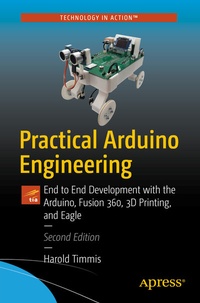
Practical Arduino Engineering
Description

Implement Arduino-based designs in your project, and build, debug, and extend it using a solid engineering approach. This second edition is expanded to provide a better understanding of the engineering process and what it means to be an end-to-end developer.
You'll start out by reviewing basic engineering procedures, from the fundamental requirements and preliminary design to prototyping and testing. You'll then apply those principles to single devices like LCDs, potentiometers and GPS modules, and move on to the integration of several modules into a larger project, a sub-autonomous robot. This robot will include devices such as GPS, Bluetooth, an OLED screen, an accelerometer, humidity and temp sensor, motor drivers, and ultrasonic sensor.
This version goes on to cover how to create 3D models with Fusion360, make your own PCBs using Eagle, and use and maintain a 3D printer. Each and every chapter exemplifies this process and demonstrates how you can profit from the implementation of solid engineering principles-regardless of whether you just play in your basement or you want to publicize and sell your devices. With Practical Adruino Engineering you'll be able to review and improve this process, and even extend its scope.
What You'll Learn
? Set up the Arduino software landscape and project for testing
? Review the process of hardware engineering as applicable to Arduino projects
? Create 3D models for 3D printing using Fusion360 in a robot chassis project? Make PCBs using Eagle and incorporate it into a sensor station shield project
? Use and maintain a 3D printer with your own project
? Create Arduino shields in Eagle
? Debug Arduino projects of varying complexities via LabVIEW
? Use a special Arduino board for Bluetooth to control domestic and mobile Arduino projects
Who This Book Is For
Primarily aimed at intermediate engineers or engineering students. However, this book is also great for beginners and any maker who wants to expand their abilities in a single book.
More details
Other editions
Additional editions
Previous edition
Person
Content
Chapter 1: The Process of Arduino Engineering.- Chapter 2: Understanding the Arduino Software.- Chapter 3: Modelling with Fusion 360.- Chapter 4: 3D Printing.- Chapter 5: PCB Design.- Chapter 6: Robot Engineering Requirements: Controlling Motion.- Chapter 7: Final Project PCB.- Chapter 8: Final Project 3D Model.- Chapter 9: Final Project Software.- Chapter 10: Final Project Putting It All Together.
