

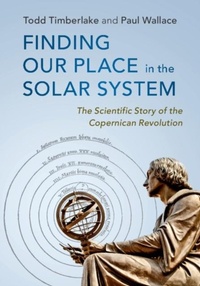
Finding our Place in the Solar System
The Scientific Story of the Copernican Revolution
Published on 20. March 2019
398 pages
978-1-316-86538-5 (ISBN)
Description

Finding our Place in the Solar System gives a detailed account of how the Earth was displaced from its traditional position at the center of the universe to be recognized as one of several planets orbiting the Sun under the influence of a universal gravitational force. The transition from the ancient geocentric worldview to a modern understanding of planetary motion, often called the Copernican Revolution, is one of the great intellectual achievements of humankind. This book provides a deep yet accessible explanation of the scientific disputes over our place in the solar system and the work of the great scientists who helped settle them. Readers will come away knowing not just that the Earth orbits the Sun, but why we believe that it does so. The Copernican Revolution also provides an excellent case study of what science is and how it works.
Reviews / Votes
'The story of understanding our Solar System is essentially a story of how science works. Finding Our Place in the Solar System connects the dots between observations of the movements of the Sun, the Moon and the stars on the celestial sphere to the scientific revolution brought about by Copernicus, Kepler, Galileo and ultimately Newton. Every chapter describes the key steps that led towards our current understanding of our Solar System, but also reflects on what these steps can tell us about how science in general works. The book, aimed at non-science-majors and the general public alike, motivates a very timely discussion on the dynamic and ever-changing nature of science.' Marios Karouzos, Nature Astronomy '... at the end of each section [is] a short chapter titled Reflections on science, a sort of philosophy of science light ... they are actually very well done and add, in my opinion, a lot to the value of the book as a teaching text ... Timberlake writes well and lucidly. His text is easy to read and his explanations are clear and straightforward. He covers the material well and I on the whole would thoroughly endorse his book as an excellent textbook and introduction to the history of European astronomy ... Timberlake's book is an excellent entry level introduction to the history of European mathematical astronomy as well as serving as an introduction to the process of science for non scientists and anybody looking to teach themselves or looking for a textbook for an advanced school class or a college level course should definitely consider using this volume ...' Thony C, The Renaissance Mathematicus '... the authors' ability to present complex scientific concepts in the history of astronomy and physics clearly and concisely is invaluable for undergraduate teaching. The figures, diagrams, and appendixes in the book enhance the clarity of their presentation, which was already impressive. This text will be very useful for those teaching the history of ancient, medieval, or early modern science. Even for those whose pedagogy differs markedly from that of Timberlake and Wallace, Finding Our Place in the Solar System could serve as a useful complement to the main themes of a course.' Nicholas A. Jacobson, IsisMore details
Language
English
Place of publication
Cambridge
United Kingdom
Publishing group
Cambridge University Press
Target group
College/higher education
Illustrations
Worked examples or Exercises; 60 Halftones, black and white; 50 Line drawings, black and white
File size
17,06 MB
ISBN-13
978-1-316-86538-5 (9781316865385)
Copyright in bibliographic data and cover images is held by Nielsen Book Services Limited or by the publishers or by their respective licensors: all rights reserved.
Schweitzer Classification
Other editions
Additional editions
Todd Timberlake | Paul Wallace
Finding our Place in the Solar System
The Scientific Story of the Copernican Revolution
Book
03/2019
Cambridge University Press
€41.50
Shipment within 15-20 days
Persons
Content
Preface; 1. Introduction: mysterious skies; 2. Two spheres: modeling the heavens and the Earth; 3. Wanderers: the Moon and the planets; 4. An Earth-centered cosmos: astronomy and cosmology from Eudoxus to Regiomontanus; 5. Moving the Earth: the revolutions of Copernicus; 6. Instruments of reform: Tycho's restoration of observational astronomy; 7. Physical causes: Kepler's new astronomy; 8. Seeing beyond Aristotle: Galileo's controversies; 9. The system of the world: Newton's universal physics; 10. Confirming Copernicus: evidence for Earth's motions; Appendix A. Mathematical details; Notes; References; Index.
