

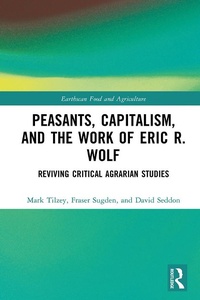
Peasants, Capitalism, and the Work of Eric R. Wolf
Reviving Critical Agrarian Studies
1st Edition
Published on 30. August 2023
240 pages
978-0-429-94657-8 (ISBN)
Description

Fifty years after the publication of Eric Wolf's celebrated Peasant Wars of the Twentieth Century, and forty years after the publication of his path-breaking Europe and the People Without History, this book offers a much-needed critical assessment and update of Wolf's contribution to the study of the peasantry and its relationship to capitalism, the state, and imperialism.
This book provides a comprehensive evaluation of Wolf's premises, methodology, and understanding of the peasantry, and its relationship to the rise of capitalism and the modern state. The authors analyse Wolf's theoretical approach and, by building on his work in Europe and the People Without History especially, argue their own position concerning the dynamics of the peasantry in relation to capitalism, state, class, and imperialism. Further, the text aims to answer the agrarian question more widely, focusing on agrarian society and the political role of the peasantry in contested transitions to capitalism and to modes beyond capitalism. This requires, the authors argue, an analysis of class struggle and of the resources, material and discursive, that different classes can bring to bear on this struggle. Based on well-founded theoretical premises, the book focuses on the contested rise of capitalism in the global North, the development of core-periphery relations in the global political economy, and the place of the peasantry in these dynamics. The book presents case studies of transitions to agrarian capitalism in the British Isles, France, Germany, Japan, and the USA.
The book will be of great interest to students and researchers in the areas of peasant studies, rural politics, agrarian studies, development, and political ecology.
This book provides a comprehensive evaluation of Wolf's premises, methodology, and understanding of the peasantry, and its relationship to the rise of capitalism and the modern state. The authors analyse Wolf's theoretical approach and, by building on his work in Europe and the People Without History especially, argue their own position concerning the dynamics of the peasantry in relation to capitalism, state, class, and imperialism. Further, the text aims to answer the agrarian question more widely, focusing on agrarian society and the political role of the peasantry in contested transitions to capitalism and to modes beyond capitalism. This requires, the authors argue, an analysis of class struggle and of the resources, material and discursive, that different classes can bring to bear on this struggle. Based on well-founded theoretical premises, the book focuses on the contested rise of capitalism in the global North, the development of core-periphery relations in the global political economy, and the place of the peasantry in these dynamics. The book presents case studies of transitions to agrarian capitalism in the British Isles, France, Germany, Japan, and the USA.
The book will be of great interest to students and researchers in the areas of peasant studies, rural politics, agrarian studies, development, and political ecology.
Reviews / Votes
"Building on Eric Wolf's critical peasant studies, this book traces global capitalism's tectonic dynamics, arguing that much 'progressivism' only helps to dampen tensions in the Global North, while the real fault line is the superexploitation of nature and underclasses in the Global South. A must-read for academic progressives who take their ideals seriously, and for all curious about the potential of unorthodox Marxist thought."Niek Koning, emeritus Wageningen University
"Drawing on the classical work by Eric Wolf the authors critically discuss and update his oeuvre with due regard to the changes over the last half century. They undertake this task from a rigorous Marxian approach which takes account not only of class, power and exploitation but also of ecology, gender, ethnicity and race. This book has the making of a new classic in critical agrarian studies."
Cristobal Kay, Emeritus Professor, International Institute of Social Studies, The Hague
"The authors critically revalue Eric Wolf's Peasant Wars of the Twentieth Century. A sophisticated book for those who have read and not read Wolf's classic work. The book shines in particular when it elaborates on Wolf's theoretical groundwork in Europe and the People Without History."
Kees Jansen, Rural Sociology Group, Wageningen University
More details
Series
Edition
1. Auflage
Language
English
Place of publication
London
United Kingdom
Publishing group
Taylor & Francis Ltd
Target group
College/higher education
Product notice
Reflowable
ISBN-13
978-0-429-94657-8 (9780429946578)
Copyright in bibliographic data and cover images is held by Nielsen Book Services Limited or by the publishers or by their respective licensors: all rights reserved.
Schweitzer Classification
Other editions
Additional editions
Mark Tilzey | Fraser Sugden | David Seddon
Peasants, Capitalism, and the Work of Eric R. Wolf
Reviving Critical Agrarian Studies
Book
12/2024
1st Edition
Routledge
€63.30
Shipment within 10-20 days
Mark Tilzey | Fraser Sugden | David Seddon
Peasants, Capitalism, and the Work of Eric R. Wolf
Reviving Critical Agrarian Studies
Book
08/2023
1st Edition
Routledge
€196.20
Shipment within 10-20 days
Persons
Mark Tilzey is an Associate Professor, Centre for Agroecology, Water and Resilience, Coventry University, UK.
Fraser Sugden is an Associate Professor, Department of Geography, University of Birmingham, UK.
David Seddon is a former Professor of Politics and Sociology, Department of Development Studies, University of East Anglia, UK.
Fraser Sugden is an Associate Professor, Department of Geography, University of Birmingham, UK.
David Seddon is a former Professor of Politics and Sociology, Department of Development Studies, University of East Anglia, UK.
Content
Introduction; 1 Wolf's Peasant Wars of the Twentieth Century: A Critique; 2 Developing our Approach: Towards a Marxian Perspective after Wolf; 3 The Rise of Capitalism in England, and the Emergence of Core and Periphery in the Global Political Economy; 4 The Reform of the Corn Laws and the Emergence of the 'First' or British 'Liberal' Food Regime, 1840-1870; 5 The Emergence of the 'Second' or 'Imperial' Food Regime, 1870-1930; 6 Agrarian Capitalism and 'Core'-'Periphery' Dynamics from 1930 to the Present Day: Peasant Elimination in the North, Peasant Perpetuation in the South; 7 Conclusion: Wolf and the Revival of Critical Agrarian Studies
