

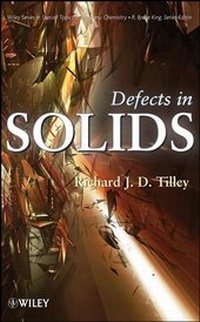
Defects in Solids
Description

More details
Other editions
Additional editions
Person
Content
1. Point Defects.
1.1 Introduction.
1.2 Point and Electronic Defects in Crystalline Solids.
1.3 Electronic Properties: Doped Silicon and Germanium as Examples.
1.4 Optical Properties: F Centers and Ruby as Examples.
1.5 Bulk Properties.
1.6 Thermoelectric Properties: The Seebeck Coefficient as an Example.
1.7 Point Defect Notation.
1.8 Charges on Defects.
1.9 Balanced Populations of Point Defects: Schottky and Frenkel Defects.
1.10 Antisite Defects.
1.11 Defect Formation and Reaction Equations.
1.12 Combinations of Point Defects in Pure Materials.
1.13 Structural Consequences of Point Defect Populations.
1.14 Answers to Introductory Questions.
Problems and Exercises.
References.
Further Reading.
2. Intrinsic Point Defects in Stoichiometric Compounds.
2.1 Equilibrium Population of Vacancies in a Monatomic Crystal.
2.2 Equilibrium Population of Self-Interstitials in a Monatomic Crystal.
2.3 Equilibrium Population of Schottky Defects in a Crystal.
2.4 Lithium Iodide Battery.
2.5 Equilibrium Population of Frenkel Defects in a Crystal.
2.6 Photographic Film.
2.7 Photochromic Glasses.
2.8 Equilibrium Population of Antisite Defects in a Crystal.
2.9 Intrinsic Defects: Trends and Further Considerations.
2.10 Computation of Defect Energies.
2.11 Answers to Introductory Questions.
Problems and Exercises.
References.
Further Reading.
3. Extended Defects.
3.1 Dislocations.
3.2 Edge Dislocations.
3.3 Screw Dislocations.
3.4 Mixed Dislocations.
3.5 Unit and Partial Dislocations.
3.6 Multiplication of Dislocations.
3.7 Interaction of Dislocations and Point Defects.
3.8 Dislocations in Nonmetallic Crystals.
3.9 Internal Boundaries.
3.10 Low-Angle Grain Boundaries.
3.11 Twin Boundaries.
3.12 Antiphase Boundaries.
3.13 Domains and Ferroic Materials.
3.14 External Surfaces and Grain Boundaries.
3.15 Volume Defects and Precipitates.
3.16 Answers to Introductory Questions.
Problems and Exercises.
Further Reading.
4. Structural Aspects of Composition Variation.
4.1 Composition Variation and Nonstoichiometry.
4.2 Substitutional Solid Solutions.
4.3 Point Defects and Departures from Stoichiometry.
4.4 Defect Clusters.
4.5 Interpolation.
4.6 Intercalation.
4.7 Linear Defects.
4.8 Modular Structures.
4.9 Ordering and Assimilation.
4.10 Modulated Structures.
4.11 Answers to Introductory Questions.
Problems and Exercises.
Further Reading.
5. Defects and Diffusion.
5.1 Diffusion.
5.2 Diffusion in Solids.
5.3 Random-Walk Diffusion in Crystals.
5.4 Diffusion Mechanisms.
5.5 Point Defect Concentration and Diffusion.
5.6 Correlation Factors.
5.7 Temperature Variation of the Diffusion Coefficient.
5.8 Temperature Variation and Intrinsic Diffusion.
5.9 Diffusion Mechanisms and Impurities.
5.10 Chemical and Ambipolar Diffusion.
5.11 Dislocation and Grain Boundary Diffusion.
5.12 Diffusion in Amorphous and Glassy Solids.
5.13 Answers to Introductory Questions.
Problems and Exercises.
Further Reading.
6. Intrinsic and Extrinsic Defects in Insulators: Ionic Conductivity.
6.1 Ionic Conductivity.
6.2 Mechanisms of Ionic Conductivity.
6.3 Impedance Measurements.
6.4 Electrochemical Cells and Batteries.
6.5 Disordered Cation Compounds.
6.6 b-Alumina Oxides.
6.7 Enhancement of Ionic Conductivity.
6.8 Calcia-Stabilized Zirconia and Related Fast Oxygen Ion Conductors.
6.9 Proton (H+ Ion) Conductors.
6.10 Solid Oxide Fuel Cells.
6.11 Answers to Introductory Questions.
Problems and Exercises.
Further Reading.
7. Nonstoichiometry and Intrinsic Electronic Conductivity.
7.1 Nonstoichiometry and Electronic Defects in Oxides.
7.2 Conductivity and Defects.
7.3 Stoichiometry, Defect Populations and Partial Pressures.
7.4 Variation of Defect Populations with Partial Pressure.
7.5 Brouwer Diagrams.
7.6 Brouwer Diagrams: Electronic Defects.
7.7 Brouwer Diagrams: More Complex Examples.
7.8 Brouwer Diagrams: Effects of Temperature.
7.9 Polynomial Forms for Brouwer Diagrams.
7.10 Answers to Introductory Questions.
Problems and Exercises.
References.
Further Reading.
8. Nonstoichiometry and Extrinsic Electronic Conductivity.
8.1 Effect of Impurity Atoms.
8.2 Impurities in Oxides.
8.3 Negative Temperature Coefficient (NTC) Thermistors.
8.4 Brouwer Diagrams for Doped Systems.
8.5 Metals and Insulators.
8.6 Cuprate High-Temperature Superconductors.
8.7 Mixed Electronic/Ionic Conductors.
8.8 Mixed Proton/Electronic Conductors.
8.9 Choice of Compensation Mechanism.
8.10 Answers to Introductory Questions.
Problems and Exercises.
Further Reading.
9. Magnetic and Optical Defects.
9.1 Magnetic Defects.
9.2 Magnetic Defects in Semiconductors.
9.3 Magnetic Defects in Ferrites.
9.4 Charge and Spin States in Cobaltites and Manganites.
9.5 Extended Magnetic Defects.
9.6 Optical Defects.
9.7 Pigments, Minerals and Gemstones.
9.8 Photoluminescence.
9.9 Solid-State Lasers.
9.10 Color Centers.
9.11 Electrochromic Films.
9.12 Photoinduced Magnetism.
9.13 Answers to Introductory Questions.
Problems and Exercises.
Further Reading.
Supplementary Material.
S1 Crystal Structures.
S1.1 Crystal Systems and Unit Cells.
S1.2 Crystal Planes and Miller Indices.
S1.3 Directions.
S1.4 Crystal Structures.
Further Reading.
S2 Band Theory.
S2.1 Energy Bands.
S2.2 Insulators, Semiconductors and Metals.
S2.3 Point Defects and Energy Bands in Semiconductors and Insulators.
S2.4 Transition-Metal Oxides.
S3 Seebeck Coefficient.
S3.1 Seebeck Coefficient and Entropy.
S3.2 Seebeck Coefficient and Defect Populations.
S4 Schottky and Frenkel Defects.
S4.1 Equilibrium Concentration of Schottky Defects Derived from Configurational Entropy.
S4.2 Stirling's Approximation.
S4.3 Equilibrium Concentration of Frenkel Defects Derived from Configurational Entropy.
S5 Diffusion.
S5.1 Diffusion Equations.
S5.2 Non-Steady-State Diffusion.
S5.3 Random-Walk Diffusion.
S5.4 Concentration Profile.
S5.5 Fick's Laws and the Diffusion Equations.
S5.6 Penetration Depth.
S6 Magnetic Properties.
S6.1 Atomic Magnetism.
S6.2 Types of Magnetic Material.
S6.3 Crystal Field Splitting.
Answers to Problems and Exercises.
Formula Index.
Subject Index.
