

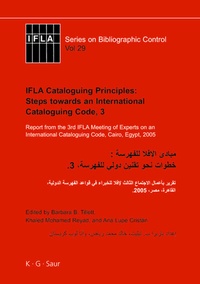
IFLA Cataloguing Principles: Steps towards an International Cataloguing Code, 3
Description

This is the latest report in a process towards International Cataloguing Principles that began in 2003 and will continue through 2007. Through the series of meetings represented by each volume the reader will be able to track the development and consultation taking place throughout the different parts of the world that will culminate with the creation of a truly international set of principles to guide the development of cataloguing codes worldwide. This volume contains information in English and Arabic on the recommendations of cataloguing experts from countries in the Arabic-speaking Middle East. The April 2006 draft Statement on International Cataloguing Principles included here reflects the votes of agreement from all participants of the IME ICC1 (Europe and Anglo-American), IME ICC2 (Latin America and the Caribbean), and IME ICC3 (Middle East).
More details
Other editions
Additional editions
Content
2 - Welcome Words from the Head of the National Library of Egypt [Seite 7]
3 - IFLA Welcome [Seite 11]
4 - Introduction [Seite 13]
5 - Statement of International Cataloguing Principles [Seite 21]
6 - Clean-copy Draft of April 2006 [Seite 29]
7 - GLOSSARY [Seite 44]
8 - SUMMARY VOTES BY THE IME ICC1 AND IME ICC2 ON THE RECOMMENDATIONS OF THE IME ICC3, MARCH 2006 [Seite 49]
9 - IFLA'S ISBD PROGRAMME: PURPOSE, PROCESS, AND PROSPECTS [Seite 57]
10 - BRAVE NEW FRBR WORLD (Version 3) [Seite 73]
11 - A VIRTUAL INTERNATIONAL AUTHORITY FILE (VIAF) [Seite 90]
12 - LEBANESE COUNTRY REPORT [Seite 117]
13 - STATEMENT OF PRINCIPLES: ADOPTED BY THE INTERNATIONAL CONFERENCE ON CATALOGUING PRINCIPLES PARIS, OCTOBER 1961 [Seite 121]
14 - RESULTS OF THE CODE COMPARISONS: A SUMMARY [Seite 130]
15 - OVERVIEW OF THE DRAFT STATEMENT OF INTERNATIONAL CATALOGUING PRINCIPLES [Seite 143]
16 - WORKING GROUP 1 - PERSONAL NAMES [Seite 163]
17 - Working Group 2 - Corporate Names [Seite 171]
18 - WORKING GROUP 3 - SERIALITY [Seite 174]
19 - WORKING GROUP 4 - UNIFORM TITLES/GMD [Seite 177]
20 - WORKING GROUP 5 - MULTIVOLUME/MULTIPART STRUCTURES [Seite 181]
21 - APPENDICES [Seite 185]
By Bughdana Ch. Hajjar
Dr. Tillett, Chair of the IFLA Cataloguing Section, Members of the different organizing committees, Fellow cataloguers, ladies and gentlemen, I would like to start my short address by thanking Dr. Tillett and everyone who joined efforts with her to make this meeting possible. In Lebanon we never tried to "reinvent the wheel." We have always believed in following international standards. This belief was materialized through teaching these standards in the Lebanese University, Faculty of Information and Documentation.
AACR2, Library of Congress subject headings, and Dewey Decimal Classification are mainly used. Some other institutions use AFNOR, Lavalle list of subject headings and other French tools but to a lesser extent. These international rules are, so far, applied for both Arabic and Western material. With the major changes and developments and little guidance we are trying to cope and keep up to date. FRBR, FRANAR, RDA among others are emerging concepts. We were trying to learn about them, even before this meeting took place, with no clues as to how and when of their implementation.
Our work has been automated for few years now. We are aware of the differences between traditional cataloguing and online cataloguing. We are trying to embrace the changes without drifting very far away from the basic principles. Above all we want to reassess our work and streamline it into more benefits to the user. Otherwise we will stand no chance in the face of commercialized vendors and other entities that are eager to "throw the baby cataloger with the bath water" (quoting the title of the article written by Dr. Tillett).
Joining cataloguing listservs was one step towards trying to establish harmonization with the different practices abroad, and above all a way to compare our work with the work of other peer cataloguers. At the beginning, attending discussions was frustrating especially when we could watch others speak MARCese fluently. In other instances, watching the discussions gave us the motivation to keep abreast if not to compete in some cases. Autocat was the main listserv we enlisted in. It worked as an eye opener to all the recent changes and developments.
There, we read about FRBR and RDA even though the FRBR seemed a little bit far away from our instant implementation. Also we learned about Metadata and Dublin Core, but we are still far away from integrating them into our projects. Lebanon is a multilingual country practicing English, French, and Arabic. Our Arabic collection is still relatively small. We use the Arabic translation of AACR2 for the bibliographical description. This translation needs urgent updating and modification to include examples from the local Arabic practice and actual problems. Dewey Decimal Classification in English is used to classify the Arabic collection.
Unfortunately, DDC has its drawbacks as to some topics namely the Islamic religion. The big problem lies in the establishment of a new Arabic subject heading. Several rather than one unified list are consulted: Khazendar, Sueiydan, Khalifah, Alecso, translated subject headings from the Library of Congress relying heavily for this purport on the work already done by the Cataloguing Department in the American University of Beirut. All these tools are surveyed to create the appropriate heading. Great care is applied to the syntax, semantics, and consistency with headings already established, and this has never been an easy job.
