

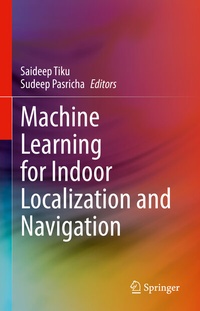
Machine Learning for Indoor Localization and Navigation
Description

In particular, the book:
- Provides comprehensive coverage of the application of machine learning to the domain of indoor localization;
- Presents techniques to adapt and optimize machine learning models for fast, energy-efficient indoor localization;
- Covers design and deployment of indoor localization frameworks on mobile, IoT, and embedded devices in real conditions.
More details
Other editions
Additional editions
Persons
Sudeep Pasricha is a Walter Scott Jr. College of Engineering Professor in the Department of Electrical and Computer Engineering, the Department of Computer Science, and the Department of Systems Engineering at Colorado State University. He is Director of the Embedded, High Performance, and Intelligent Computing(EPIC) Laboratory and the Chair of Computer Engineering. Prof. Pasricha received the B.E. degree in Electronics and Communication Engineering from Delhi Institute of Technology, India, in 2000, and his Ph.D. in Computer Science from the University of California, Irvine in 2008. He joined Colorado State University (CSU) in 2008. Prior to joining CSU, he spent several years working in STMicroelectronics and Conexant Inc. Prof. Pasricha's research broadly focuses on software algorithms, hardware architectures, and hardware-software co-design for energy-efficient, fault-tolerant, real-time, and secure computing. These efforts target multi-scale computing platforms, including embedded and Internet of Things (IoT) systems, cyber-physical systems, mobile devices, and datacenters. He has received funding for his research from various sponsors such as the NSF, SRC, AFOSR, ORNL, DoD, Fiat-Chrysler, and NASA. He has co-authored five books, contributed to several book chapters, and published morethan 250 research articles in peer-reviewed conferences, journals, and books.
Prof. Pasricha has received 16 Best Paper Awards and Nominations at various IEEE and ACM conferences, including at DAC, ASPDAC, NOCS, GLSVLSI, SLIP, AICCSA, and ISQED. Other notable awards include: the 2022 ACM Distinguished Speaker selection, 2019 George T. Abell Outstanding Research Faculty Award, the 2016-2018 University Distinguished Monfort Professorship, 2016-2019 Walter Scott Jr. College of Engineering Rockwell-Anderson Professorship, 2018 IEEE-CS/TCVLSI mid-career research
Achievement Award, the 2015 IEEE/TCSC Award for Excellence for a mid-career researcher, the 2014 George T. Abell Outstanding Mid-career Faculty Award, and the 2013 AFOSR Young Investigator Award.
Prof. Pasricha is currently the Vice Chair and Conference Chair of ACM SIGDA and a Senior Associate Editor for the ACM Journal of Emerging Technologies in Computing (JETC). He is currently or has been an Associate Editorfor the ACM Transactions on Embedded Computing Systems (TECS), IEEE Transactions on Computer-Aided Design of Integrated Circuits and Systems (TCAD), IEEE Consumer Electronics (CM), and IEEE Design & Test of Computers (D&T). He also serves as the Chair of the steering committee of IEEE Transactions on Sustainable Computing (TSUSC). He is currently or has been an Organizing Committee Member of several IEEE/ACM conferences such as DAC, ESWEEK, ICCAD, GLSVLSI, NOCS, RTCSA, etc. He has served as the General Chair for various IEEE/ACM conferences such as NOCS, HCW, IGSC, iSES, ICESS, etc.; and as Program Chair for CODES+ISSS, NOCS, IGSC, iNIS, VLSID, HCW, DAC PhD Forum, ICCAD Cadathlon, etc. He is also in the Technical Program Committee of several IEEE/ACM conferences such as DAC, DATE, ICCAD, ICCD, NOCS, etc. He holds an affiliate faculty member position at the Center for Embedded and Cyber-Physical Systems at UC Irvine. He has also received multiple awards for professional service,including the 2019 ACM SIGDA Distinguished Service Award, the 2015 ACM SIGDA Service Award, and the 2012 ACM SIGDA Technical Leadership Award.Content
Introduction to Indoor Localization and its Challenges.- Advanced Pattern-Matching Techniques for Indoor Localization.- Machine Learning Approaches for Resilience to Device Heterogeneity.- Enabling Temporal Variation Resilience for ML based Indoor Localization.- Deploying Indoor Localization Frameworks for Resource Constrained Devices.- Securing Indoor Localization Frameworks.
