

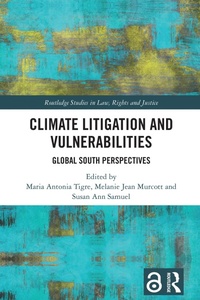
Climate Litigation and Vulnerabilities
Global South Perspectives
1st Edition
Published on 19. June 2025
348 pages
978-1-040-39115-0 (ISBN)
Description

This volume explores climate litigation as a means to tackle the rights and socio-ecological, intergenerational, gender, racial, and other justice implications of the ever-growing vulnerability to climate change, whilst critically engaging with the notions of vulnerability and intersectional climate justice.
With insightful analysis, thought-provoking case studies, and a global perspective, the collection illustrates the opportunities and pitfalls of litigation pursued by people from the Global South who face intersecting forms of oppression and marginalisation amidst the climate crisis. Contributors discuss litigation strategy, novel legal arguments, institutional barriers, and unique socio-ecological and political challenges in the Global South. Divided into two parts, the book recognises that climate change is an existential threat to humanity more frequently being tackled in courts worldwide. The first part exposes the limits of litigation as a mechanism for intersectional climate justice for vulnerable people in the Global South. The second part highlights innovations in climate litigation in pursuit of intersectional climate justice.
The book will be of interest to academics, researchers, and policymakers in the areas of human rights law, environmental law, climate law, Latin American studies, South Asian studies, and African studies.
With insightful analysis, thought-provoking case studies, and a global perspective, the collection illustrates the opportunities and pitfalls of litigation pursued by people from the Global South who face intersecting forms of oppression and marginalisation amidst the climate crisis. Contributors discuss litigation strategy, novel legal arguments, institutional barriers, and unique socio-ecological and political challenges in the Global South. Divided into two parts, the book recognises that climate change is an existential threat to humanity more frequently being tackled in courts worldwide. The first part exposes the limits of litigation as a mechanism for intersectional climate justice for vulnerable people in the Global South. The second part highlights innovations in climate litigation in pursuit of intersectional climate justice.
The book will be of interest to academics, researchers, and policymakers in the areas of human rights law, environmental law, climate law, Latin American studies, South Asian studies, and African studies.
Reviews / Votes
"A groundbreaking compilation, this book offers a unique blend of theoretical and practical insights on climate litigation in the Global South. With a focus on vulnerabilities and intersectionality, the editors bring together a diverse range of voices to provide a framework for understanding the disproportionate impacts of climate change and the role of courts in addressing them. The book's contributors explore innovative ways litigation can be more responsive to the lived realities of affected communities, and relay novel perspectives and strategies rooted in local contexts. A significant contribution to the field of climate litigation, this volume reshapes how we think about climate justice and legal accountability in a rapidly changing world." - Michael Burger, Executive Director of the Sabin Center for Climate Change Law, Columbia University "A groundbreaking compilation, this book offers a unique blend of theoretical and practical insights on climate litigation in the Global South. With a focus on vulnerabilities and intersectionality, the editors bring together a diverse range of voices to provide a framework for understanding the disproportionate impacts of climate change and the role of courts in addressing them. The book's contributors explore innovative ways litigation can be more responsive to the lived realities of affected communities, and relay novel perspectives and strategies rooted in local contexts. A significant contribution to the field of climate litigation, this volume reshapes how we think about climate justice and legal accountability in a rapidly changing world."Michael Burger, Executive Director of the Sabin Center for Climate Change Law, Columbia University
More details
Series
Edition
1. Auflage
Language
English
Place of publication
London
United Kingdom
Publishing group
Taylor & Francis Ltd
Target group
Professional and scholarly
College/higher education
Illustrations
5 Tables, black and white; 1 Line drawings, black and white; 1 Illustrations, black and white
File size
0,76 MB
ISBN-13
978-1-040-39115-0 (9781040391150)
Copyright in bibliographic data and cover images is held by Nielsen Book Services Limited or by the publishers or by their respective licensors: all rights reserved.
Schweitzer Classification
Other editions
Additional editions

Maria Antonia Tigre | Melanie Jean Murcott | Susan Ann Samuel
Climate Litigation and Vulnerabilities
Global South Perspectives
Book
07/2025
Routledge
Unfortunately, price unknown
Available (delivery time upon request)
Maria Antonia Tigre | Melanie Jean Murcott | Susan Ann Samuel
Climate Litigation and Vulnerabilities
Global South Perspectives
Book
06/2025
1st Edition
Routledge
€217.50
Shipment within 10-20 days
Persons
Maria Antonia Tigre is the Director of Global Climate Change Litigation at the Sabin Center for Climate Change Law at Columbia Law School in New York, United States. She is originally from Brazil.
Melanie Jean Murcott is a South African intersectional climate justice scholar, and an Associate Professor at the Institute of Marine and Environmental Law at the University of Cape Town, South Africa.
Susan Ann Samuel is a lawyer in India and a PhD researcher at the University of Leeds - School of Politics and International Studies, United Kingdom.
Melanie Jean Murcott is a South African intersectional climate justice scholar, and an Associate Professor at the Institute of Marine and Environmental Law at the University of Cape Town, South Africa.
Susan Ann Samuel is a lawyer in India and a PhD researcher at the University of Leeds - School of Politics and International Studies, United Kingdom.
Content
Introduction: Linking Global South Vulnerability, Intersectionality, and Climate Litigation, Melanie Jean Murcott, Maria Antonia Tigre, Susan Ann Samuel; Part I: Exposing the Limits of Litigation as a Mechanism for Intersectional Climate Justice; 1. Facing Coloniality within Legal Systems: Indigenous Peoples in Latin American Climate Litigation, Elisa Fiorini Beckhauser and Valeriana Augusta Broetto; 2. Reframing Climate Change Litigation in the Global South: A Study of Wind Energy Projects and Extractivism in India, Ayan Garg and Nitai Vishal Hinduja; 3. Addressing Health Crises through Courts? Understanding Inequality in Latin America's Climate Litigation, Thalia Viveros Uehara; 4. The Inclusion of Women and Girls in Climate Adaptation Policy in India: Opportunities and Challenges for Future Litigation, Moushita Dutta and Katherine Lofts; Part 2 - Innovative Litigation in Pursuit of Intersectional Climate Justice 5. Elevating Women's Voices in Transnational Climate Litigation: The Case of Asmania et al. v Holcim, Nina Burri and Laura Duarte Reyes; 6. Forum Shopping in Climate Litigation? Three Cases Involving the Torres Strait Islands, James Barrett; 7. The Need for Child-Led Climate Litigation in Bangladesh: Lessons from India and Pakistan, Preetkiran Kaur, Sathiabama S. and Vedavalli S.; 8. A Human Rights Approach to Environmental Protection (HRAEP) as a Tool for Fostering Climate-Resilience for the Nigerian Woman, Muhammed Tawfiq Ladan and Nkiruka Chidia Maduekwe; 9. A Litigation Strategy for Vulnerable Communities Pursuing Climate Litigation: The Indian Iteration of the Precautionary Principle and the Reversal of the Burden of Proof, Kanika Jamwal; 10. Conclusion: Key Lessons and A Future Research Agenda for Climate Litigation and Vulnerabilities, Maria Antonia Tigre, Melanie Jean Murcott, and Susan Ann Samuel.
