

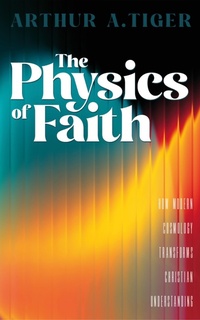
The Physics of Faith: How Modern Cosmology Transforms Christian Understanding
Description

The universe is 13.8 billion years old, contains two trillion galaxies, and is heading toward heat death. How can Christians maintain faith in divine purpose within such cosmic immensity and apparent indifference?
"The Physics of Faith" offers an honest, profound exploration of the dialogue between modern cosmology and Christian belief. Rather than forcing easy harmonization or accepting inevitable conflict, this book dwells thoughtfully in the creative tension between scientific discovery and religious faith.
Drawing on cutting-edge physics and classical theology, the author examines:
- How spacetime and relativity complicate our understanding of prayer and divine eternity
- Why quantum mechanics neither proves nor disproves God, despite popular claims
- The genuine challenge that evolutionary suffering poses to belief in a good Creator
- How fine-tuning might point to design?or to multiple universes
- What dark matter and dark energy reveal about the limits of our knowledge
- Why the heat death of the universe challenges Christian hope for new creation
Through lyrical prose that moves between scientific precision and spiritual reflection, this book speaks to three audiences: scientists who maintain faith despite professional pressures, young Christians encountering cosmology for the first time, and thoughtful believers seeking honest engagement with modern physics.
Unlike books that claim science proves God or that faith requires rejecting evolution, "The Physics of Faith" respects both domains while acknowledging real tensions. It includes candid testimonies from working scientists about their struggles to integrate research with faith, a survey of different approaches to science-religion dialogue, and resources for continued exploration.
This is not a book of easy answers but of profound questions: Can prayer make sense in a block universe? How does God act in nature without violating physical laws? What does human significance mean at cosmic scales? How do we maintain hope when physics predicts cosmic death?
Perfect for book clubs, adult education classes, and individual seekers, "The Physics of Faith" offers a mature, nuanced approach to one of our era's most important conversations. It will challenge believers to take science seriously and scientists to remain open to transcendence, while equipping both for honest dialogue.
Written for those who refuse to choose between telescope and scripture, between laboratory and sanctuary, this book models intellectual courage and spiritual depth in exploring how the God of faith might relate to the cosmos of modern science.
More details
Person
Arthur A. Tiger is a writer and theologian who explores the territory where faith meets science, philosophy, and the mysteries of human experience. At the heart of his work stands the apostle Paul ? a figure he returns to again and again, reconstructing lost epistles, reimagining Paul's voice for today, and tracing the depths of his radical transformation. Beyond Pauline studies, Tiger writes across an unusually wide range: from astrobiology and cosmology to psychology, relationships, and cultural criticism ? always searching for the connections that unite these disciplines rather than divide them. His own journey from skepticism to faith runs through everything he writes. Rather than offering easy answers, he invites readers to discover that honest questioning and genuine belief are not opposites but companions ? and that every scientific discovery is not a challenge to faith but an invitation to see it more clearly.
