

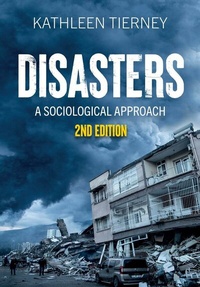
Disasters
Description

Disasters kill, maim, and generate increasingly large economic losses. But they do not wreak their damage equally across nations and populations. Every disaster has social forces at its very core. This important book sheds light on the social conditions and the global, national, and local processes that produce environmental degradation and disaster.
Topics covered include the social roots of disaster vulnerability, exposure to natural hazards as a form of environmental injustice, and emerging threats. Written by a leading expert in the field, the book provides the necessary frameworks for understanding hazards and disasters, as it explores the contributions of various social science disciplines to disaster research and how these ideas have evolved over time. Bringing the social aspects of disasters to the forefront, Tierney discusses the challenge of conducting research in the aftermath of a disaster and critiques the concept of disaster resilience, which has come to be seen as a key to disaster risk reduction. This second edition places greater emphasis on climate-related disasters and offers new reflections on the impacts of Covid-19, additional material on the legacies of colonialism, and refreshed case studies.
Peppered with research findings and insights from a wide range of disciplines, this rich introduction is an invaluable resource for students and scholars interested in both the social nature of disasters and their relation to broader social forces.
More details
Other editions
Person
Content
Detailed Contents Figures, Tables, and Boxes Acknowledgments Preface to the Second Edition
1 The Social Significance of Disasters 2 Disaster Research in Historical Context 3 Theoretical Approaches and Perspectives in the Study of Hazards and Disasters 4 Middle-Range Theory: Panic, Emergence, Self-Protective Actions, and Organizational Risk 5 Disaster Vulnerability 6 Disaster Resilience: Concepts, Measures, and Critiques 7 Key Contributions from Other Disciplines 8 Confronting Disaster Research Challenges 9 What the Future Holds: Greater Risks and Impacts or Greater Coping Capacity?
Notes Bibliography
1
The Social Significance of Disasters
Introduction
Disasters are a frequent occurrence across the globe. Despite organized national and international efforts to reduce disaster losses, these losses continue to grow. In 2022 nearly 400 disasters occurred worldwide, resulting in an estimated 40,000 deaths and causing nearly $224 billion in losses; approximately 1.85 million people were adversely affected (Centre for Research on the Epidemiology of Disasters 2023). Heat waves, floods, hurricanes, and other weather-related disasters increasingly plague our warming planet. July, August, and September 2023 were the hottest months ever recorded. That year, Phoenix, Arizona saw fifty-four days, including a thirty-one-day period, when temperatures soared to over 110°F (43.3°C). In September 2023, torrential rains intensified by climate change caused vulnerable dams to fail, killing thousands in Derna, Libya. Also in 2023, Canada saw its worst ever wildfire season, as nearly 46 million acres (18.7 million hectares) - an area twice the size of Portugal - burned, releasing vast amounts of carbon dioxide and spreading smoke and particulates widely. Climate change was also implicated in hurricanes such as Harvey, which struck Texas in 2017, causing $125 billion in losses. As climate change progresses, societies around the world will be forced to grapple with more frequent extreme weather, the spread of infectious disease agents, land loss in coastal areas, and a host of other climate change-induced effects.
In addition to causing deaths, injuries, and economic losses, disasters have other profound social impacts that we will explore in this volume. Disasters are a key factor in driving people into poverty and keeping them there (World Bank Group 2017). Disasters can lead to short- and long-term health and mental health problems. Experiencing a disaster can be a major stressor for households and business owners. The extensive damage and disruption that disasters cause can result in the breakup of neighborhoods and in the loss of significant sources of social support for survivors. Many who survive disaster can find themselves living in temporary accommodations for months or even years, their daily routines disrupted and their plans for recovery stalled. After disasters, children's development may suffer as a result of interruptions in schooling, residential dislocation, and parental stress.
Key societal institutions also experience difficulties in the aftermath of disasters, as schools, churches, charitable organizations, and agencies that provide health and welfare services see their burdens increase. Communities face challenges associated with the disruption and restoration of key lifelines such as water, electrical power, transportation, and other critical infrastructure systems. Local jurisdictions may experience population decline and tax losses.
Deaths and injuries are more common in disasters in low- and middle-income countries by several orders of magnitude, while economic losses are significantly higher in wealthier nations (Centre for Research on the Epidemiology of Disasters 2016). That said, large economies such as those of the United States and other developed countries experience temporary economic setbacks in the aftermath of disasters, but there is little evidence to date that disasters cause significant economic downturns in developed nations. But this is not the case for smaller and poorer countries; there disasters can have significant economic impacts, particularly when they affect key sectors of those economies. For a nation seeking to improve its level of economic development, a disaster can be a major setback. In both large and small countries, the need to respond to and recover from disasters drains financial resources that could otherwise be employed more productively. In the United States, as billion- and multibillion-dollar disasters continue to occur with alarming frequency, taxpayers, insurance companies, and disaster survivors themselves are forced to foot the bill. For households and businesses, disasters can generate increased debt and an inability to take advantage of opportunities for financial advancement.
Media attention typically focuses on the immediate impacts of disasters and fades away in days or weeks. As a result, the public is generally unaware of the cascading effects of disasters and of the struggles that survivors endure over time. For example, when Hurricane Maria struck the US territory of Puerto Rico in 2017, the island's already fragile electric power infrastructure was essentially destroyed and hundreds of thousands of residents were left homeless.
After the devastating 2010 earthquake in Haiti, Nepalese troops providing relief under the auspices of the United Nations brought cholera to the island. By 2016, an estimated 770,000 people, about 8 percent of the population, were infected with cholera and over 9,000 died - and those numbers are thought to be underestimates (Knox 2016). In 2011 in Japan, when the Great Tohoku earthquake triggered a deadly tsunami that caused a triple meltdown at the Fukushima nuclear power plant, the media covered that sensational story, but now there is little coverage of the ongoing effects of the large-scale population displacement and long-term nuclear decontamination efforts that this massive disaster caused.
Disasters can also challenge the competence and legitimacy of governments and institutions. The 2003 epidemic of severe acute respiratory syndrome (SARS) that originated in China created a legitimacy crisis for the ruling Communist Party, which had attempted to cover up the outbreak even as it spread worldwide. This same pattern was repeated in 2020 and subsequent years, with the genesis and spread of the devastating COVID-19 pandemic, and with draconian containment measures in China that were widely criticized. In 2023, a massive earthquake that struck Turkey and northern Syria, which resulted in an estimated 50,000 deaths, and the flooding in Derna, Libya mentioned earlier were accompanied by widespread criticisms of the failure of institutions to protect at-risk populations from well-recognized hazards.
As we will see throughout this volume, disaster impacts and losses are not random, nor are the burdens of disasters borne equally by all members of affected populations. Rather the impacts of disasters often fall most heavily on those who are most vulnerable: the poor, racial and ethnic minorities, and other marginalized groups. Many current inquiries into the sociological study of disasters center on how various axes of inequality such as class, race, and gender, alongside other aspects of social stratification, contribute to patterns of disaster victimization and recovery.
It is not difficult to see why sociologists and other social scientists find these events and the efforts to reduce their impacts fascinating. As we have already seen, disasters have economic, political and policy, health and mental health dimensions. They frequently bring to the fore issues of inequality and social justice, shining a light on the problems experienced by marginalized and vulnerable populations. At the same time, social behavior in disasters also reveals the human capacity for altruism and creativity. We will explore together these and other themes in the chapters that follow.
Key Concepts and Definitions in the Study of Disasters
To ensure that we are working from a common set of definitions in the discussions that follow, in this section I introduce concepts that are commonly used in the sociological study of disasters and that will be employed in later chapters. Obviously one key concept is the idea of disaster itself. An important takeaway is that disasters are by their nature social events, not merely physical ones. If a major volcanic eruption were to occur in an area where human settlements did not exist or remained unaffected, that eruption would be a significant geophysical event, but not a disaster. In keeping with sociological conceptualizations, disasters involve the juxtaposition of physical forces - geological, atmospheric, technological, and other forces - and vulnerable human communities. The severity of a disaster is measured not by the magnitude of the physical forces involved, but rather by the magnitude of its societal impacts.
As subsequent discussions will show, disasters were previously seen as discrete events, concentrated in time and space, that disrupt the social order and interfere with the ability of a community or society to continue to operate, for example by interfering with governmental functions, economic activities, utility services, education, transportation, telecommunications, and housing. More recent social science formulations, such as those discussed in this volume, see disasters as arising not so much from the physical forces that trigger them at specific times as from longer-term global and societal processes, which in turn result in an increase of the potential for loss - or what I referred to in an earlier publication as "risk buildup" (Tierney 2014). Much of the discussion that follows will focus on those processes, making the point that the potential for disasters and disaster victimization can build up over long periods.
While media accounts and commonsense views of disaster tend to gloss over differences in event severity, in a search for commonalities among events, sociological formulations are attentive to such differences because of their social implications. Sociologists typically classify events into emergencies, disasters, and catastrophes (see Quarantelli 1996). As shown in Table...
