


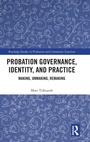
Probation Governance, Identity, and Practice
Making, Unmaking, Remaking
1st Edition
Published on 22. December 2025
218 pages
978-1-040-67323-2 (ISBN)
Description

This book explores the making, unmaking, and remaking of the Probation Service in England and Wales - an organisation that, in recent decades, has seemingly been in a constant state of flux. It draws on original empirical data derived from 38 semi-structured interviews with staff from across the probation estate to scrutinise ongoing changes to probation governance, identity, and practice.
The book focuses on recent restructurings of probation - namely, the 2014 Transforming Rehabilitation reforms, which resulted in the majority of services being delivered by private providers; and the subsequent unification, in 2021, when services were returned to the public sector. In this sense, it provides the first monograph-length account of the re-nationalisation of a public service in the UK. Drawing on Michel Foucault's theory of governmentality, it explores how probation governance, identity, and practice have been made, unmade, and remade. In particular, it situates the Probation Service within a neoliberal apparatus of (in)security, a concept that highlights the convergence of heightened punitiveness and managerialism, increased expectations for inter-agency working, and the weakening of the public sector in the UK. The book argues that the Probation Service can, and ought to, perform a civilizing role as an organising 'node' that brings together social welfare, treatment, and community spheres. However, probation's ability to realise this axial role has been undermined by both organisational crisis and the impact of the politics of austerity.
This book will be essential reading for students and scholars of criminology. It will also be of interest to practitioners, policymakers, and social workers engaged in probation and welfare services.
The book focuses on recent restructurings of probation - namely, the 2014 Transforming Rehabilitation reforms, which resulted in the majority of services being delivered by private providers; and the subsequent unification, in 2021, when services were returned to the public sector. In this sense, it provides the first monograph-length account of the re-nationalisation of a public service in the UK. Drawing on Michel Foucault's theory of governmentality, it explores how probation governance, identity, and practice have been made, unmade, and remade. In particular, it situates the Probation Service within a neoliberal apparatus of (in)security, a concept that highlights the convergence of heightened punitiveness and managerialism, increased expectations for inter-agency working, and the weakening of the public sector in the UK. The book argues that the Probation Service can, and ought to, perform a civilizing role as an organising 'node' that brings together social welfare, treatment, and community spheres. However, probation's ability to realise this axial role has been undermined by both organisational crisis and the impact of the politics of austerity.
This book will be essential reading for students and scholars of criminology. It will also be of interest to practitioners, policymakers, and social workers engaged in probation and welfare services.
Reviews / Votes
The book is a timely analysis of the key tensions that have shaped, and continue to shape, the probation service in England and Wales. Locating the probation service and its many faces within a Foucauldian framework, Tidmarsh argues that governmentality provides an overarching lens through which to explore how probation contributes to the health and wellbeing of individuals and of society. By weaving together original empirical data with insights from across criminology, sociology and law, the book not only provides an invaluable analysis of governance in our neo-liberal era but it makes an empathetic plea to reconceive of the probation service as an important public good. A must read for anyone interested in how to humanely reform institutions within a deeply broken criminal justice system.Insa Lee Koch, Professor of British Cultures, Universitaet St. Gallen
This is a must-read for policy-makers as well as probation leaders, inspectors and criminologists. The book charts significant changes in the organization of Probation since its inception in compelling fashion. Drawing on Foucault's theory of governmentality, the author suggests that the Probation Service can, and ought to, perform a civilizing role as an organising 'node' which brings together social welfare, treatment, and community spheres. But this axial role has been undermined both by organisational crises and the impact of the politics of austerity over time, leading to what has been described as 'an insidious form of neo-liberalism' that has weakened capacity and vision for Probation. There are strong and persuasive argument for the decentring of current organisational practices and a revisioning of probation as a more localised and 'grounded' practice. It is a book which pushes forward debate!
Loraine Gelsthorpe, Emeritus Professor of Criminology and Criminal Justice, University of Cambridge
Departing from the common but misleading metaphor that criminal justice institutions swing pendulum-like between punitive and rehabilitative goals Matt Tidmarsh provides the first proper genealogy of probation in the UK. Probation Governance, Identity, and Practice: Making, Unmaking, Remaking unpacks how probation has been a site of struggle among competing actors and political logics in the course of more than a century. Tidmarsh's sophisticated and clearly presented analytic framework will be a boon to students of other criminal justice institutions and other national experiences.
Jonathan Simon, Lance Robbins Professor of Criminal Justice Law, University of California, Berkeley
More details
Series
Edition
1. Auflage
Language
English
Place of publication
London
United Kingdom
Publishing group
Taylor & Francis Ltd
Target group
College/higher education
Professional and scholarly
Illustrations
1 Tables, black and white
File size
0,90 MB
ISBN-13
978-1-040-67323-2 (9781040673232)
Copyright in bibliographic data and cover images is held by Nielsen Book Services Limited or by the publishers or by their respective licensors: all rights reserved.
Schweitzer Classification
Other editions
Additional editions
Book
approx. 12/2025
1st Edition
Routledge
€207.50
Not yet published
Person
Matt Tidmarsh is Associate Professor of Criminal Justice in the School of Law at the University of Leeds. His research interests are interdisciplinary, drawing from criminology, sociology, and penology, with a particular focus on governance, identity, and practice in probation. He is also the Co-Director of the Centre for Criminal Justice Studies at the University of Leeds.
Content
1. Introduction: Making, Unmaking, and Remaking 2. Probation, Punishment, and (Welfare) Professions 3. Probation Beyond the State? Governance, Identity, and Practice 4. Transforming Rehabilitation as an (Unsuccessful) Exercise in Nodal Governance 5. Unifying Probation: Professional Identity in a 'Caring' Profession 6. 'We're Genericists'? Towards Nodal Governance, Identities, and Practices in Probation 7. Conclusion: Civilizing Probation?
