

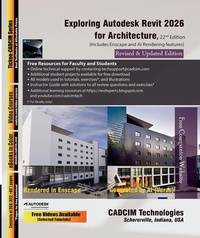
Exploring Autodesk Revit 2026 for Architecture, 22nd Edition
Description

Exploring Autodesk Revit 2026 for Architecture is a comprehensive book written to cater to the needs of the students and the professionals who are involved in Building Information Modeling (BIM) Profession. Revit 2026 book is a gateway to power, skill, and competence in the field of architecture and interior presentations, drawings, and documentations. In this Revit book, the author has emphasized on the concept of designing, creating families, massing, documentation, rendering orthographic/perspective views of building and usage of other advanced tools. In addition, Revit 2026 for Architecture book covers the description of various stages involved in rendering the model in Enscape plug-in.
In this book, the chapters have been punctuated with tips and notes that provide additional information on the concept and the functioning of the tools and commands is explained with the help of suitable examples for better understanding. The simple and lucid language used in Revit 2026 book makes it a ready reference for both beginners and intermediate users. This book is also an ideal guide for students who are appearing for Autodesk Revit Certified Professional and Revit Certified User Exams, especially for Architecture. Also, it can be used as a guide for students and professionals who are planning to make their career in BIM industry. Table of Contents
- Chapter 1: Introduction to Autodesk Revit 2026 for Architecture
- Chapter 2: Starting an Architectural Project
- Chapter 3: Placing Architectural Walls
- Chapter 4: Adding Doors, Windows, and Openings
- Chapter 5: Modifying Building Elements
- Chapter 6: Working with Datum Plane and Creating Standard Views
- Chapter 7: Adding Floors, Roofs, Ceilings, and Rooms
- Chapter 8: Adding Stairs, Railings, and Ramps
- Chapter 9: Designing Site Elements and Topography
- Chapter 10: Working with Conceptual Masses and Custom Families
- Chapter 11: Applying Annotations, Tags, and Dimensions
- Chapter 12: Developing Construction Details and Generating Schedules
- Chapter 13: Composing and Printing Drawing Sheets
- Chapter 14: Creating and Managing 3D Views
- Chapter 15: Rendering and Creating Walkthroughs
- Chapter 16: Exploring Advanced Revit Features *
- Student Project *
- Index (* For free download)
Salient Features
- Detailed explanation of architectural tools of Autodesk Revit
- Heavily illustrated text
- Introduction to Enscape Rendering and AI Tool
- Real-world structural projects given as tutorials
- Tips and Notes throughout the textbook
- Self-Evaluation Tests, Review Questions, and Exercises at the end of the Chapters
- BIM Concepts for tools
More details
Person
Prof. Sham Tickoo is professor of Manufacturing Engineering at Purdue University Northwest, USA where he has taught design, drafting, CAD and other engineering courses for over nineteen years. Before joining Purdue University, Prof. Tickoo has worked as a machinist, quality control engineer, design engineer, engineering consultant, and software developer. He has received a US patent for his invention Self Adjusting Cargo Organizer for Vehicles. Professor Tickoo also leads the team of authors at CADCIM Technologies to develop world-class teaching and learning resources for Computer Aided Design and Manufacturing (CAD/CAM) and related technologies.
